
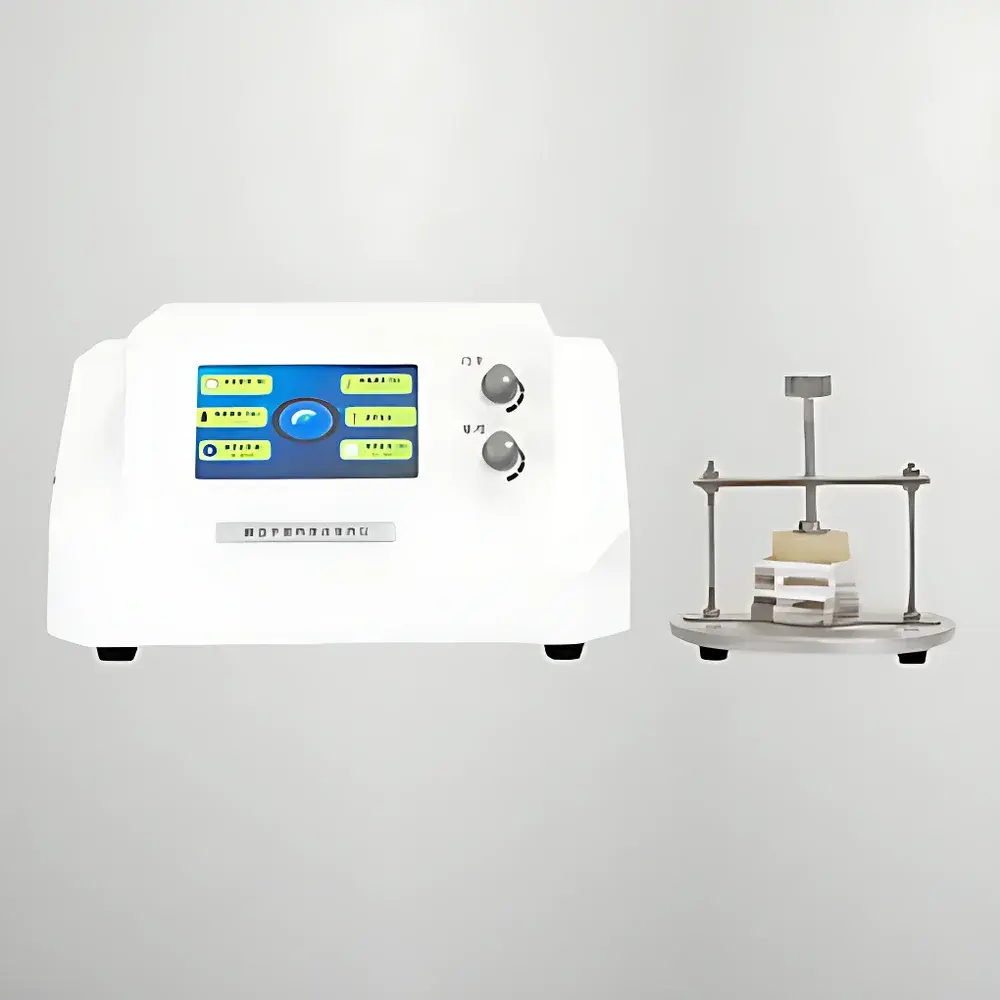
Nanjing Dazhan DZDR-S Transient Plane Source (TPS) Thermal Conductivity Analyzer
| Brand | Nanjing Dazhan |
|---|---|
| Origin | Jiangsu, China |
| Manufacturer Type | Direct Manufacturer |
| Country of Origin | China |
| Model | DZDR-S |
| Instrument Principle | Transient Plane Source (TPS) Method |
| Sample Throughput | Single sample per test |
| Test Environment | Ambient temperature (20–30 °C) |
| Thermal Conductivity Range | 0.0001–300 W/(m·K) |
| Accuracy | ±3% |
| Repeatability | ≤3% |
| Measurement Time | 5–160 s (user-configurable) |
| Probe Options | 7.5 mm, 15 mm, and 50 mm diameter (standard and customizable) |
| Sample Geometry Requirements | Minimum planar dimension ≥2× probe diameter |
| Sample Forms Supported | Solid blocks, powders (with optional container), pastes, gels, liquids, granules, coatings, thin films, and thermal insulation materials |
| Power Supply | AC 220 V, <500 W |
| Control Interface | Color TFT LCD with capacitive touchscreen |
| Data Acquisition | High-resolution imported ADC chip |
| Core Processor | ARM-based embedded microcontroller |
| Compliance | Designed to support ASTM D7984, ISO 22007-2, and GLP-aligned data integrity practices |
Overview
The Nanjing Dazhan DZDR-S Transient Plane Source (TPS) Thermal Conductivity Analyzer is an engineered solution for rapid, contact-based measurement of thermal conductivity across a broad spectrum of materials. It operates on the transient plane source principle—a well-established, standards-aligned method in which a sandwiched sensor (acting simultaneously as heat source and resistance thermometer) delivers a short-duration constant-power pulse into the sample. The resulting time-dependent temperature rise is recorded and analyzed using inverse modeling based on Fourier’s law of heat conduction in semi-infinite media. Unlike steady-state or guarded-hot-plate techniques, the TPS method eliminates reliance on thermal equilibrium, significantly reducing test duration while minimizing interfacial contact resistance errors. The DZDR-S is optimized for ambient-temperature characterization of heterogeneous, anisotropic, and low-conductivity materials—making it especially suitable for R&D labs, QC departments, and academic thermal physics groups requiring high-throughput screening without compromising metrological traceability.
Key Features
- Three interchangeable platinum spiral probe configurations (7.5 mm, 15 mm, and 50 mm diameters) enable scalable testing—from small laboratory coupons to industrial-sized insulation panels.
- ARM-based real-time control architecture ensures deterministic timing resolution during pulse delivery and signal acquisition, critical for accurate curve-fitting in the early-time regime (t < 10 s).
- High-resolution analog-to-digital conversion (≥24-bit effective resolution) captures subtle thermal transients with minimal quantization noise, supporting reliable detection down to 0.0001 W/(m·K).
- Integrated precision balance (optional or built-in depending on configuration) enables direct mass-normalized thermal diffusivity estimation when combined with specific heat data from complementary DSC measurements.
- Probe geometry and embedded calibration algorithms comply with ISO 22007-2 Annex A requirements for sensor self-heating correction and edge-effect compensation.
- Touch-enabled 7-inch color TFT display provides intuitive navigation through test setup, real-time curve visualization, and post-test parameter review—no external PC required for basic operation.
- Modular sample stage accommodates variable thicknesses (3.75–7.5 mm minimum, depending on probe size) and includes alignment guides and clamping force optimization to ensure consistent thermal contact without deformation of soft or compliant specimens.
Sample Compatibility & Compliance
The DZDR-S accepts samples in virtually any physical state—rigid solids, flexible foams, viscous pastes, suspensions, granular media, and thin-layer coatings—without requiring machining, polishing, or metallization. For powders and loose granules, an optional standardized stainless-steel containment cell (included with custom order) maintains uniform density and eliminates air-gap artifacts. All probe-sample interfaces are validated per ASTM D7984 guidelines for interfacial thermal resistance mitigation. System firmware supports audit-trail logging and user-access controls aligned with GLP and ISO/IEC 17025 documentation frameworks. While not FDA 21 CFR Part 11 certified out-of-the-box, raw data export (CSV, TXT) and timestamped metadata generation facilitate integration into validated LIMS environments.
Software & Data Management
Built-in firmware handles full-cycle data acquisition, model inversion, uncertainty propagation, and result validation. Exportable datasets include raw voltage-vs.-time traces, fitted thermal conductivity values, standard deviation estimates, and goodness-of-fit metrics (R², residual RMS). Optional PC software (Windows-compatible) extends functionality with batch reporting, statistical trend analysis, comparative overlay plots, and automated compliance report generation per ISO 22007-2 Clause 8. All measurement files contain embedded instrument ID, operator tag, environmental timestamp, and probe calibration certificate reference—ensuring full traceability in regulated settings.
Applications
- Thermal interface material (TIM) qualification for electronics cooling modules
- Quality control of polymer composites, aerogels, and vacuum-insulated panels (VIPs)
- Research on phase-change materials (PCMs) and nanofluids
- Characterization of geological cores, building insulation, and fire-retardant coatings
- Validation of computational models (e.g., finite-element thermal simulations)
- Teaching laboratories demonstrating transient heat conduction theory and parameter estimation
FAQ
What standards does the DZDR-S comply with?
The instrument implements core physical models and calibration protocols aligned with ISO 22007-2 and ASTM D7984 for transient plane source methods. Its measurement uncertainty budget and probe geometry adhere to the technical requirements specified in those standards.
Can the DZDR-S measure anisotropic materials?
Yes—by orienting the probe normal to the expected direction of heat flow and repeating measurements across orthogonal faces, users can derive directional thermal conductivity components. Anisotropy assessment requires manual sample repositioning and is supported by the system’s repeatability (<3% RSD) and low-contact-resistance design.
Is temperature control available?
The base DZDR-S operates at ambient conditions (20–30 °C). Optional environmental chamber integration (up to 130 °C) is available upon request and must be specified at time of order; thermal stability during elevated-temperature testing is maintained via PID-regulated heating and dual-point RTD monitoring.
How is probe calibration performed?
Each probe ships with a NIST-traceable calibration certificate referencing measurements against certified reference materials (e.g., Pyroceram 9606, copper, and glycerol). Field recalibration is performed using the included standard reference set and follows the two-point verification procedure described in the operator manual.
Does the system support automated reporting for ISO/IEC 17025 accreditation?
While the instrument itself does not generate fully accredited reports, its structured data output—including timestamps, operator IDs, calibration status flags, and raw sensor traces—meets the foundational data integrity requirements for integration into accredited laboratory information management systems (LIMS).



