
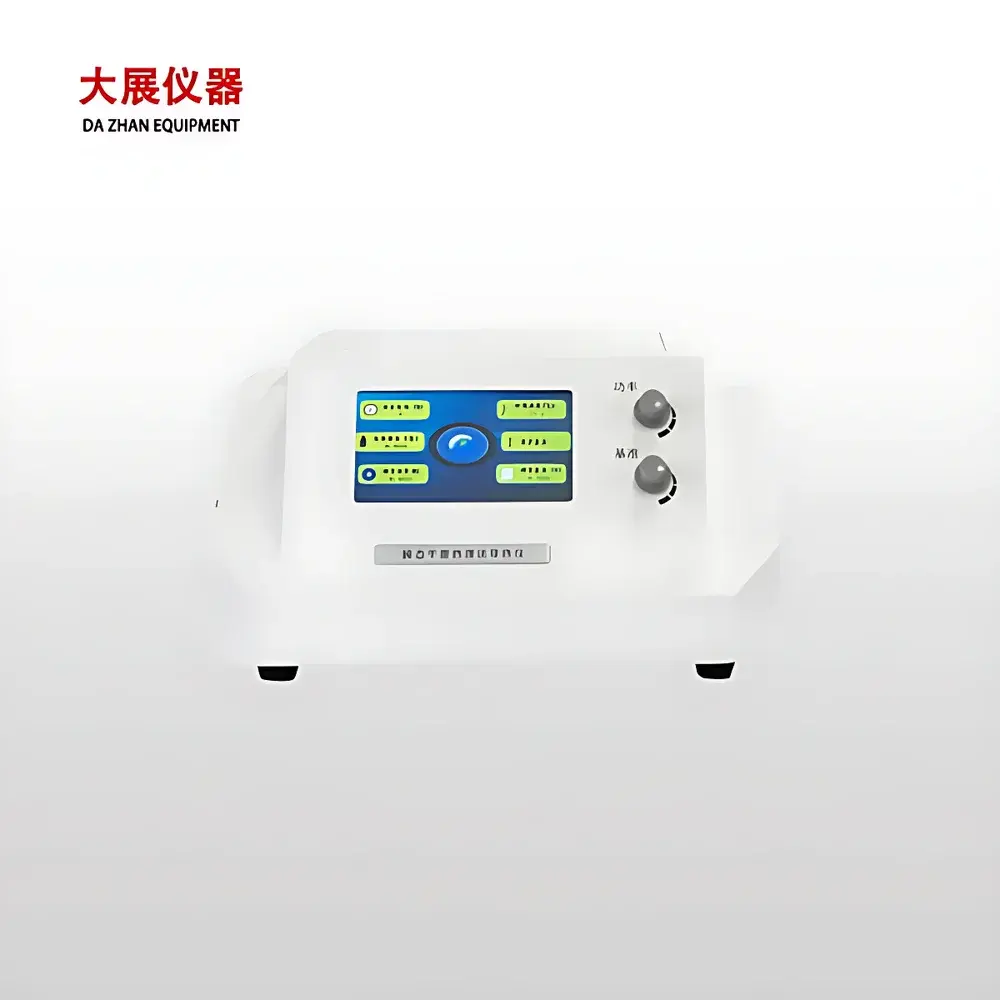
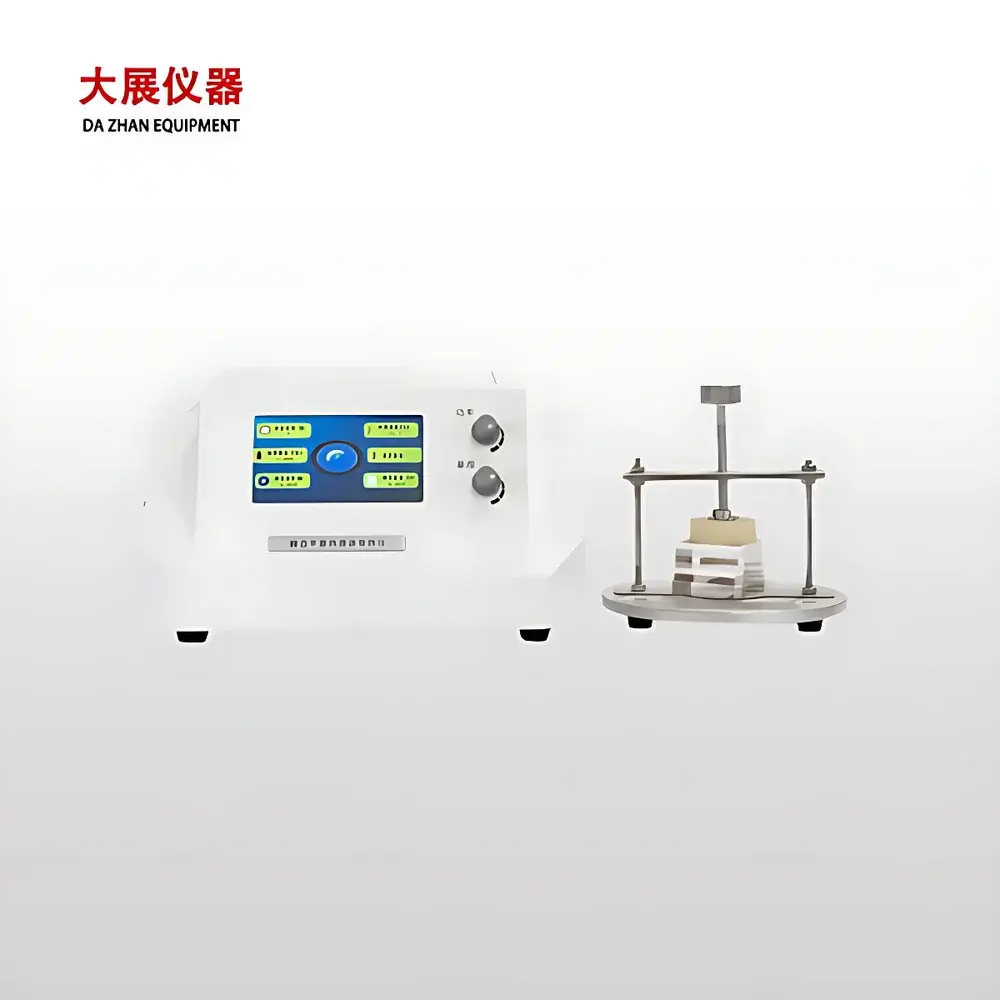
Nanjing Dazhan DZDR-S Thermal Conductivity Analyzer for Rubber & Plastic Compounding
| Key | Brand: Nanjing Dazhan |
|---|---|
| Origin | Jiangsu, China |
| Manufacturer Type | Direct Manufacturer |
| Country of Origin | China |
| Model | DZDR-S |
| Price Range | USD 4,200–7,000 |
| Thermal Conductivity Range | 0.0001–300 W/(m·K) |
| Temperature Range | Ambient to 130 °C |
| Probe Diameters | 7.5 mm (Probe #1), 15 mm (Probe #2), 50 mm (Probe #3, optional) |
| Accuracy | ±3% |
| Repeatability | ≤3% |
| Measurement Time | 5–160 s |
| Power Supply | AC 220 V |
| Max Power Consumption | <500 W |
| Sample Dimensions (min) | 15×15×3.75 mm (Probe #1), 30×30×7.5 mm (Probe #2), 50×50×7.5 mm (Probe #3) |
| Powder Test Kit | Included (customizable) |
Overview
The Nanjing Dazhan DZDR-S Thermal Conductivity Analyzer is a dedicated transient plane source (TPS) instrument engineered for precise thermal conductivity characterization of elastomers, thermoplastics, filled polymers, and carbon-black-reinforced rubber compounds. Unlike steady-state methods requiring extended equilibration, the DZDR-S employs a calibrated hot-wire or guarded-plane sensor embedded in a thin, double-layer nickel foil probe—operating on the principle of transient heat pulse diffusion. A controlled current pulse heats the sensor, and the resulting temperature rise over time is recorded with microsecond resolution. Thermal conductivity (λ) is calculated directly from the slope of the ln(ΔT) vs. ln(t) curve in the mid-time domain, independent of absolute temperature and minimizing contact resistance artifacts. This makes the DZDR-S particularly suitable for QC labs in tire manufacturing, compound development, and R&D facilities validating filler dispersion effects—where thermal transport properties correlate strongly with carbon black distribution homogeneity, crosslink density, and phase morphology.
Key Features
- Triple-probe modular design: Interchangeable probes (7.5 mm, 15 mm, and 50 mm diameter) enable scalable measurement across diverse sample geometries—from small laboratory pellets to full-size cured rubber slabs—without recalibration.
- Wide dynamic range: Capable of resolving ultra-low conductivity values down to 0.0001 W/(m·K) in highly insulating elastomer matrices, as well as high-conductivity composites up to 300 W/(m·K) when loaded with conductive fillers (e.g., graphene, metal-coated carbon black).
- Temperature-controlled test environment: Integrated Peltier-assisted stage maintains sample surface temperature between ambient and 130 °C, supporting ASTM D5470-compliant thermal resistance evaluation under service-relevant conditions.
- Low-power, portable architecture: Total system power draw remains below 500 W, enabling deployment in shared lab spaces without dedicated HVAC or three-phase supply.
- Non-destructive, single-sided measurement: Requires only one flat surface contact; no sample cutting, polishing, or vacuum enclosure needed—critical for rapid inline QC during compounding trials.
Sample Compatibility & Compliance
The DZDR-S accommodates solid, semi-crystalline, and particulate samples relevant to rubber and plastic processing. Standard configurations support vulcanized rubber sheets, injection-molded plaques, extruded profiles, and compression-molded composites. Optional powder test kits include a stainless-steel cylindrical cell with precision-machined parallel plates and adjustable axial load (0–5 MPa), enabling reproducible thermal contact pressure control per ISO 22007-2 Annex B. All measurements comply with the physical basis of ISO 22007-2 (Transient Plane Source method) and align with ASTM D7984 guidance for polymer nanocomposites. Data acquisition protocols support audit-ready metadata logging—including operator ID, sample ID, ambient RH/T, probe calibration timestamp, and thermal contact resistance estimate—facilitating GLP-compliant reporting and FDA 21 CFR Part 11–ready electronic signatures when integrated with validated LIMS environments.
Software & Data Management
Bundled DZDR Control Suite v3.2 provides real-time visualization of thermal response curves, automatic baseline correction, multi-probe calibration management, and batch export in CSV, XML, and ASTM E1447-compliant .tdf formats. The software implements built-in uncertainty propagation per GUM (JCGM 100:2008), calculating expanded uncertainty (k=2) for each reported λ value based on repeatability, probe geometry tolerance, temperature drift, and signal-to-noise ratio. Audit trail functionality logs all parameter changes, manual overrides, and calibration events with timestamps and user attribution. Raw data files are digitally signed and checksum-verified to prevent tampering—meeting requirements for regulated environments operating under ISO/IEC 17025 or IATF 16949 quality systems.
Applications
- Quantifying carbon black dispersion efficiency in SBR/BR/NR tread compounds via thermal anisotropy mapping.
- Correlating thermal diffusivity shifts with crosslink density changes during post-cure aging studies.
- Screening thermally conductive additives (e.g., AlN, BN, Cu flakes) in electric vehicle battery encapsulants.
- Validating mold-filling uniformity in LSR (liquid silicone rubber) parts through localized λ profiling.
- Supporting DOE-driven formulation optimization where thermal conductivity serves as a surrogate for filler network integrity.
FAQ
What standards does the DZDR-S comply with for thermal conductivity testing?
The instrument implements the transient plane source method aligned with ISO 22007-2 and supports traceable calibration per ASTM D5470 Annex A3 for thermal interface materials.
Can the DZDR-S measure anisotropic materials such as fiber-reinforced thermoplastics?
Yes—by rotating the probe orientation relative to the material’s principal axis and comparing λ∥ and λ⊥, directional conductivity ratios can be derived with ≤5% inter-orientation variance.
Is third-party calibration certification available?
Nanjing Dazhan provides NIST-traceable calibration certificates (ISO/IEC 17025 accredited by CNAS) for all probes upon request, including uncertainty budgets at three reference points (0.1, 10, and 100 W/(m·K)).
How is thermal contact resistance minimized during measurement?
The system applies programmable normal force (0–200 N) via spring-loaded probe mounts and uses thermally optimized graphite-based thermal interface paste (included) with known λ = 12 W/(m·K) to reduce interfacial resistance to <1% of total measured resistance.
Does the software support automated pass/fail judgment against specification limits?
Yes—user-defined upper/lower limits trigger color-coded status flags and generate PDF compliance reports with embedded signature fields for QA sign-off.




