
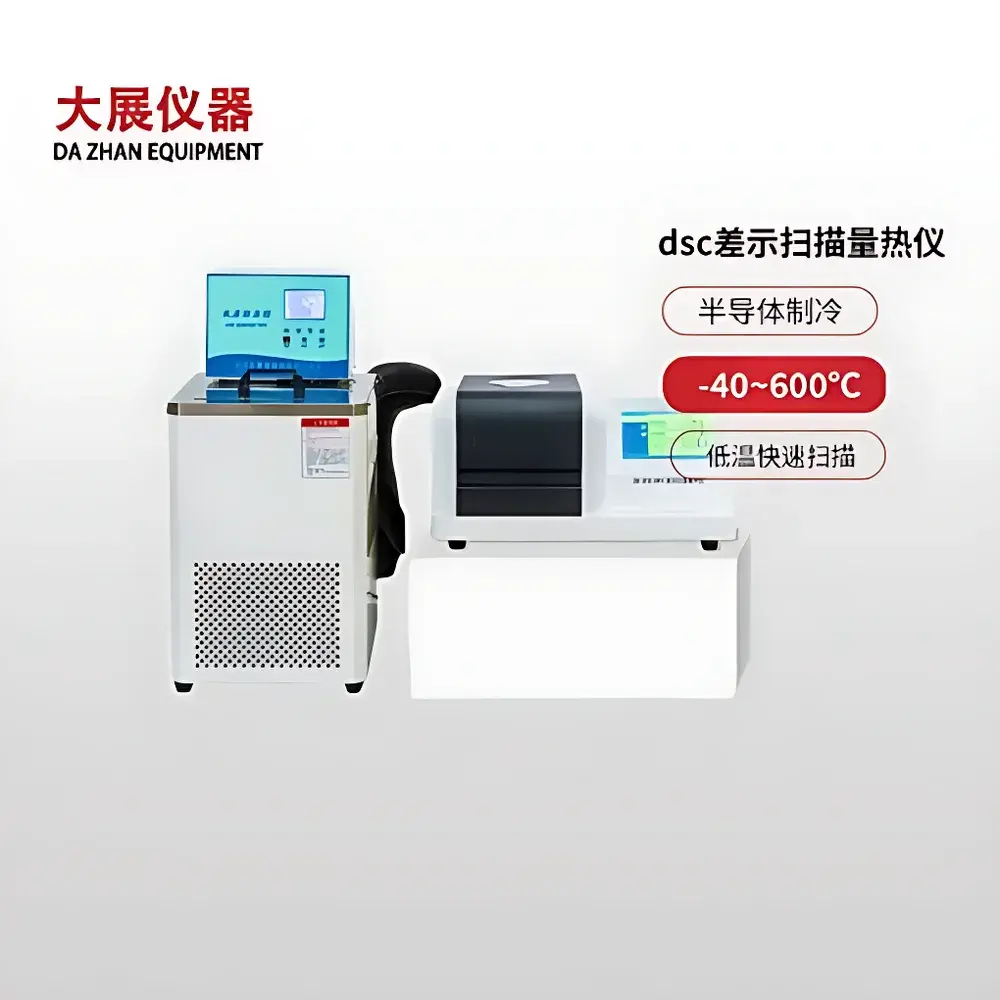
Nanjing Dazhan DSC300C Differential Scanning Calorimeter
| Brand | Nanjing Dazhan |
|---|---|
| Origin | Jiangsu, China |
| Manufacturer Type | Manufacturer |
| Country of Origin | China |
| Model | DSC300C |
| Sample Capacity | Single |
| Instrument Type | DSC |
| Temperature Range | -40 to 600 °C |
| Temperature Resolution | 0.01 °C |
| Temperature Stability | ±0.01 °C |
| Heating/Cooling Rate | 0.1–100 K/min (heating), 0.1–40 K/min (cooling) |
| DSC Signal Range | 0 to ±600 mW |
| DSC Sensitivity | 0.001 mW |
| DSC Resolution | 0.01 µW |
| Atmosphere Control | Dual gas channels with automatic switching, plus dedicated purge gas inlet |
| flow rate | 0–300 mL/min |
| max pressure | ≤5 MPa |
| Temperature Program | Up to 6 segments (ramp/hold) |
| Power Supply | AC 220 V / 50 Hz (customizable) |
| Display | 7-inch 24-bit color LCD touchscreen |
| Interface | Standard USB 2.0 with auto-reconnect capability |
| Calibration Standards Included | Indium, tin, lead |
Overview
The Nanjing Dazhan DSC300C Differential Scanning Calorimeter is a precision thermal analysis instrument engineered for quantitative measurement of heat flow differences between a sample and an inert reference as a function of temperature or time. Operating on the principle of heat-flux DSC, it detects endothermic and exothermic transitions—including glass transitions (Tg), melting points (Tm), crystallization events, solid-solid phase changes, curing reactions, oxidative induction times (OIT), and enthalpy changes—under controlled atmospheric conditions. With a wide operational temperature range from –40 °C to 600 °C and programmable heating/cooling rates spanning 0.1 to 100 K/min, the DSC300C supports both low-temperature polymer characterization and high-temperature ceramic or metal alloy studies. Its integrated Peltier cooling system enables reliable sub-ambient operation down to –40 °C without liquid nitrogen, enhancing laboratory safety and reducing consumable dependency.
Key Features
- Industrial-grade 7-inch full-color LCD touchscreen interface with intuitive navigation, real-time curve visualization, and on-device parameter configuration—no external PC required for basic operation.
- Robust all-metal furnace architecture optimized for thermal homogeneity and mechanical stability, delivering improved baseline flatness and long-term signal reproducibility across repeated thermal cycles.
- High-resolution thermal detection system with 0.01 µW DSC resolution and 0.001 mW sensitivity, enabling precise quantification of subtle thermal events in polymers, pharmaceuticals, and composites.
- Dual independent gas channel control with fast-acting solenoid valves; automated switching between reactive (e.g., O2) and inert (e.g., N2, Ar) atmospheres during a single run; optional third dedicated purge line for enhanced oxidation resistance.
- Advanced PID-based intelligent temperature control with <0.01 °C temperature fluctuation and programmable multi-segment thermal profiles (up to six ramps/holds), supporting ISO 11357, ASTM E794, and USP <1163> compliant testing protocols.
- USB 2.0 communication interface with hardware-level auto-recovery logic—ensures uninterrupted data streaming even after transient host connection loss, critical for unattended overnight runs.
Sample Compatibility & Compliance
The DSC300C accommodates standard aluminum, gold-coated aluminum, and high-pressure stainless-steel crucibles (20–50 µL capacity), compatible with solids, powders, films, gels, and small-volume liquids. It meets essential design and performance criteria referenced in international standards including ISO 11357-1 (general principles), ISO 11357-2 (determination of Tg), ISO 11357-3 (melting and crystallization), and ASTM E793 (enthalpy measurements). Optional validation packages support GLP/GMP environments, including electronic audit trails, user access levels, and 21 CFR Part 11–compliant data integrity features when paired with certified software modules.
Software & Data Management
Bundled with cross-platform thermal analysis software (Windows/macOS/Linux), the DSC300C supports raw data export in ASCII and universal .tdms formats, enabling seamless integration with MATLAB, Python (NumPy/Pandas), or statistical process control (SPC) platforms. The software includes baseline correction algorithms (tangent, step, polynomial), peak deconvolution tools for overlapping transitions, and automated calculation of onset, peak, and offset temperatures per ASTM E1356. All calibration data—including certified reference materials (indium, tin, lead)—are stored with traceable metadata, and instrument configuration logs are timestamped and digitally signed to fulfill regulatory documentation requirements.
Applications
- Thermal stability assessment of pharmaceutical actives and excipients under accelerated aging conditions.
- Quantification of degree of cure and residual reactivity in thermosetting resins (epoxies, polyimides).
- Characterization of crystallinity, cold crystallization behavior, and melt memory effects in semi-crystalline polymers (PP, PET, PEEK).
- Oxidative induction time (OIT) and oxidative induction temperature (OITT) determination per ASTM D3895 and ISO 11357-6 for antioxidant efficacy evaluation.
- Phase diagram construction for binary and ternary alloy systems via sequential heating/cooling scans.
- Quality control release testing for batch-to-batch consistency in food ingredients, battery electrode materials, and nanocomposites.
FAQ
Does the DSC300C support nitrogen purging during low-temperature measurements?
Yes—the dual-gas manifold allows simultaneous delivery of cooling gas (e.g., dry air or N2) and purge gas, minimizing moisture condensation and thermal lag at sub-zero temperatures.
Can the instrument perform isothermal holds at –40 °C?
Yes, the Peltier-based cooling system maintains stable isothermal conditions at –40 °C for up to 60 minutes with <±0.05 °C deviation, verified using embedded Pt100 sensor feedback.
Is temperature calibration traceable to national standards?
Each unit ships with NIST-traceable indium, tin, and lead standards; users may perform in-house calibration with documented uncertainty budgets aligned with ISO/IEC 17025 guidelines.
What is the minimum sample mass required for reliable DSC detection?
For typical organic polymers, ≥1.0 mg yields signal-to-noise ratios >100:1; for high-conductivity metals or low-enthalpy transitions, 3–5 mg is recommended to ensure metrological confidence.
How does the DSC300C handle data integrity in regulated environments?
When operated with validated software, it supports role-based user authentication, immutable raw data archives, electronic signatures, and full audit trail generation—fully compliant with FDA 21 CFR Part 11 and EU Annex 11 requirements.



