
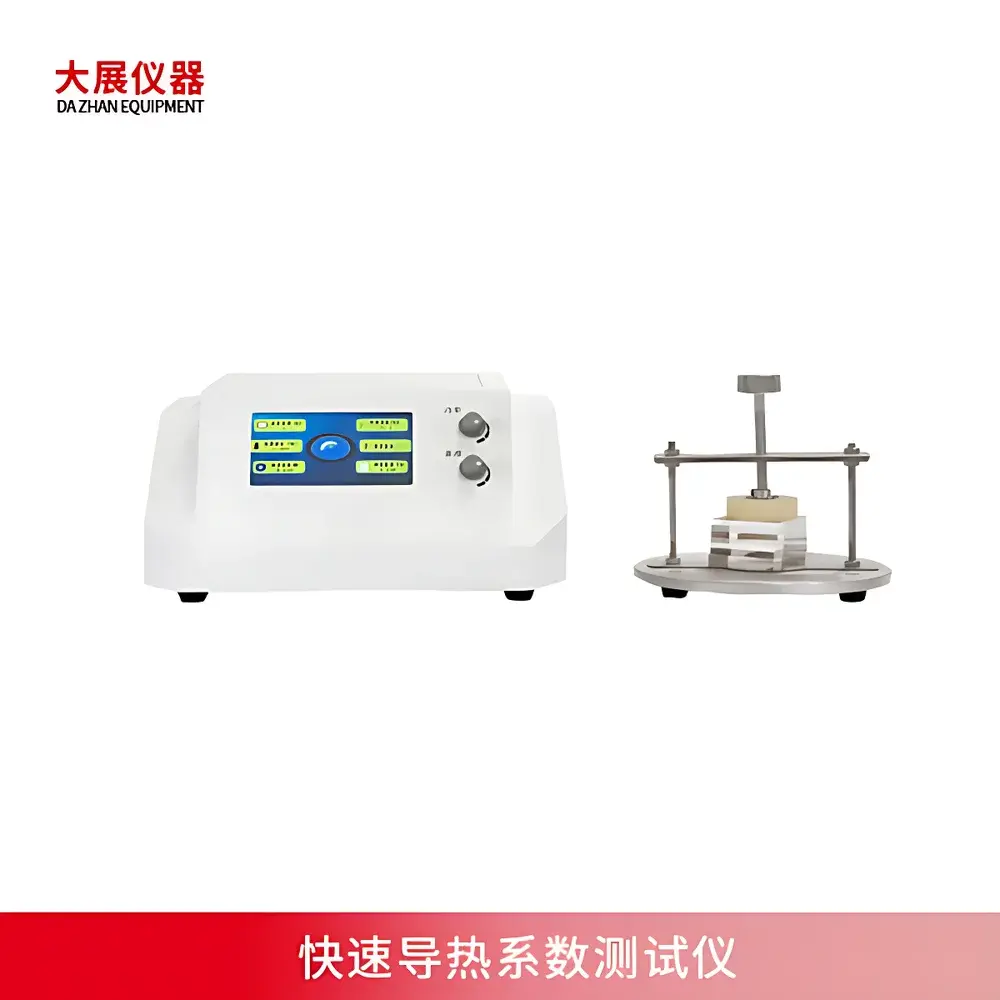
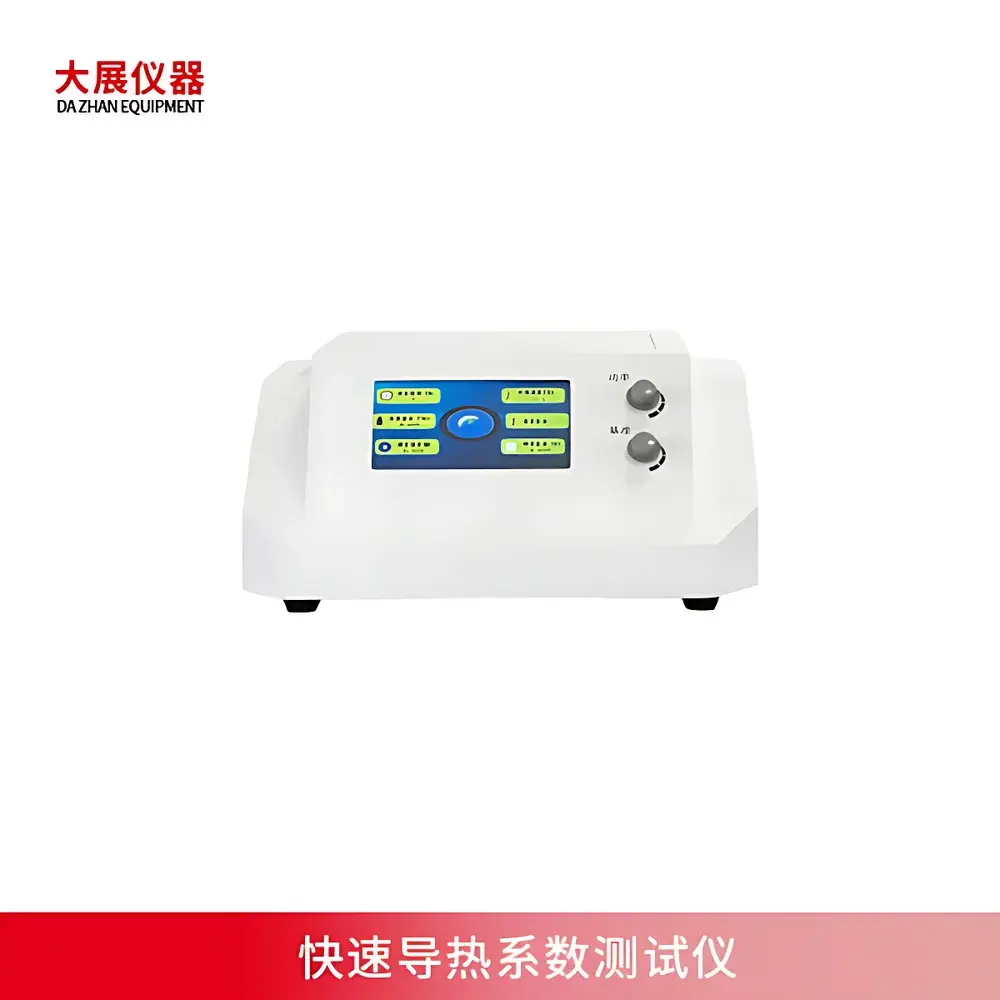
Nanjing Dazhan DZDR-S Transient Plane Source (TPS) Thermal Conductivity Analyzer
| Brand | Nanjing Dazhan |
|---|---|
| Origin | Jiangsu, China |
| Manufacturer Type | Manufacturer |
| Country of Origin | China |
| Model | DZDR-S |
| Instrument Type | Transient Plane Source (TPS) Method |
| Sample Throughput | Single sample per test |
| Test Environment | Ambient temperature (20–25°C) |
| Thermal Conductivity Range | 0.0001–300 W/(m·K) |
| Accuracy | ±3% |
| Dimensions (L×W×H) | 440 × 390 × 220 mm |
| Sample Forms | Solids (bulk, film, coating), powders, liquids, gels, pastes, metallic and non-metallic materials |
| Temperature Range | Room temperature to 130°C (optional heating module) |
| Probe Options | 7.5 mm, 15 mm, and 50 mm diameter dual-spiral TPS sensors |
| Measurement Time | 5–160 s (user-configurable) |
| Repeatability | ≤3% |
| Power Supply | AC 220 V, <500 W |
| Minimum Sample Dimensions | ≥15×15×3.75 mm (for 7.5 mm probe), ≥30×30×7.5 mm (for 15 mm probe), ≥50×50×7.5 mm (for 50 mm probe) |
| Powder Test Kit | Included (customizable vessel available) |
Overview
The Nanjing Dazhan DZDR-S Transient Plane Source (TPS) Thermal Conductivity Analyzer is a precision-engineered instrument designed for rapid, contact-based measurement of thermal conductivity across a broad spectrum of material classes. Based on the internationally standardized transient plane source method (ISO 22007-2:2015), the DZDR-S applies a thin, electrically resistive sensor—acting simultaneously as both heat source and temperature sensor—to the surface or interior of a sample. A controlled current pulse generates a transient temperature rise, and the resulting thermal response is recorded in real time. Using the analytical solution of the heat diffusion equation for an infinite medium with a planar heat source, the system computes thermal conductivity directly from the slope of the ln(ΔT) vs. ln(t) curve during the mid-time domain—eliminating dependence on absolute temperature calibration or interfacial contact resistance assumptions. This first-principles approach ensures high reproducibility and traceability without requiring reference standards for routine operation. The instrument is optimized for laboratory environments where throughput, minimal sample preparation, and non-destructive evaluation are critical—particularly in R&D labs, QC/QA departments, and materials certification facilities.
Key Features
- Direct thermal conductivity measurement via ISO-compliant transient plane source (TPS) methodology—no steady-state equilibration required.
- Three interchangeable dual-spiral TPS probes (7.5 mm, 15 mm, 50 mm) enabling scalable testing across diverse sample geometries and thermal effusivity ranges.
- ARM-based embedded control architecture delivering deterministic real-time data acquisition at up to 10 kHz sampling rate, ensuring resolution of fast thermal transients.
- Integrated high-resolution analog front-end with low-noise instrumentation amplifiers and 24-bit ADCs—minimizing quantization error and enhancing signal-to-noise ratio.
- Modular sample stage accommodating solids, powders (with included containment kit), films, liquids, and composites—no specialized machining or coating needed.
- User-configurable test duration (5–160 s) balancing speed and statistical confidence; typical measurement completes within 30–90 s for most industrial materials.
- Non-destructive testing protocol: samples remain intact and reusable post-measurement, supporting longitudinal studies and multi-parameter characterization workflows.
- Compact benchtop footprint (440 × 390 × 220 mm) with EMI-shielded enclosure suitable for shared lab spaces and ISO/IEC 17025-accredited environments.
Sample Compatibility & Compliance
The DZDR-S supports heterogeneous sample forms—including rigid and flexible solids (e.g., polymers, ceramics, metals), low-density insulators (aerogels, foams), phase-change materials, slurries, nanoparticle dispersions, and anisotropic thin films. For powders and granular media, the included stainless-steel compression cell ensures consistent packing density and interfacial contact. All probe configurations comply with the geometric constraints defined in ISO 22007-2: minimum lateral dimension ≥2× probe diameter and thickness ≥½ probe radius. The system operates under ambient conditions but optionally integrates a PID-controlled heating stage (up to 130°C) for temperature-dependent thermal property mapping. Data integrity meets GLP and GMP-aligned practices: audit trails, user access levels, electronic signatures, and raw-data export (CSV, TXT) support compliance with FDA 21 CFR Part 11 requirements when deployed with validated software protocols.
Software & Data Management
The proprietary DZDR Analysis Suite runs on Windows OS and provides real-time visualization of voltage decay curves, temperature rise profiles, and thermal diffusivity/conductivity convergence plots. Each test session auto-generates a timestamped report containing raw sensor output, fitted parameters (k, α, ρcp), uncertainty estimates (based on propagation-of-error analysis), and pass/fail flags against user-defined specification limits. Batch processing mode enables automated sequence execution across multiple samples with configurable pause intervals. Export formats include CSV (for Excel/Python/MATLAB integration), PDF (print-ready certificates), and XML (LIMS interoperability). Software validation documentation (IQ/OQ protocols) and 21 CFR Part 11 configuration packages are available upon request for regulated industries.
Applications
- Thermal interface material (TIM) qualification in power electronics packaging and EV battery thermal management systems.
- Quality control of insulation materials (rock wool, vacuum panels, aerogel blankets) in building envelope certification per ASTM C518 and EN 12667.
- R&D of thermally conductive polymer composites, metal matrix composites, and additive-manufactured lattice structures.
- Characterization of phase-change materials (PCMs) and heat sink substrates for aerospace thermal regulation.
- Validation of thermal performance claims for consumer electronics housings, LED substrates, and wearable device components.
- Academic research in nanoscale heat transport, phonon scattering mechanisms, and structure–property relationships in amorphous solids.
FAQ
What standards does the DZDR-S comply with?
The instrument implements the transient plane source method per ISO 22007-2:2015 and aligns with ASTM D5470 for thermal transmission properties of thermally conductive electrical insulation materials.
Can the DZDR-S measure anisotropic materials?
Yes—by orienting the probe normal to principal axes and performing orthogonal measurements, directional thermal conductivity tensors can be reconstructed for layered or fibrous composites.
Is calibration required before each test?
No routine calibration is needed; the system self-validates via internal reference resistors and thermal time-constant checks prior to every measurement cycle.
How is contact resistance mitigated in the TPS method?
Unlike guarded-hot-plate or laser-flash techniques, the TPS method inherently accounts for interfacial thermal resistance through its mathematical model—making it insensitive to minor surface roughness or imperfect contact.
Does the software support automated reporting for ISO/IEC 17025 accreditation?
Yes—the DZDR Analysis Suite includes configurable report templates, electronic signature fields, and full audit-log generation compliant with ILAC P14 and EURACHEM guidelines.



