
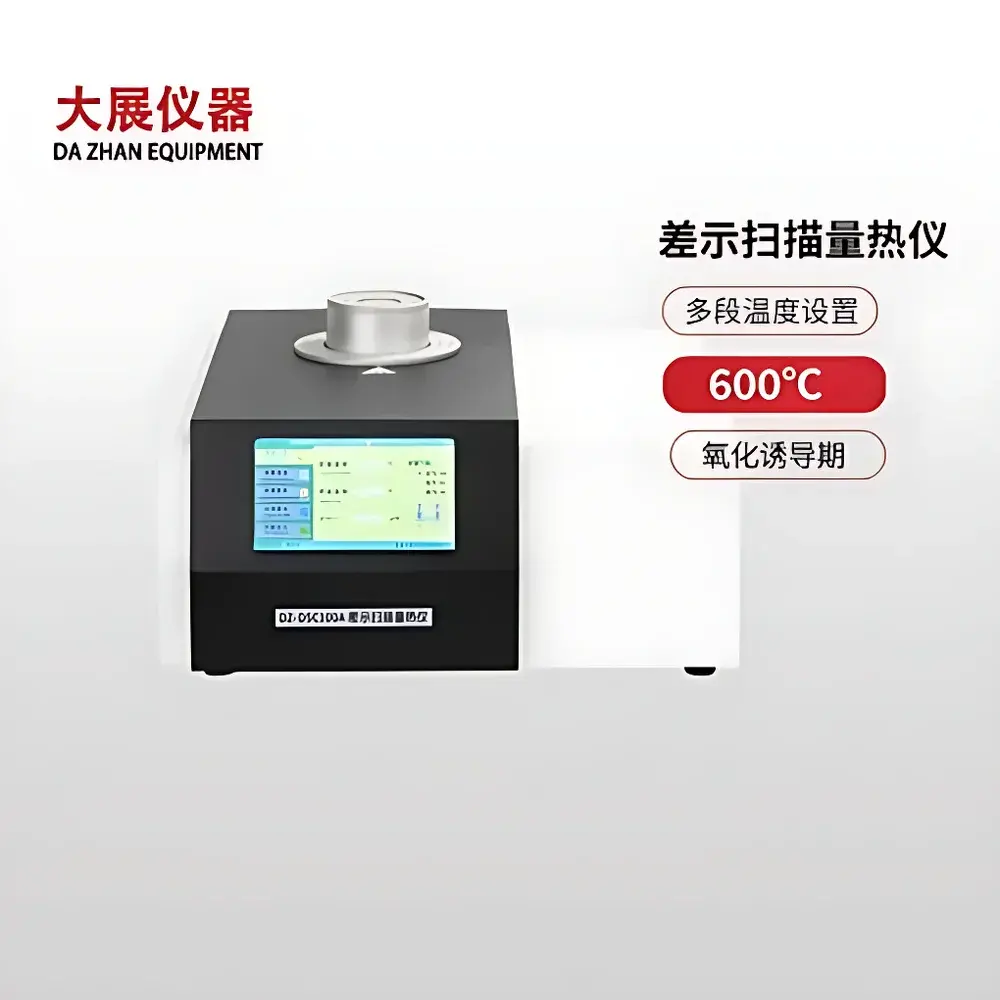
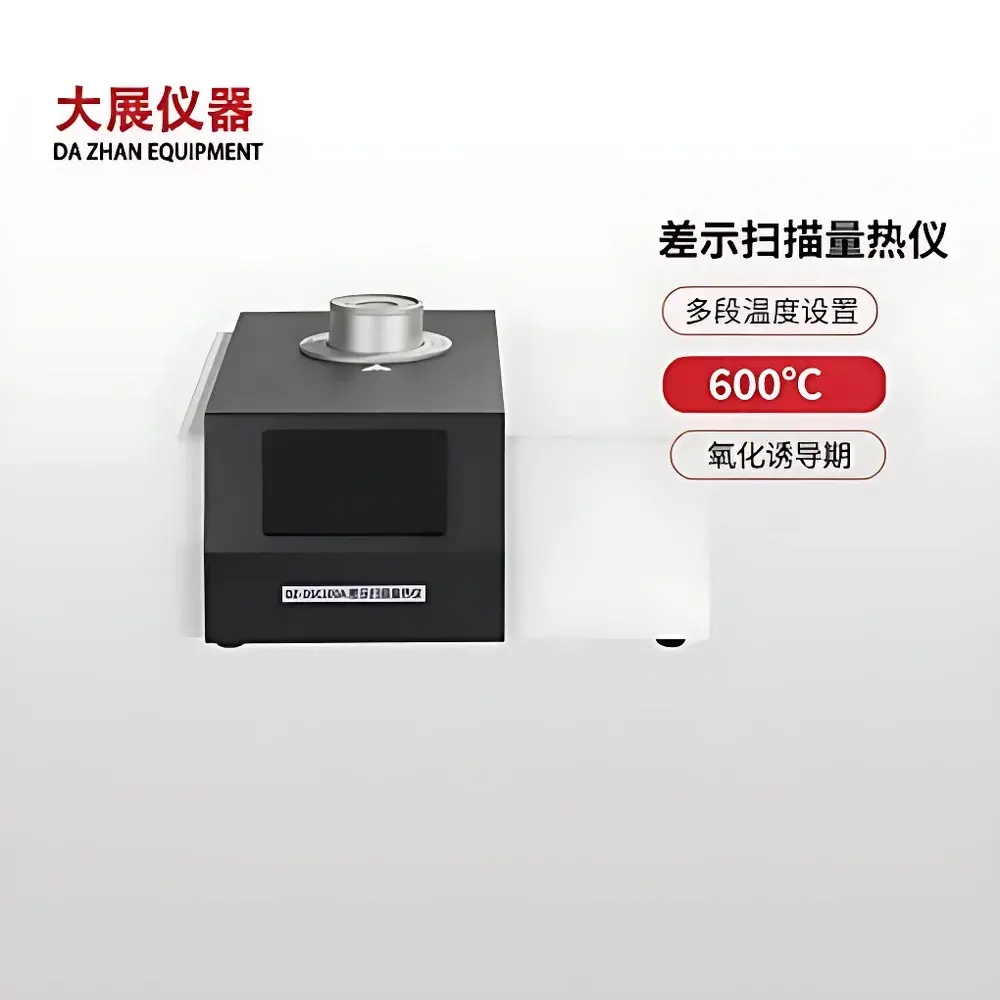
Nanjing Dazhan DZ-DSC100A Differential Scanning Calorimeter
| Brand | Nanjing Dazhan |
|---|---|
| Origin | Jiangsu, China |
| Manufacturer Type | Direct Manufacturer |
| Region of Origin | Domestic (China) |
| Model | DZ-DSC100A |
| Sample Capacity | Single-sample |
| Instrument Type | Differential Scanning Calorimeter (DSC) |
| Temperature Range | Ambient to 600 °C |
| Programmable Temperature Control | Intelligent PID |
| Heating/Cooling Rate | 0.1–100 K/min |
| DSC Signal Range | 0 to ±600 mW |
| Temperature Stability | ±0.01 °C |
| Temperature Resolution | 0.01 °C |
| Temperature Repeatability | ±0.1 °C |
| DSC Noise Level | 0.01 μW |
| DSC Sensitivity | 0.001 mW |
| DSC Resolution | 0.01 μW |
| Sensor Material | Corrosion-Resistant Alloy |
| Gas Flow Control | Digital Mass Flow Meter |
| Interface | USB 2.0 Bidirectional Communication |
| Display | 7-inch 24-bit Color TFT Touchscreen |
| Calibration | Integrated Standard Reference Materials with One-Touch Temperature & Enthalpy Calibration |
Overview
The Nanjing Dazhan DZ-DSC100A Differential Scanning Calorimeter is a precision thermal analysis instrument engineered for quantitative measurement of heat flow differences between a sample and an inert reference as a function of temperature or time. Based on the heat-flux DSC principle, it delivers high-fidelity thermograms essential for characterizing endothermic and exothermic transitions—including glass transition (Tg), cold crystallization, melting (Tm), recrystallization, solid-solid phase changes, oxidative induction time (OIT), oxidative induction temperature (OITT), specific heat capacity (Cp), and cure kinetics in thermosetting resins. Its optimized furnace architecture—featuring enhanced thermal insulation and symmetrical sensor geometry—ensures superior baseline stability and signal-to-noise ratio, critical for detecting low-energy transitions and evaluating long-term thermal stability under controlled atmospheres.
Key Features
- High-stability furnace design with dual-layer insulation and alloy-based sensor assembly, delivering exceptional thermal homogeneity and resistance to oxidation/corrosion during extended high-temperature operation.
- Intelligent PID temperature control system with real-time adaptive tuning, enabling precise ramp rates from 0.1 to 100 K/min and maintaining thermal stability within ±0.01 °C across the full operating range (ambient to 600 °C).
- Digital mass flow controller integrated into the purge gas module, supporting programmable N2, O2, or synthetic air delivery; flow parameters are timestamped and stored directly in the measurement database for full traceability.
- Bidirectional operational flexibility: fully functional via embedded 7-inch 24-bit color touchscreen interface or external PC software—both supporting identical parameter sets and real-time data visualization.
- Cortex-M3 ARM microcontroller core ensures deterministic real-time processing of thermal signals, minimizing latency in feedback loops and enhancing reproducibility of repeated scans.
- USB 2.0 interface compliant with standard HID and CDC protocols, enabling plug-and-play connectivity without proprietary drivers; supports simultaneous instrument control and raw data streaming.
- Preloaded calibration routines using certified reference materials (e.g., high-purity indium, tin, zinc), allowing users to perform routine temperature and enthalpy calibration with one-touch execution and automatic report generation.
Sample Compatibility & Compliance
The DZ-DSC100A accommodates standard 40 µL aluminum crucibles (hermetic or vented), platinum crucibles for aggressive environments, and custom sample holders for fiber, powder, or thin-film geometries. It complies with fundamental requirements of ISO 11357 (Plastics — Differential Scanning Calorimetry), ASTM E794 (Melting and Crystallization Temperatures by DSC), and ASTM D3895 (Oxidative Induction Time of Polyolefins). While not pre-certified for FDA 21 CFR Part 11, its audit-trail-capable software architecture—supporting user access levels, electronic signatures, and immutable data logs—enables straightforward validation for GLP/GMP-regulated laboratories upon site-specific qualification.
Software & Data Management
The accompanying Windows-based analysis suite provides full ICH Q5A-compliant data acquisition, baseline correction (tangent, linear, polynomial), peak integration, kinetic modeling (Ozawa-Flynn-Wall, Kissinger), and Cp calculation via step-heating protocols. All raw data (.dsc binary format) and processed results (.csv, .xlsx, .pdf reports) are stored with embedded metadata—including operator ID, instrument serial number, calibration status, gas flow settings, and environmental conditions. Database structure supports SQL queries for cross-experiment trending, and export modules meet LIMS interoperability standards (ASTM E1467, ISO/IEC 17025 Annex A.2).
Applications
- Quantification of oxidative induction time (OIT) and oxidative induction temperature (OITT) in polyolefin stabilization studies per ASTM D3895 and ISO 11357-6.
- Determination of glass transition temperature (Tg) in amorphous polymers, pharmaceutical amorphous dispersions, and food matrices, with sensitivity sufficient to resolve weak transitions in low-mass samples (<1 mg).
- Analysis of curing behavior in epoxy, phenolic, and acrylic systems—including gelation onset, vitrification, and post-cure exotherms—using isothermal and dynamic scan modes.
- Thermal stability assessment of battery electrode materials, catalysts, and nanocomposites under inert or oxidizing atmospheres.
- Specific heat capacity (Cp) measurement via modulated DSC or step-scanning methods for thermodynamic modeling and process simulation inputs.
FAQ
What reference materials are included for calibration?
The system ships with certified indium (Tm = 156.60 °C, ΔHf = 28.45 J/g) and zinc (Tm = 419.53 °C) standards, enabling independent verification of temperature accuracy and enthalpy response.
Is the instrument compatible with inert and reactive gas environments?
Yes—the integrated digital mass flow controller supports N2, Ar, He, O2, and synthetic air with adjustable flow rates (0–200 mL/min); gas switching is programmable within method files.
Can multiple samples be analyzed sequentially without manual intervention?
No—the DZ-DSC100A is a single-position instrument; however, automated sample loading can be achieved via optional robotic autosampler integration (third-party compatible through TTL/RS232 trigger interface).
Does the software support compliance with 21 CFR Part 11?
The base software provides audit trail, user authentication, and electronic signature placeholders; full Part 11 compliance requires laboratory-specific validation documentation and IT infrastructure alignment.
What is the minimum detectable heat flow change?
With a noise level of 0.01 μW and resolution of 0.01 μW, the instrument reliably resolves transitions with enthalpy changes ≥0.1 J/g for typical 5–10 mg polymer samples under standard scanning conditions.



