
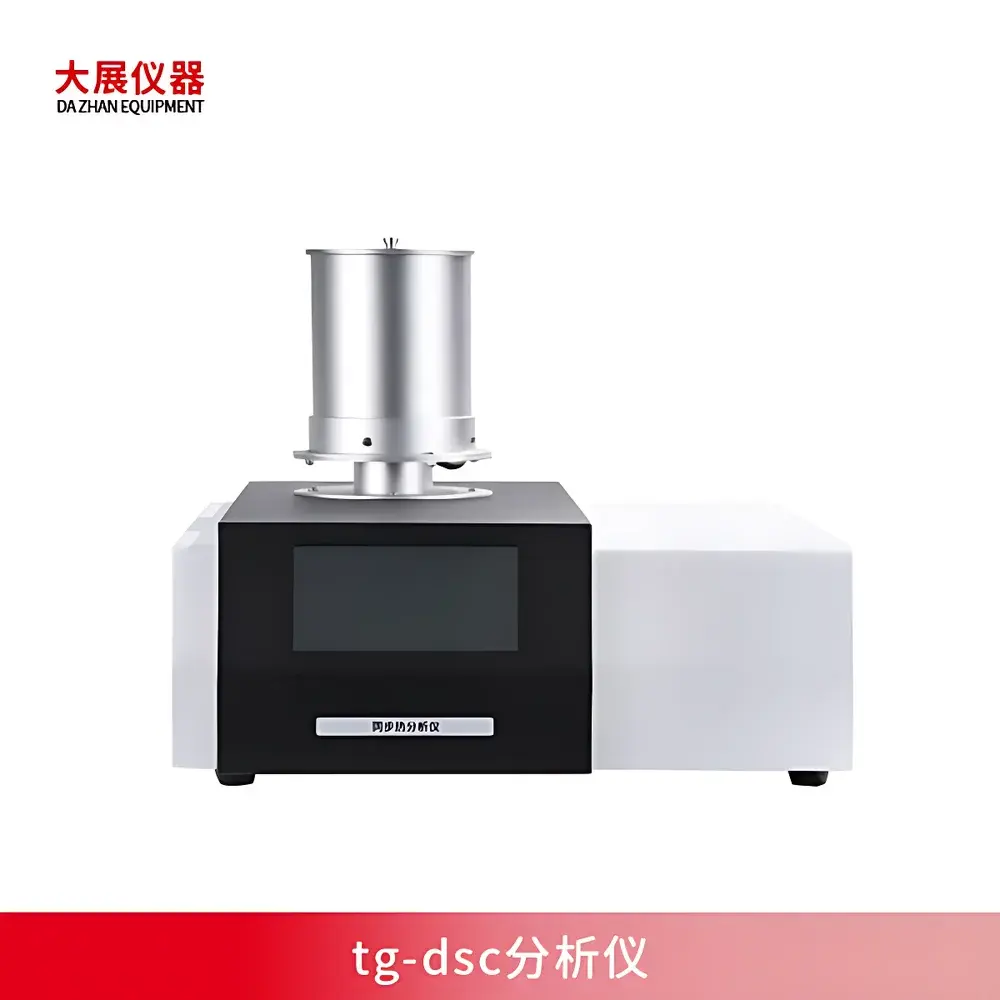
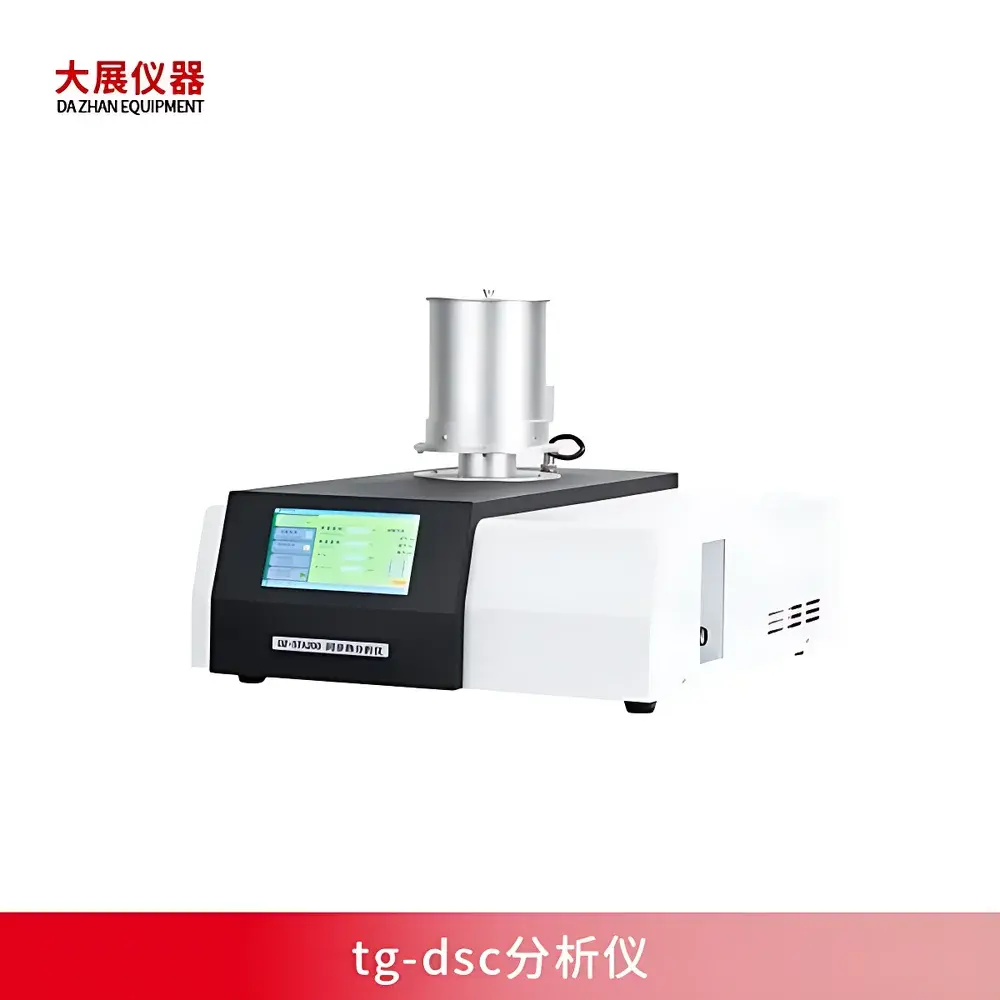
Nanjing Dazhan DZ-STA200 Simultaneous Thermal Analyzer (TG-DSC/DTA)
| Brand | Nanjing Dazhan |
|---|---|
| Model | DZ-STA200 |
| Origin | Jiangsu, China |
| Manufacturer Type | Direct Manufacturer |
| Temperature Range | Ambient to 1200 °C |
| Heating Rate | 0.1–100 °C/min |
| Max Sample Mass | 5 g |
| Atmosphere Compatibility | Inert, Oxidizing, Reducing |
| TG Resolution | 0.1 µg |
| TG Accuracy | 0.01 mg |
| DSC Range | ±1000 mW |
| DSC Resolution | 0.1 µW |
| DSC Accuracy | 0.01 mW |
| Temperature Resolution | 0.01 °C |
| Temperature Stability | ±0.1 °C |
| Cooling Time (1000 °C → 100 °C) | ≤15 min |
| Display | 7-inch 24-bit LCD Touchscreen |
| Gas Control | Dual-channel mass flow control with integrated flow meters |
| Software | Integrated thermal analysis suite with TG, DTG, and TG-DSC overlay, calibration support (temperature & enthalpy), PDF/Excel export, audit-trail-capable data logging |
Overview
The Nanjing Dazhan DZ-STA200 Simultaneous Thermal Analyzer is an engineered solution for high-fidelity, real-time correlation of mass change and thermal energy flow in a single sample under controlled atmospheric conditions. Based on the principle of simultaneous thermogravimetric analysis (TG) and differential scanning calorimetry (DSC)—or optionally differential thermal analysis (DTA)—the instrument delivers synchronized, time-aligned data streams that eliminate inter-run variability and enable precise attribution of endothermic/exothermic events to concurrent mass loss or gain. Its dual-sensor architecture integrates a microbalance with sub-microgram resolution and a heat-flux DSC sensor within a single furnace chamber, ensuring identical thermal history across both measurement domains. Designed for laboratories requiring regulatory-compliant thermal characterization—especially in polymer science, pharmaceutical development, battery materials research, and inorganic synthesis—the DZ-STA200 operates across a broad temperature envelope (ambient to 1200 °C) with programmable heating rates from 0.1 to 100 °C/min, supporting both kinetic modeling and standardized thermal stability assessments such as oxidation induction time (OIT) per ASTM D3895.
Key Features
- High-stability dual-wound platinum-rhodium alloy furnace with optimized thermal uniformity and minimal electromagnetic interference.
- Ceramic push-rod sample holder assembly resistant to thermal shock, oxidation, and chemical corrosion up to 1200 °C.
- Physically decoupled power supply and forced-air cooling module—mounted separately from the main chassis—to suppress mechanical vibration and conductive heat transfer to the microbalance.
- Top-loading furnace design with rapid-access lid mechanism, enabling efficient sample exchange without realignment or recalibration.
- Multi-layer passive thermal shielding isolates the balance and electronics compartment from furnace radiation, maintaining baseline stability during extended high-temperature holds.
- Modular furnace configuration allows optional replacement with alternative temperature-range variants (e.g., low-temperature cryo-furnace or ultra-high-temperature variant) without system revalidation.
- Programmable multi-segment temperature profiles with bidirectional control (heating/cooling/holding), supporting complex protocols such as step-isothermal analysis and modulated DSC (MDSC)-compatible ramp sequences.
Sample Compatibility & Compliance
The DZ-STA200 accommodates standard crucible formats—including high-purity alumina, platinum, and quartz—with maximum sample capacity of 5 g. Its dual-gas manifold supports independent control of two gas streams (e.g., N₂ + O₂ or Ar + H₂), each equipped with digital mass flow controllers (MFCs) for precise static or dynamic atmosphere management (flow range: 0–200 mL/min). The system complies with core thermal analysis standards including ISO 11357 (plastics—DSC), ISO 11358 (TG), ASTM E1131 (TG), ASTM E1269 (heat capacity by DSC), and USP (thermal analysis in pharmaceuticals). Data acquisition and reporting meet GLP/GMP documentation requirements, with software-enforced user access levels, electronic signatures, and full audit trail functionality aligned with FDA 21 CFR Part 11 principles.
Software & Data Management
The embedded thermal analysis software provides native support for real-time visualization and post-processing of TG, DTG (derivative thermogravimetry), DSC, and overlaid TG-DSC curves. Calibration routines include multi-point temperature verification (using certified Ni, In, Sn, Zn, Al, Ag standards) and enthalpy calibration (KNO₃, indium) across defined temperature intervals. All raw and processed datasets are stored in a structured SQLite database with timestamped metadata (operator ID, instrument ID, method file hash, gas composition, purge rate). Export options include CSV, Excel (.xlsx), and PDF report generation with customizable templates—suitable for internal QA review or regulatory submission. USB 2.0 interface enables secure offline data transfer; no cloud connectivity or remote telemetry is implemented, preserving data sovereignty.
Applications
- Determination of decomposition onset, char yield, and residual ash content in polymers, composites, and flame-retardant formulations.
- Quantification of crystallinity, melting enthalpy, and cold-crystallization behavior in semi-crystalline thermoplastics and biopolymers.
- Stability profiling of active pharmaceutical ingredients (APIs) and excipients under oxidative stress (OIT testing) or moisture-induced degradation.
- Thermal behavior analysis of cathode/anode materials in Li-ion batteries, including phase transitions, oxygen release, and SEI formation kinetics.
- Reaction enthalpy and stoichiometry assessment in solid-state synthesis, catalyst deactivation studies, and metal oxide reduction pathways.
- Validation of thermal aging protocols for aerospace-grade resins and encapsulation materials per MIL-STD-883 or IPC-TM-650.
FAQ
What types of atmospheres can be used during analysis?
Inert (N₂, Ar), oxidizing (air, O₂), and reducing (H₂/N₂ mixtures, CO) gases are supported in both static and dynamic modes, with independent flow control for two channels.
Is the instrument compliant with FDA 21 CFR Part 11?
Yes—the software implements role-based access control, electronic signatures, and immutable audit trails for all critical operations including method editing, calibration, and report generation.
Can the DZ-STA200 perform quantitative DSC measurements?
Yes—calibrated DSC signal output (±1000 mW range, 0.1 µW resolution, ±0.01 mW accuracy) enables absolute enthalpy determination when paired with certified reference materials and validated crucible geometry.
What is the typical cooling time from 1000 °C to 100 °C?
≤15 minutes under forced-air cooling with standard furnace configuration; optional liquid-nitrogen-assisted cooling modules reduce this further upon request.
Does the system support custom crucible geometries or proprietary sample holders?
The ceramic push-rod interface is mechanically standardized; third-party crucibles meeting ISO 11357 dimensional specifications (e.g., 5 mm OD × 2.5 mm depth) are fully compatible.



