
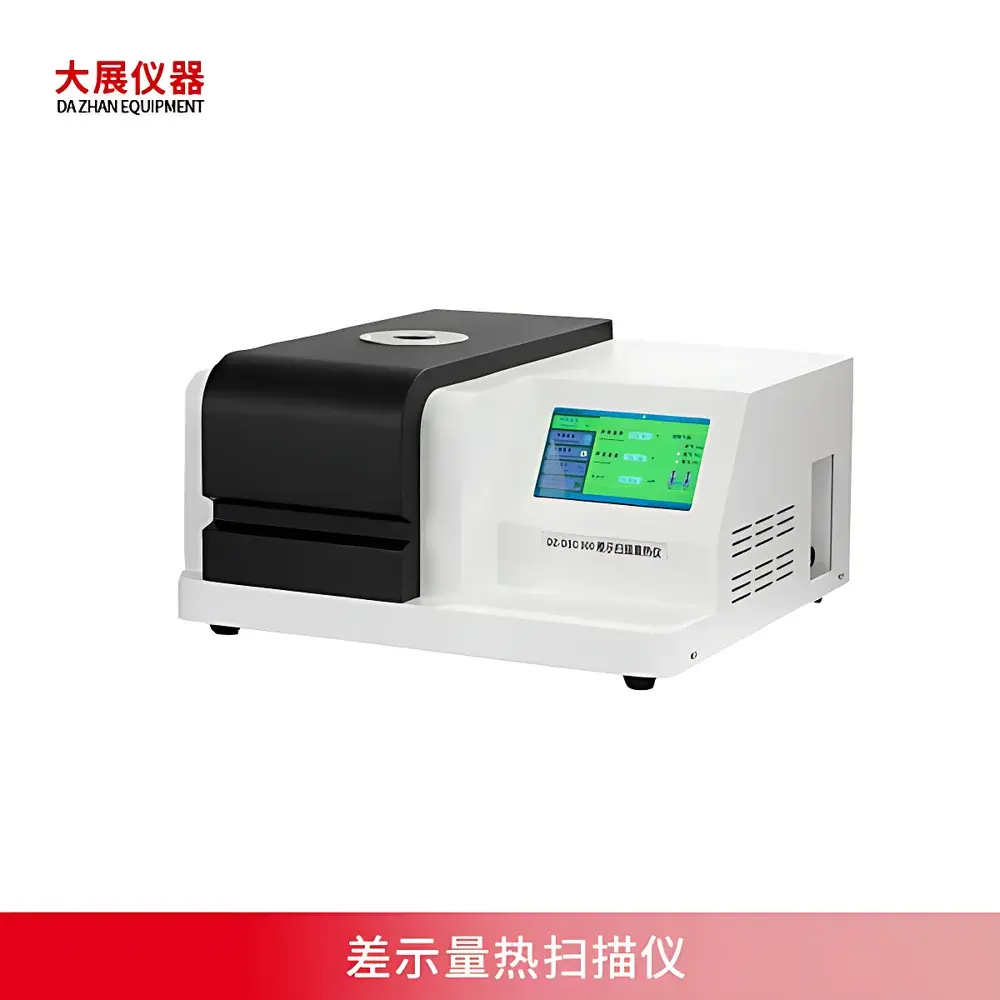
DZHAN DZ-DSC300 Differential Scanning Calorimeter
| Brand | DAZHAN |
|---|---|
| Origin | Jiangsu, China |
| Model | DZ-DSC300 |
| Sample Capacity | Single |
| Instrument Type | DSC |
| Temperature Range | Ambient to 600 °C |
| Programmable Temperature Control | Heating, Isothermal, Cooling (Fully Automated) |
| Heating/Cooling Rate | 0.1–100 K/min |
| DSC Signal Range | 0–±800 mW (Expandable) |
| Temperature Stability | ±0.01 °C |
| Temperature Resolution | 0.001 °C |
| DSC Sensitivity | 0.001 mW |
| Gas Control | Dual-channel Automatic Switching (N₂, Air, or Custom Gases), Flow Rate 0–200 mL/min, Max Pressure 0.5 MPa |
| Thermal Calibration Standards Included | Indium, Tin, Lead |
| Data Interface | USB 2.0 |
| Display | 7-inch 24-bit TFT LCD Touchscreen |
| Power Supply | AC 220 V / 50 Hz (Optional Custom Voltage) |
Overview
The DZHAN DZ-DSC300 is a high-precision differential scanning calorimeter engineered for quantitative thermal analysis of solid and semi-crystalline materials across research, quality control, and regulatory environments. Based on the heat-flux DSC principle, the instrument measures the differential heat flow between a sample and an inert reference as both are subjected to identical, precisely controlled temperature programs. This enables direct quantification of endothermic and exothermic transitions—including glass transitions (Tg), melting (Tm), crystallization (Tc), solid-solid phase changes, oxidative induction time (OIT), and cure kinetics—under defined atmospheric conditions. Its robust furnace architecture features a top-opening design with triple-layer thermal shielding, minimizing thermal lag and maximizing baseline stability. The integrated thermoelectric sensor employs fusion-bonded junction technology—replacing conventional spot-welded thermocouples—to deliver enhanced signal-to-noise ratio and long-term calibration integrity. With a certified temperature range from ambient to 600 °C and programmable ramp rates spanning 0.1 to 100 K/min, the DZ-DSC300 supports both rapid screening and high-resolution kinetic profiling.
Key Features
- High-stability furnace with top-access configuration and triple-insulated lid assembly for superior thermal homogeneity and reduced environmental drift
- Fusion-bonded dual-sensor array delivering improved sensitivity (0.001 mW) and reproducibility over conventional welded thermocouple designs
- Full bidirectional control: simultaneous operation via embedded 7-inch touchscreen interface and external PC-based software—no dependency on continuous computer connection
- Automated dual-gas manifold with pressure-regulated switching (N₂, air, or user-defined purge gases); flow rate digitally adjustable from 0 to 200 mL/min
- Multi-segment thermal programming: up to six independent heating/cooling/isothermal steps per run, with customizable dwell times up to 24 hours
- 24-bit analog-to-digital conversion with active electromagnetic shielding on all signal paths to suppress line noise and improve low-signal fidelity
- Onboard temperature calibration using supplied NIST-traceable standards (indium, tin, lead); software-supported multi-point correction for long-term accuracy maintenance
Sample Compatibility & Compliance
The DZ-DSC300 accommodates standard aluminum, gold-plated aluminum, and high-pressure stainless-steel crucibles (40 µL capacity), supporting samples ranging from 1 mg to 50 mg in mass. It is compatible with powders, films, fibers, granules, and cured resins—provided they exhibit no volatile decomposition below the onset of target transitions. The instrument meets fundamental requirements for GLP-compliant thermal characterization workflows, including audit-trail-capable data logging, user-access-level controls, and timestamped metadata embedding. While not pre-certified to ISO 11357 or ASTM E794/E1269 out-of-the-box, its calibrated performance parameters align with the measurement uncertainty budgets specified in those standards. Optional validation packages—including IQ/OQ documentation templates and third-party traceable calibration reports—are available upon request for regulated pharmaceutical (USP , ICH Q5C) and polymer (ISO 11357-1 to -7) applications.
Software & Data Management
The proprietary DSC Analysis Suite provides real-time visualization, baseline correction (tangent, step, polynomial), peak integration, and comparative overlay of multiple runs. Raw data are saved in vendor-neutral CSV format with full metadata (temperature, heat flow, time, gas flow, PID settings). The software supports automated Tg determination per ASTM E1356, enthalpy normalization per mass or mole, and OIT calculation per ASTM D3895. All processing steps are logged with operator ID, timestamp, and parameter history—enabling full traceability in accordance with FDA 21 CFR Part 11 principles when deployed on validated Windows systems. Export modules support direct generation of PDF reports with embedded spectra, summary tables, and annotated transition markers.
Applications
- Polymers & Composites: Quantification of Tg, cold crystallization enthalpy, degree of crystallinity (via %ΔHf relative to 100% crystalline reference), crosslink density estimation, and thermal degradation onset
- Pharmaceuticals: Polymorph screening, amorphous content assessment, excipient compatibility studies, and stability-indicating assay development per ICH guidelines
- Food Science: Fat polymorphism analysis (β, β′, α transitions), starch gelatinization enthalpy, protein denaturation temperature, and shelf-life prediction via accelerated oxidation testing
- Ceramics & Inorganics: Phase transformation mapping (e.g., quartz → cristobalite), sintering behavior, specific heat capacity (Cp) determination via modulated DSC protocols
- Metallurgy: Solidus/liquidus identification in alloys, precipitation kinetics in age-hardening systems, and martensitic transformation hysteresis evaluation
- Energetic Materials: Decomposition onset temperature, reaction enthalpy, and compatibility screening with binders or oxidizers
FAQ
What calibration standards are included with the DZ-DSC300?
Indium (Tm = 156.60 °C), tin (Tm = 231.93 °C), and lead (Tm = 327.50 °C) are supplied as primary temperature standards. Enthalpy calibration is performed using the known ΔHf of indium (28.45 J/g).
Can the DZ-DSC300 operate under inert, oxidative, or reducing atmospheres?
Yes—the dual-gas manifold supports automatic switching between two independently regulated gas streams (e.g., N₂ and synthetic air), with optional upgrade kits for H₂ or Ar compatibility and pressure-rated crucibles.
Is the instrument suitable for dynamic mechanical thermal analysis (DMTA) or modulated DSC (MDSC)?
No—the DZ-DSC300 is a conventional heat-flux DSC platform. It does not support oscillatory temperature modulation or force-controlled deformation measurements.
What is the minimum detectable heat flow change?
The system achieves a noise floor of ≤0.001 mW under standard operating conditions (50 mL/min N₂, 10 K/min ramp), verified per ASTM E1356 Annex A1.
Does the software comply with 21 CFR Part 11 requirements?
The software includes electronic signature capability, audit trail export, and role-based access control. Full Part 11 compliance requires site-specific validation, which DZHAN supports through documented IQ/OQ protocols and URS alignment services.
Related Products



