
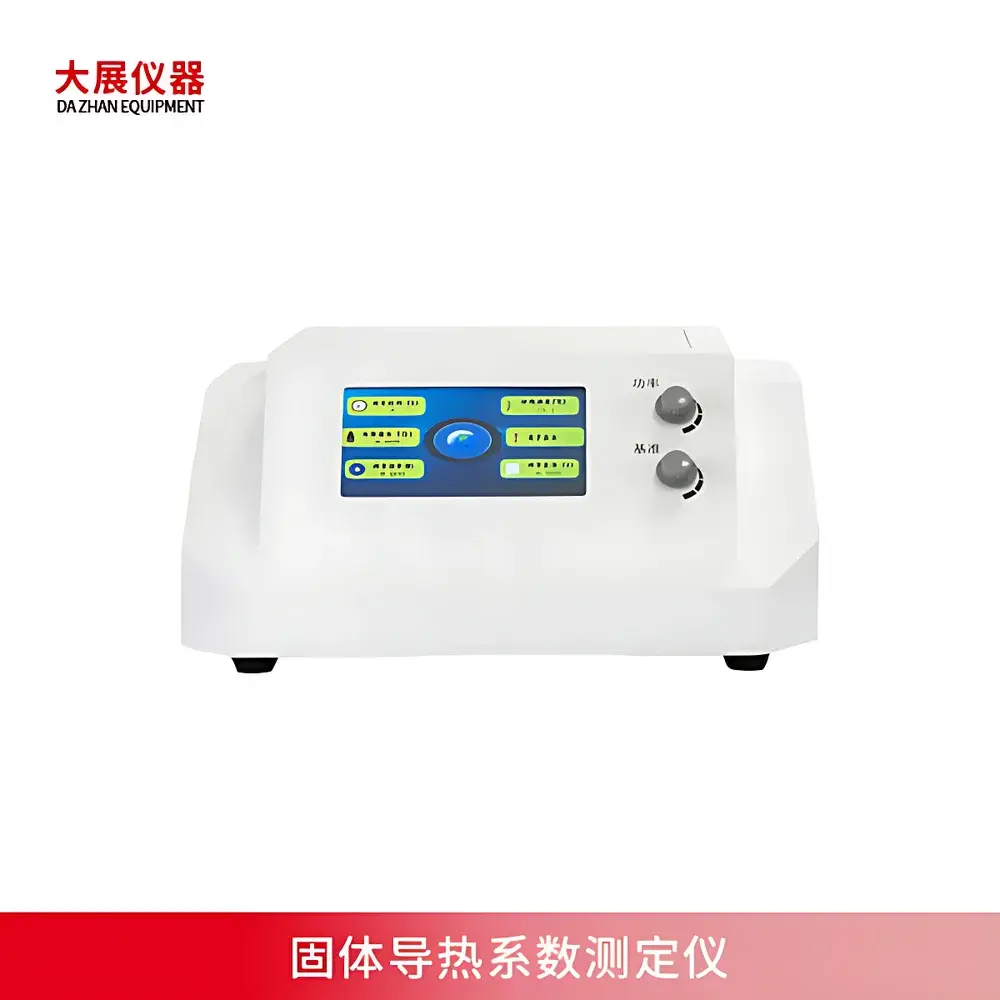
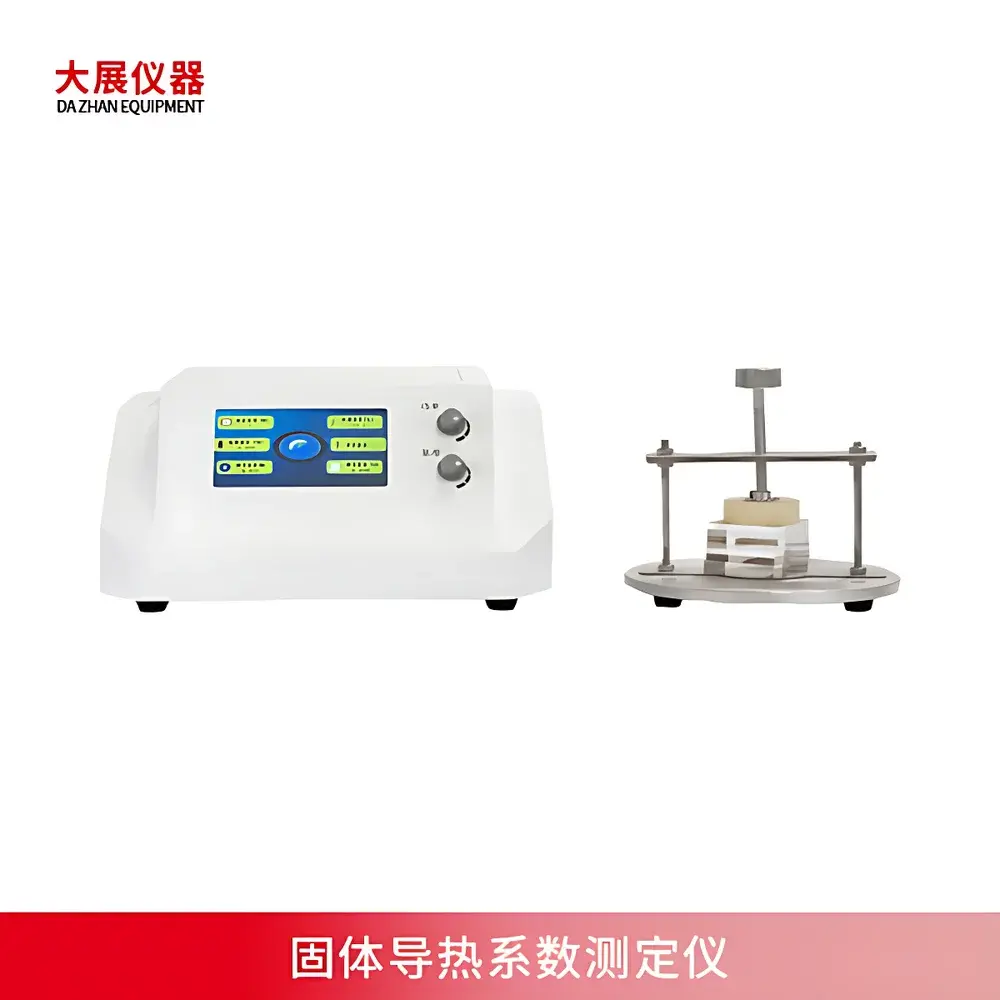
Nanjing Dazhan DZDR-S Transient Plane Source (TPS) Thermal Conductivity Analyzer
| Brand | Nanjing Dazhan |
|---|---|
| Origin | Jiangsu, China |
| Manufacturer Type | Direct Manufacturer |
| Instrument Category | Domestic |
| Model | DZDR-S |
| Price Range | USD 5,600–9,800 (based on configuration) |
| Measurement Principle | Transient Plane Source (TPS) Method |
| Sample Throughput | Single sample per test |
| Test Environment | Ambient temperature (20–30 °C) |
| Thermal Conductivity Range | 0.0001–300 W/(m·K) |
| Accuracy | ±3% |
| Repeatability | ≤3% |
| Sample Forms | Solids, liquids, powders, pastes, gels, metals, coatings, thin films, and thermal insulation materials |
| Probe Options | 7.5 mm (No. 1), 15 mm (No. 2), 50 mm (No. 3, optional/customizable) |
| Sample Dimensions (min.) | 15×15×3.75 mm (for No. 1 probe), 30×30×7.5 mm (for No. 2), 50×50×7.5 mm (for No. 3) |
| Measurement Duration | 5–160 s (user-configurable) |
| Operating Temperature Range | 20–130 °C |
| Power Supply | AC 220 V, <500 W |
| Data Acquisition | High-resolution integrated ADC chip |
| Interface | Color TFT LCD touchscreen |
Overview
The Nanjing Dazhan DZDR-S Transient Plane Source (TPS) Thermal Conductivity Analyzer is a precision instrument engineered for the direct, non-destructive determination of thermal conductivity (λ) across an exceptionally broad range—from ultra-low-conductivity insulators (0.0001 W/(m·K)) to high-conductivity metals (up to 300 W/(m·K)). It implements the internationally standardized transient plane source method (ISO 22007-2, ASTM D7984), in which a thin, double-helix nickel sensor acts simultaneously as both heat source and resistance thermometer. Upon application of a constant current pulse, the sensor’s time-dependent temperature rise is recorded with microsecond-level resolution. Thermal conductivity is derived from the slope of the ln(t)–T(t) curve during the early-time linear regime—ensuring minimal influence from contact resistance and boundary effects. This physics-based approach eliminates the need for steady-state equilibration, enabling reliable measurements within 5–160 seconds without external calibration standards.
Key Features
- True non-destructive testing: Samples remain structurally intact and reusable post-measurement, critical for precious or limited-volume materials (e.g., battery electrode composites, pharmaceutical excipients, or aerospace alloys).
- Minimal sample preparation: No machining, coating, or vacuum sealing required. Solid samples only require two parallel, moderately smooth surfaces; minimum dimensions scale with probe size (e.g., ≥30×30×7.5 mm for the 15 mm probe).
- Multi-form compatibility: Validated for homogeneous and heterogeneous phases—including granular powders (with included custom container), viscoelastic gels, viscous pastes, low-viscosity liquids, metallic foils, polymer films, and porous insulation boards.
- Triple-probe modular design: Interchangeable probes (7.5 mm, 15 mm, 50 mm diameter) enable optimized spatial resolution and signal-to-noise ratio across diverse sample geometries and thermal diffusivities.
- Embedded high-fidelity data acquisition: Integrated 24-bit analog-to-digital converter ensures sub-millikelvin temperature resolution and robust noise rejection under laboratory electromagnetic conditions.
- Intuitive human-machine interface: 7-inch color TFT touchscreen with graphical real-time curve display, parameter presets, and on-device result export (CSV/Excel-compatible).
Sample Compatibility & Compliance
The DZDR-S accommodates specimens ranging from millimeter-thick metal plates to sub-millimeter polymer films and loosely packed powders. Its TPS methodology inherently satisfies ISO 22007-2 Annex A requirements for isotropic, non-metallic solids—and has been cross-validated against guarded hot plate (ASTM C177) and laser flash (ASTM E1461) methods for reference materials including Pyroceram® 9606, stainless steel 304, and silica aerogel. For regulated environments, measurement logs include timestamped operator ID, probe serial number, ambient temperature/humidity metadata, and full raw voltage-vs.-time datasets—supporting GLP-compliant audit trails. While not FDA 21 CFR Part 11-certified out-of-the-box, the system architecture permits integration with validated LIMS platforms via RS-232/USB virtual COM port.
Software & Data Management
Firmware v3.2 includes embedded analysis algorithms compliant with the fundamental TPS solution for infinite medium approximation (k = (Q / 4π) × [d(√t)/dT]⁻¹). Raw thermistor voltage data is converted to temperature using a calibrated Callendar-Van Dusen polynomial. Post-acquisition processing provides automatic baseline correction, noise-filtered derivative calculation, and uncertainty propagation based on repeatability statistics (≤3% RSD) and instrument accuracy (±3%). Export formats include UTF-8 CSV with headers (Time[s], Voltage[V], Temp[K], dT/d√t[K·s⁻⁰·⁵]), enabling traceable reanalysis in MATLAB, Python (SciPy), or OriginLab. Optional PC software adds batch reporting, statistical trend charts, and ISO/IEC 17025-aligned certificate templates.
Applications
- Quality control of thermal interface materials (TIMs) in electronics packaging—verifying λ consistency across production lots of silicone greases, phase-change pads, and graphite films.
- R&D of next-generation battery components—measuring through-plane conductivity of cathode slurries, separator membranes, and solid-state electrolytes at controlled temperatures (20–130 °C).
- Building material certification—rapid screening of aerogel blankets, vacuum insulation panels (VIPs), and lightweight concrete formulations per EN 12667.
- Geotechnical and petrochemical labs—characterizing thermal transport in saturated soils, drilling muds, and bituminous binders under ambient and elevated thermal conditions.
- Academic research in soft matter physics—quantifying structure–property relationships in hydrogels, colloidal dispersions, and polymer nanocomposites without drying or compression artifacts.
FAQ
What standards does the DZDR-S comply with?
It adheres to ISO 22007-2 (Plastics — Determination of thermal conductivity and thermal diffusivity — Part 2: Transient plane source (hot disc) method) and ASTM D7984 (Standard Test Method for Thermal Conductivity of Liquids by Transient Hot Wire Method), with methodological equivalence established for solids.
Can it measure anisotropic materials?
The standard configuration assumes isotropy. For layered or fiber-reinforced composites, directional measurements require orthogonal probe placement and post-test tensor modeling—supported via optional advanced analysis module.
Is vacuum or inert gas purging required?
No. Ambient air operation is sufficient for most applications. Optional environmental chamber integration (−20 °C to 200 °C, N₂-purged) is available for high-temperature or oxidation-sensitive samples.
How is contact resistance mitigated?
The double-helix probe geometry and proprietary thermal interface algorithm minimize interfacial thermal resistance effects. Validation tests using graphite-coated interfaces show <1.2% deviation from ideal-contact models.
What maintenance is required?
Annual verification using NIST-traceable reference materials (e.g., SRM 1470a) is recommended. Probe cleaning with isopropanol and lint-free wipes suffices between samples; no recalibration is needed under normal use.
Related Products



