
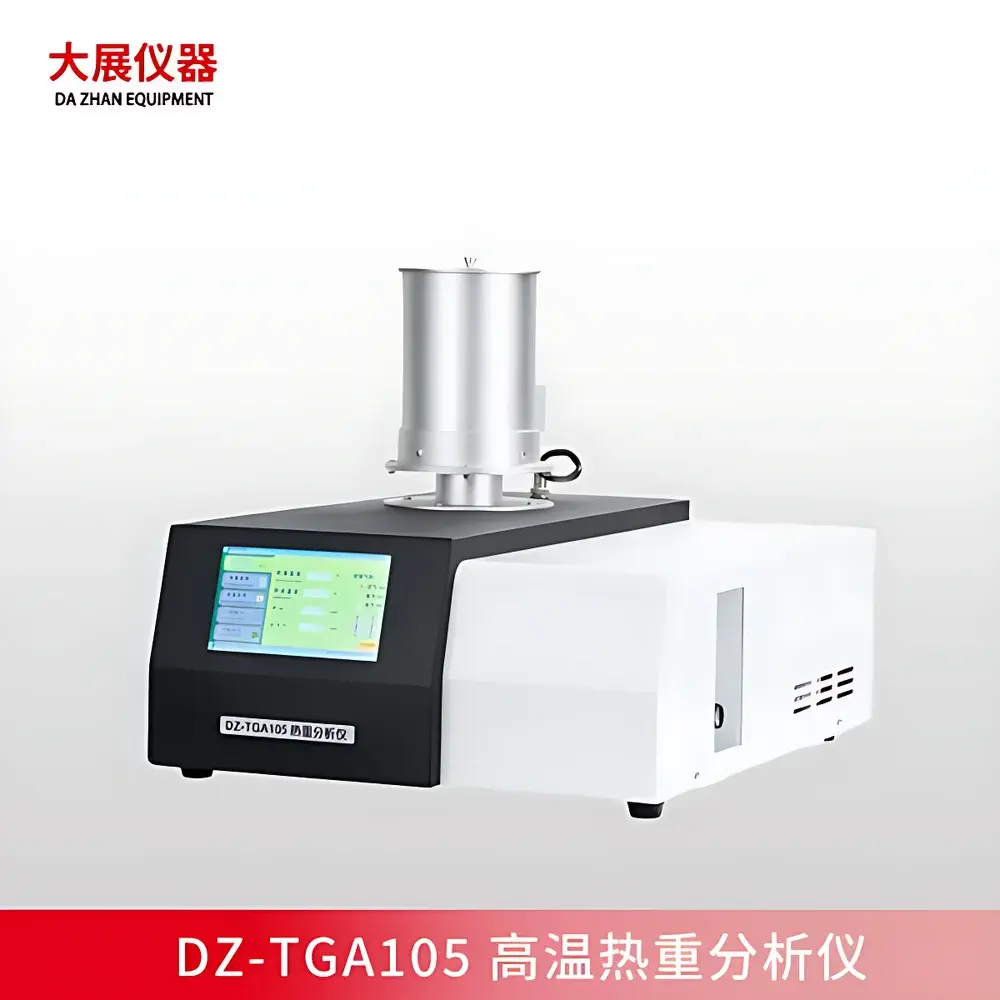
Nanjing Dazhan DZ-TGA105 High-Temperature Thermogravimetric Analyzer
| Brand | Nanjing Dazhan |
|---|---|
| Origin | Jiangsu, China |
| Manufacturer Type | Direct Manufacturer |
| Country of Origin | China |
| Model | DZ-TGA105 |
| Structure Type | Top-loading (upright) |
| Ambient Pressure Operation | Yes |
| Sample Capacity | 1 sample per run |
| Instrument Class | General-purpose TGA |
| Temperature Range | Ambient to 1550 °C |
| Temperature Resolution | 0.01 °C |
| Temperature Accuracy | ±0.01 °C |
| Heating/Cooling Rate | 0.1–100 °C/min |
| Maximum Sample Mass | 30 g |
| Baseline Repeatability | High reproducibility |
| Balance Sensitivity | 0.01 mg |
| Balance Dynamic Range | 0.1 mg–2 g (extendable to 30 g) |
| Cooling Time | ≤15 min (from 1000 °C to 100 °C) |
| Data Interface | USB 2.0 |
| Control Processor | STM32 microcontroller |
| ADC Resolution | 48-bit, quad-channel for TG, DSC (if equipped), and temperature signals |
| Display | 7-inch 24-bit color touchscreen |
Overview
The Nanjing Dazhan DZ-TGA105 High-Temperature Thermogravimetric Analyzer is an engineered solution for precise, real-time mass change measurement under controlled thermal conditions. Based on the fundamental principle of thermogravimetry—monitoring sample mass as a function of temperature or time under inert, oxidative, or reactive atmospheres—the DZ-TGA105 delivers quantitative insight into thermal decomposition kinetics, phase transitions, volatilization behavior, oxidative stability, and compositional evolution. Its extended operational range up to 1550 °C enables rigorous characterization of refractory ceramics, high-performance alloys, advanced composites, and inorganic catalysts where conventional TGA systems reach functional limits. The instrument employs a top-loading, upright microbalance architecture with electromagnetic force compensation, ensuring minimal mechanical drift and high signal fidelity across wide temperature excursions.
Key Features
- High-temperature capability: Stable operation from ambient to 1550 °C, supported by dual-zone furnace design with optimized thermal uniformity and low thermal inertia.
- Precision temperature control: PID-regulated heating/cooling with resolution of 0.01 °C and accuracy of ±0.01 °C; programmable linear, step, or isothermal profiles with ramp rates adjustable from 0.1 to 100 °C/min.
- Robust microbalance system: 48-bit quad-channel analog-to-digital conversion synchronized with temperature and optional DSC signals; sensitivity of 0.01 mg and dynamic range scalable from 0.1 mg to 30 g.
- Integrated human-machine interface: 7-inch full-color 24-bit resistive touchscreen with intuitive navigation; on-screen calibration, parameter setup, and real-time curve visualization without external PC dependency.
- Dual-control architecture: STM32-based embedded controller ensures deterministic sampling timing and low-latency response; USB 2.0 interface enables bidirectional communication for remote configuration, data streaming, and firmware updates.
- Rapid thermal cycling: Active forced-air cooling achieves ≤15-minute cooldown from 1000 °C to 100 °C, enhancing throughput in routine QC and method development workflows.
Sample Compatibility & Compliance
The DZ-TGA105 accommodates solid, powdered, or granular samples in standard alumina, platinum, or graphite crucibles (up to 30 g nominal load). Its atmospheric flexibility supports operation under ambient air, N2, Ar, O2, CO, or custom gas mixtures via optional mass flow controllers. While not certified to ISO 11358 or ASTM E1131 out-of-the-box, the system’s hardware architecture and data traceability features—including timestamped raw data logging, user-accessible calibration logs, and audit-ready parameter histories—align with GLP and GMP documentation requirements. Software-generated reports include metadata (operator ID, instrument serial number, calibration date, environmental conditions) to support regulatory submissions under FDA 21 CFR Part 11 when deployed with validated IT infrastructure.
Software & Data Management
The proprietary intelligent software suite provides native support for TG, DTG, and derivative signal processing. Users may toggle between absolute mass (mg), normalized mass (%), and derivative (mg/°C or %/°C) axes; apply baseline correction, peak deconvolution, and kinetic model fitting (e.g., Coats-Redfern, Kissinger). All datasets export directly to Excel (.xlsx), CSV, or PDF report formats with customizable templates. Software updates are distributed free-of-charge via secure download portal, with version-controlled changelogs and backward-compatible data file handling. Raw binary acquisition files retain full 48-bit resolution for post-acquisition reprocessing, ensuring long-term data integrity and method transferability.
Applications
- Quantitative determination of filler content (e.g., CaCO3, SiO2) in polymer composites via multi-step decomposition modeling.
- Thermal stability assessment of pharmaceutical APIs and excipients under ICH Q1A(R3) stress conditions.
- Oxidation onset temperature (OOT) and char yield evaluation of carbon fibers and ceramic matrix precursors.
- Decomposition kinetics of metal oxides, battery cathode materials (e.g., NMC, LFP), and MOFs under controlled oxygen partial pressure.
- Residue analysis in catalyst regeneration studies, including coke burn-off profiles and metal sintering thresholds.
- Quality control of refractory raw materials (e.g., Al2O3, ZrO2, MgO) for sintering behavior prediction and impurity quantification.
FAQ
What atmosphere options are supported during testing?
The DZ-TGA105 operates under ambient pressure and is compatible with inert (N2, Ar), oxidizing (air, O2), or reducing (H2/Ar, CO) gas environments using externally plumbed mass flow controllers.
Can the instrument perform simultaneous DSC measurements?
The DZ-TGA105 is configured as a dedicated thermogravimetric platform. While its 48-bit ADC architecture reserves channels for future DSC integration, it does not include a built-in DSC sensor or heat-flux module in the base configuration.
Is baseline drift compensated automatically during long-duration runs?
Yes—software-assisted baseline correction algorithms allow users to define pre- and post-run reference segments; manual or auto-fitted polynomial baselines can be applied prior to derivative calculation or mass-loss quantification.
How is calibration traceability maintained?
Mass calibration uses NIST-traceable stainless steel and aluminum standards; temperature calibration employs high-purity metal reference materials (e.g., In, Sn, Zn, Ag) per ASTM E967. Calibration records—including date, operator, standard IDs, and deviation values—are stored in encrypted internal memory and exported with test reports.
Does the system meet cybersecurity requirements for networked lab environments?
The DZ-TGA105 operates as a USB-connected peripheral with no embedded IP stack or wireless interfaces. When integrated into validated laboratory networks, it complies with IEC 62443-3-3 segmentation guidelines through host-level firewall policies and endpoint protection protocols.



