
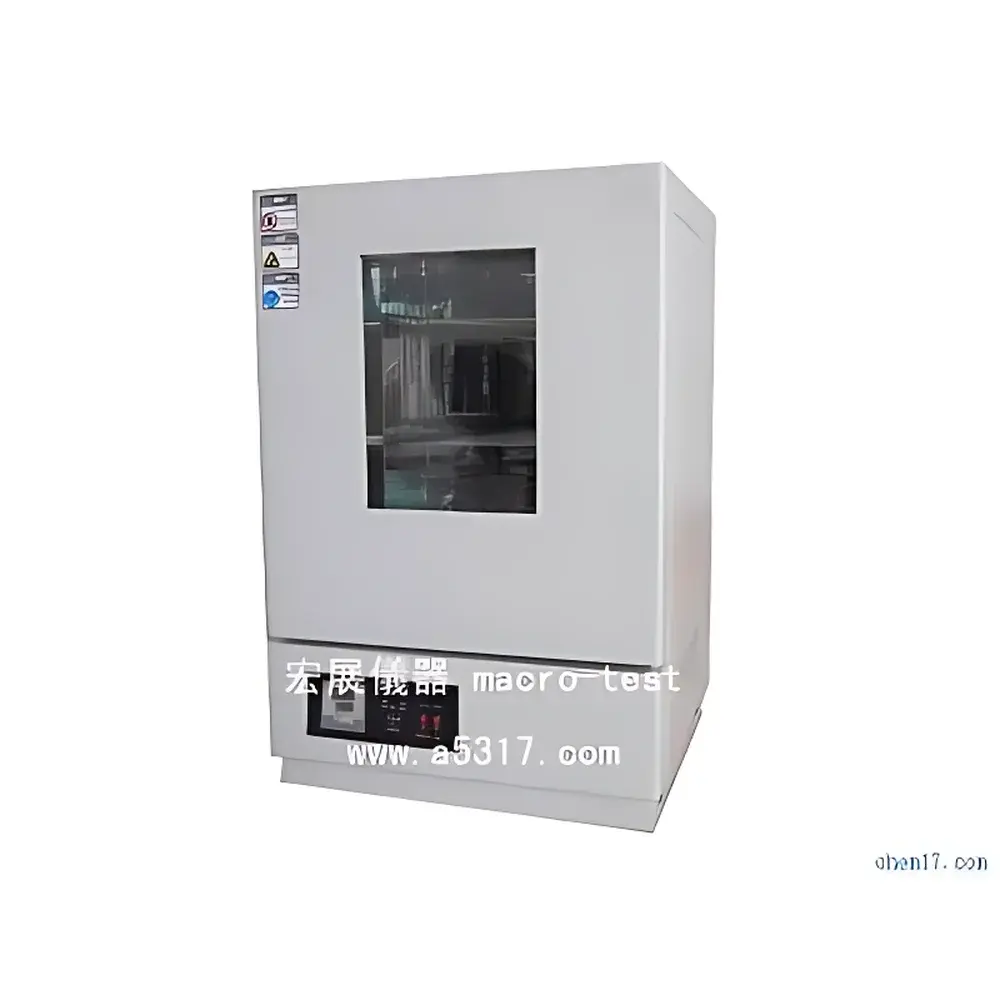
LabCompanion HH-72 Precision Drying Oven
| Brand | LabCompanion |
|---|---|
| Model | HH-72 |
| Type | Forced-Air Constant-Temperature Drying Oven |
| Temperature Range | Ambient +5°C to 300°C |
| Temperature Stability | ±1°C |
| Temperature Uniformity | ±1.5°C (at 100°C, steady state) |
| Internal Chamber Dimensions (W×H×D) | 450 × 400 × 400 mm |
| External Dimensions (W×H×D) | 610 × 905 × 575 mm |
| Interior Material | Mirror-Finish Stainless Steel (SUS304) |
| Exterior Material | Powder-Coated Cold-Rolled Steel |
| Insulation | High-Density Compressed Glass Wool (≥80 mm thickness) |
| Heating System | Finned Tubular Heaters with Aluminum Heat Sinks |
| Air Circulation | Adjustable-Speed Centrifugal Blower + Optimized Baffle-Style Airflow Ducts |
| Control System | Microprocessor-Based PID Temperature Controller with Dual-Line LED Display (Setpoint & Actual Temp), Auto-Tuning Function, Timer with Audible Alarm |
| Safety Protections | Bimetallic Liquid-Expansion Over-Temperature Cut-Off, Dual-Stage Over-Temp Protection (Alarm + Power Cut-off), MCCB Circuit Breaker, Ceramic Fuse, Non-Fuse Switch |
| Power Supply | 3-phase 380 VAC ±10% / 50 Hz or Single-Phase 220 VAC ±10% / 50 Hz |
| Standard Accessories | 2–6 Adjustable Stainless Steel Shelves |
| Optional | Programmable Controller (RS485 Modbus RTU), Data Logging Module, Ethernet Interface, GLP/GMP Audit Trail Firmware |
Overview
The LabCompanion HH-72 Precision Drying Oven is an engineered-for-reliability forced-air thermal processing system designed for controlled drying, baking, sterilization, moisture removal, and aging applications in R&D laboratories, quality control environments, and production support settings. It operates on the principle of convective heat transfer via a dynamically balanced, high-efficiency air circulation system—ensuring rapid thermal response and minimal spatial gradient across the working chamber. The oven’s architecture complies with fundamental thermal safety and operational integrity requirements defined in IEC 61010-1 (Safety Requirements for Electrical Equipment for Measurement, Control, and Laboratory Use) and aligns with general good laboratory practice (GLP) expectations for temperature-critical non-destructive processing. Its calibrated temperature range—from ambient +5°C up to 300°C—supports a broad spectrum of material conditioning protocols used in electronics manufacturing (e.g., PCB pre-baking, LED/LCD component stabilization), pharmaceutical excipient drying, polymer curing validation, and ceramic sintering pre-treatment.
Key Features
- Microprocessor-based PID temperature controller with auto-tuning capability, dual-line LED display showing both setpoint and real-time chamber temperature, and intuitive up/down key parameter entry.
- Liquid-expansion mechanical over-temperature cut-off device—providing independent, fail-safe thermal protection beyond electronic control logic.
- Dual-stage over-temperature safeguard: first-stage audible alarm at user-defined threshold; second-stage automatic power disconnection if temperature exceeds preset limit by ≥5°C.
- High-density compressed glass wool insulation (≥80 mm thick) minimizes thermal loss and improves energy efficiency while maintaining surface temperatures within Class II safety limits per IEC 61010-1.
- Optimized forced-air circulation system featuring a variable-speed centrifugal blower and baffle-guided airflow ducts—achieving ≤±1.5°C temperature uniformity across the full working volume at 100°C (per ISO 17025-referenced verification methodology).
- Modular vertical assembly design ensures structural rigidity, reduces footprint (610 × 575 mm base), and facilitates maintenance access to heating elements, blower, and control panel.
Sample Compatibility & Compliance
The HH-72 is intended exclusively for non-explosive, non-volatile, and non-corrosive samples. It is routinely deployed in semiconductor packaging lines for wafer-level moisture desorption prior to encapsulation, in medical device manufacturing for ethylene oxide residue removal validation, and in academic materials science labs for controlled dehydration of hydrogels and thin-film precursors. All internal wetted surfaces are constructed from mirror-finish SUS304 stainless steel—resistant to oxidation and compatible with mild aqueous cleaning agents under routine GLP sanitation protocols. The unit meets CE marking requirements for electromagnetic compatibility (EMC Directive 2014/30/EU) and low-voltage safety (LVD Directive 2014/35/EU). Optional firmware upgrades support 21 CFR Part 11-compliant electronic signatures and audit trail logging when integrated with LabCompanion’s LMS-Link software suite.
Software & Data Management
While the standard HH-72 operates via standalone microcontroller interface, optional digital enhancements enable seamless integration into networked lab infrastructures. The RS485 Modbus RTU port allows bidirectional communication with SCADA systems or centralized environmental monitoring platforms. When equipped with the programmable controller module, users can define multi-step thermal profiles—including ramp-soak-hold sequences—with timestamped event logging stored locally on SD card or streamed via Ethernet to secure cloud repositories. All recorded temperature data include metadata such as operator ID, batch number, chamber sensor ID, and calibration certificate traceability—supporting ISO/IEC 17025 clause 7.7 (Reporting of Results) and FDA-regulated stability study documentation requirements.
Applications
- Pre-baking of printed circuit boards (PCBs) and IC substrates to eliminate latent moisture before solder reflow (IPC-J-STD-033 compliant protocols).
- Aging tests for passive electronic components (capacitors, resistors, quartz crystals) under accelerated thermal stress conditions (MIL-STD-202G Method 108).
- Drying of lyophilized pharmaceutical intermediates and excipients under GMP-aligned environmental controls.
- Moisture content determination in food-grade polymers and biodegradable packaging films per AOAC 950.46 guidelines.
- Thermal conditioning of calibration standards (e.g., reference thermistors, RTDs) prior to metrological verification.
- Curing support for sol-gel derived optical coatings and MEMS packaging adhesives requiring precise ramp-rate control.
FAQ
What is the maximum permissible load weight per shelf?
Each adjustable stainless steel shelf is rated for 15 kg uniformly distributed load. Total chamber load capacity is limited to 60 kg to maintain airflow integrity and thermal uniformity.
Is NIST-traceable calibration documentation available?
Yes—factory-installed Class A PT100 sensors are supplied with individual calibration certificates traceable to NIST through A2LA-accredited laboratories. On-site recalibration services are offered annually.
Can the HH-72 be operated continuously at 300°C?
Yes, the oven is rated for continuous operation at its maximum temperature. However, prolonged exposure above 250°C may accelerate aging of gasket materials; recommended service interval is reduced to six months under such conditions.
Does the unit comply with UL standards for North American installation?
The HH-72 meets UL 61010-1 requirements when configured with North American power input (220 VAC single-phase) and installed with dedicated 30 A circuit protection. UL listing requires third-party field verification by authorized agents.
How is temperature uniformity verified during qualification?
Per IQ/OQ protocols, nine-point mapping is performed using calibrated handheld thermocouples (±0.2°C accuracy) placed at defined locations per ASTM E2234–22 Annex A1, with results documented in the User Requirement Specification (URS) report.



