
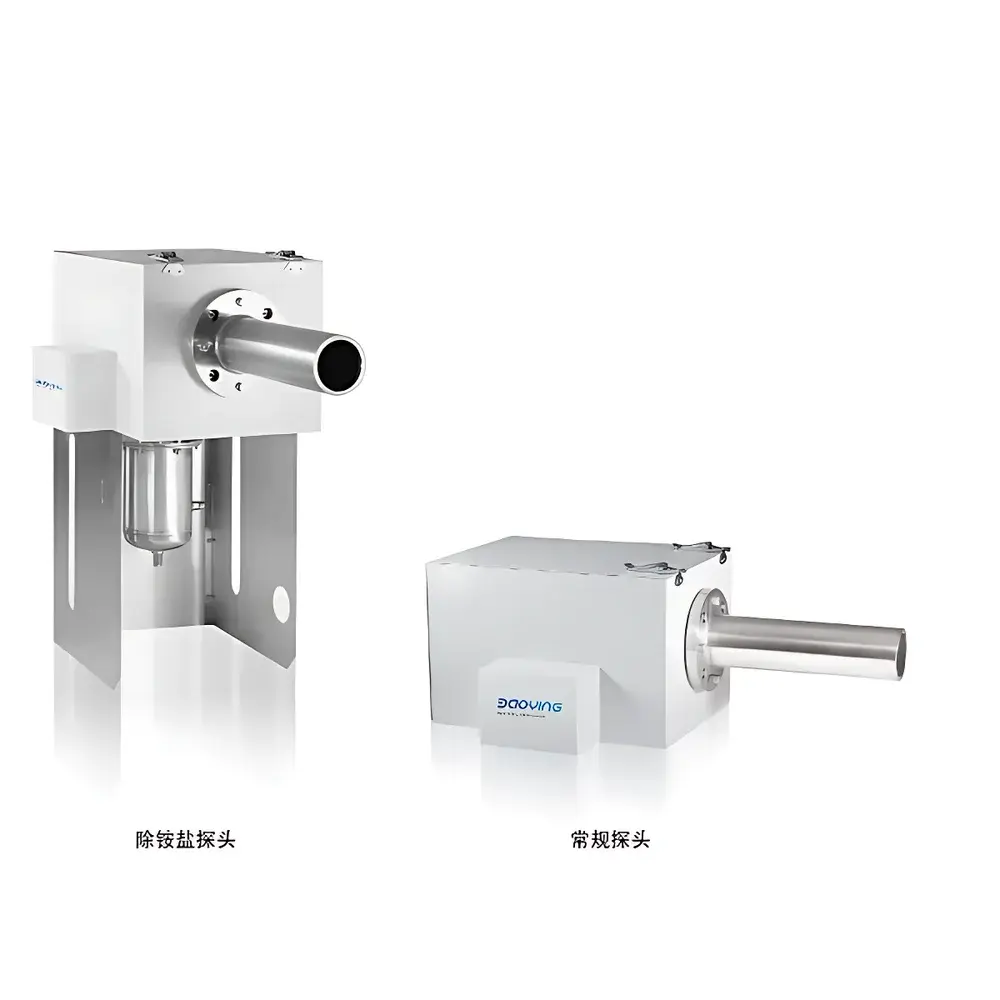
Baoying C800 Ambient-Temperature Industrial Kiln Gas Analysis System
| Brand | Baoying |
|---|---|
| Origin | Shanghai, China |
| Manufacturer Type | OEM Manufacturer |
| Country of Origin | China |
| Model | C800 |
| Price Range | USD 14,000 – 57,000 |
Overview
The Baoying C800 Ambient-Temperature Industrial Kiln Gas Analysis System is an integrated, extractive-type continuous emission monitoring system (CEMS) engineered for real-time, multi-component gas analysis in non-high-temperature industrial process streams. Unlike high-temperature probe-based systems, the C800 is specifically designed for sampling and conditioning gases downstream of primary heat recovery units—such as after electrostatic precipitators, bag filters, or heat exchangers—where flue gas temperatures typically range from 40 °C to 120 °C. It employs a combination of non-dispersive infrared (NDIR), electrochemical (EC), and paramagnetic detection principles to quantify key combustion and pollution-related species—including O₂, CO, NO, NO₂, SO₂, NH₃, CO₂, CH₄, and N₂O—with measurement intervals configurable from 30 seconds to 5 minutes. The system delivers stable, drift-compensated readings under variable dust loading and moisture conditions, making it suitable for long-term unattended operation in demanding cement, iron & steel, non-ferrous metallurgy, and chemical manufacturing environments.
Key Features
- Modular architecture with hot-wet or cold-dry sample conditioning options, including Teflon-lined heated sampling lines (up to 180 °C), particle filtration (≤0.3 µm), and condensate management via membrane dryers or chiller-based dew point control
- Dual-path NDIR cells for CO₂, CH₄, and N₂O with automatic zero/span validation using certified calibration gases (ISO 6141-compliant)
- Electrochemical sensors for CO and NOₓ (NO/NO₂ sum) with cross-sensitivity compensation algorithms validated per EN 15267-3 requirements
- O₂ measurement via paramagnetic detection (not zirconia) for improved linearity and stability in low-O₂ process zones (e.g., kiln precalciner outlets)
- Integrated data acquisition unit supporting Modbus TCP, Profibus DP, and OPC UA protocols for seamless integration into DCS/SCADA systems
- Onboard audit trail logging compliant with ISO 14064-1 and EU Monitoring Methodology (Commission Regulation (EU) No 601/2012) for GHG reporting
Sample Compatibility & Compliance
The C800 accepts sample gas streams with particulate loadings up to 100 mg/m³ (dry basis) and water vapor content up to 15 vol%—conditions commonly encountered downstream of ESPs or fabric filters in cement kiln lines. All wetted materials (sample lines, filters, valves, and sensor chambers) are constructed from 316L stainless steel, PTFE, or FEP to resist corrosion from acidic condensates (e.g., H₂SO₄, HNO₃). The system meets CE marking requirements under Directive 2014/30/EU (EMC) and 2014/35/EU (LVD), and its measurement performance aligns with EN 15267-3 (QAL1 certification readiness) and EPA Method 3A/7E/10 for reference method equivalency. For greenhouse gas reporting, CO₂, CH₄, and N₂O concentrations are automatically converted to CO₂-equivalent (CO₂-eq) using IPCC AR6 global warming potentials (GWP-100), traceable to NIST SRM 1662 and ISO 17025-accredited calibration laboratories.
Software & Data Management
The embedded CEMS Manager software provides full local configuration, diagnostics, and report generation without external PC dependency. It supports automated daily zero/span checks, sensor health monitoring (including EC sensor lifetime estimation), and dynamic range switching (e.g., low-range NO for SCR inlet vs. high-range NOₓ for stack outlet). All measurement data—including raw analog outputs, compensated concentration values, and QA/QC flags—are timestamped with UTC synchronization and stored locally for ≥90 days. Export formats include CSV, XML (per EN 17255-2), and PDF reports compliant with China’s HJ 75-2017 and HJ 76-2017 technical specifications for CEMS. Audit logs record user actions, calibration events, and system faults with immutable timestamps—supporting GLP-aligned operational review and FDA 21 CFR Part 11–compatible electronic signatures when deployed with optional identity authentication modules.
Applications
- Cement production: Real-time O₂/CO/NOₓ profiling across preheater stages to optimize kiln thermal efficiency and clinker quality; NH₃ slip monitoring at SCR/SNCR reactor outlets for reagent dosing control
- Iron & steel sintering plants: CO and dust concentration trending in exhaust ducts of main fans to prevent explosive atmospheres in dedusting systems
- Waste-to-energy and co-processing facilities: CH₄ and N₂O tracking during alternative fuel firing to quantify net GHG impact per ton of clinker
- Chemical synthesis reactors: Multi-point CO and O₂ monitoring for stoichiometric balance verification and safety interlock triggering
- Environmental compliance: Stack emission reporting for SO₂, NOₓ, CO, and total reduced sulfur (TRS) compounds in accordance with local environmental protection bureaus’ data submission mandates
FAQ
What sample gas temperature range is supported by the C800 system?
The C800 is rated for ambient-temperature operation: inlet gas temperature between 40 °C and 120 °C. For higher-temperature applications (>120 °C), optional upstream quench coolers or dilution probes must be specified.
Does the system support simultaneous measurement of NH₃ and NOₓ in SCR applications?
Yes—the C800 integrates dual electrochemical sensors with selective catalytic filtering to resolve NH₃ and NO/NO₂ independently, enabling accurate ammonia slip and deNOₓ efficiency calculation.
How is data integrity ensured during power interruptions or network outages?
All critical measurement and event data are buffered in non-volatile flash memory. Upon recovery, the system auto-resynchronizes timestamps and resumes data transmission without gaps, preserving continuity for regulatory reporting.
Can the C800 be configured for EPA or EU regulatory compliance?
Yes—hardware design and firmware logic comply with EN 15267-3 QAL1 prerequisites and EPA PS-11/PS-4 specifications. Final certification requires on-site performance testing per applicable jurisdictional protocols.
Is remote diagnostics and firmware update capability available?
Standard Ethernet connectivity enables secure remote access via TLS 1.2–encrypted VPN tunnels. Firmware updates are digitally signed and validated prior to installation to ensure system integrity.







