
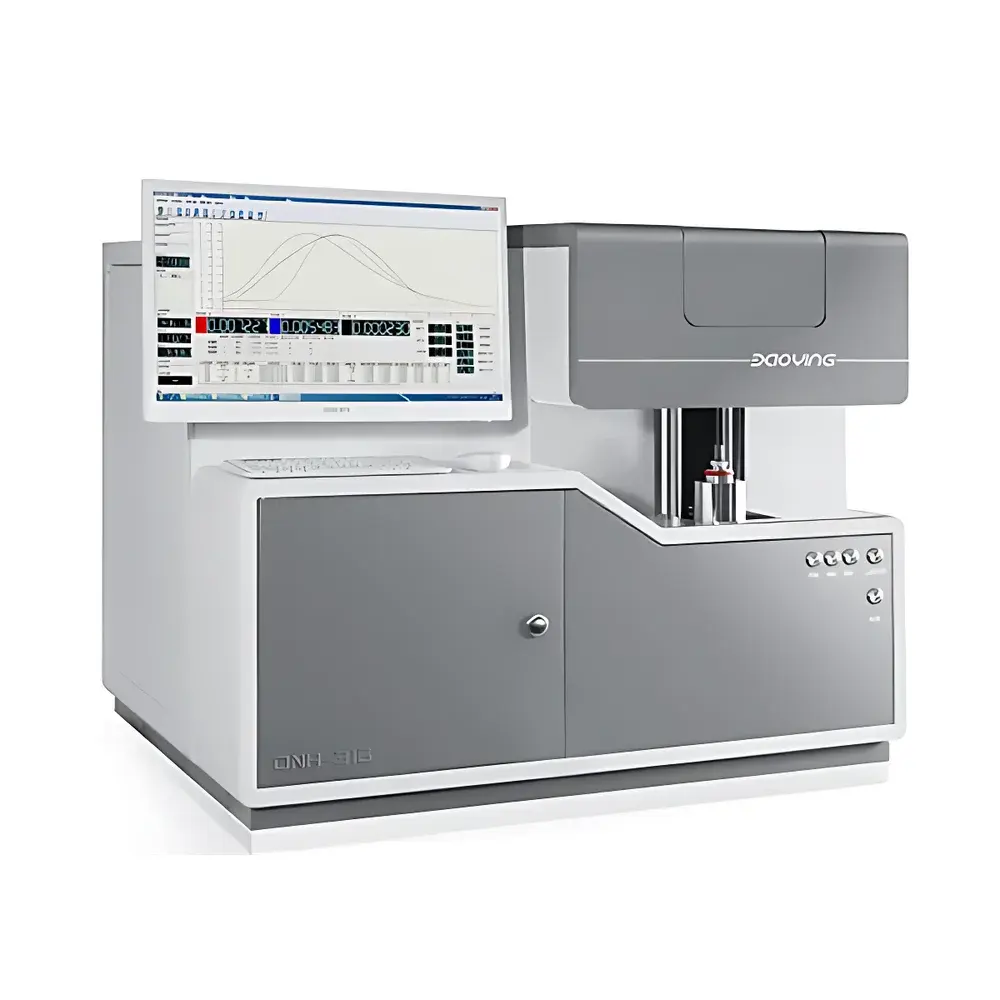
Baoying Ruifeng ONH-316 Oxygen-Nitrogen-Hydrogen Analyzer
| Brand | Baoying |
|---|---|
| Origin | Shanghai, China |
| Manufacturer Type | Direct Manufacturer |
| Instrument Type | Oxygen-Nitrogen-Hydrogen Analyzer |
| Model | ONH-316 |
| Detection Principle | Inert Gas Fusion Coupled with Non-Dispersive Infrared (NDIR) and Thermal Conductivity Detection (TCD) |
| Oxygen Range | High-O: 0.5–20 wt% |
| Low-O | 0.1–5000 ppm |
| Nitrogen Range | High-N: 0.5–50 wt% |
| Low-N | 0.1–5000 ppm |
| Hydrogen Range | 0.1–5000 ppm |
| Precision | O/N: ±1 ppm or RSD ≤ 1% |
| H | ±0.2 ppm or RSD ≤ 2% |
| Sensitivity | 0.01 ppm |
| Analysis Time | O: 120–180 s |
| N | 120–240 s |
| H | 120–180 s |
| Pulse Furnace Power | 8.0 kW |
| Detector Configuration | Dual-channel NDIR for O/C (CO), Single-channel TCD for H₂ and N₂ |
| Gas Handling | EPC-controlled pneumatic architecture with independent electronic pressure control (EPC) per gas path |
| Calibration Options | Single-point, multi-point, and slope/intercept correction |
| Software Compliance | Audit trail, user-level access control, data export in CSV/Excel, optional 21 CFR Part 11 compliance module |
| Structural Design | Integrated monolithic chassis housing furnace, gas analysis module, electronics, and industrial-grade embedded PC |
Overview
The Baoying Ruifeng ONH-316 Oxygen-Nitrogen-Hydrogen Analyzer is a high-precision inert gas fusion elemental analyzer engineered for quantitative determination of interstitial oxygen, nitrogen, and hydrogen in metallic and non-metallic solid materials—including steels, superalloys, titanium alloys, ceramics, and refractory compounds. Its core measurement principle relies on high-temperature inert gas fusion (helium or argon), where the sample is thermally decomposed in a graphite crucible under controlled atmosphere. Oxygen is converted to carbon monoxide (CO), nitrogen is liberated as molecular N₂, and hydrogen is released as H₂. These gaseous species are then swept through a fully integrated gas handling system into dedicated detection modules: non-dispersive infrared (NDIR) cells optimized for CO quantification, and a high-stability thermal conductivity detector (TCD) for simultaneous N₂ and H₂ measurement. The instrument’s design emphasizes metrological integrity—achieving sub-ppm sensitivity and long-term baseline stability through patented solid-state infrared source architecture, active thermal isolation of optical cells, and real-time electronic pressure compensation (EPC) across all gas pathways.
Key Features
- Patented solid-state pulsed infrared source with microcrystalline emitter technology—eliminates mechanical choppers, reduces signal drift, and improves signal-to-noise ratio by >40% versus conventional modulated sources.
- Multi-chamber adaptive detection module with independent thermostatic control (±0.1°C) for each NDIR cell—ensures immunity to ambient temperature fluctuations and enables stable calibration over extended operational cycles.
- 8.0 kW high-efficiency electrode pulse furnace with proprietary alloy electrodes exhibiting superior red hardness (>1800°C) and electrical conductivity—enabling complete melt homogenization of refractory samples without electrode degradation.
- Fully EPC-regulated gas circuitry: each analytical gas stream (carrier, purge, reference) features dedicated electronic pressure controllers—minimizing flow variability caused by atmospheric pressure shifts or cylinder depletion.
- Integrated automatic leak-check routine executed prior to every analysis cycle—validates system integrity against ISO 17025-recommended pre-run verification protocols.
- Modular DTU (Diagnostic & Troubleshooting Unit) interface—supports secure remote firmware diagnostics, parameter logging, and predictive maintenance alerts via encrypted Ethernet connection.
Sample Compatibility & Compliance
The ONH-316 accommodates solid samples up to 1.0 g (adjustable based on matrix and target element concentration), including castings, powders, chips, and wire segments. It complies with ASTM E1019 (Standard Test Methods for Determination of Carbon, Sulfur, Nitrogen, and Oxygen in Steel, Iron, Nickel, and Cobalt Alloys), ISO 14284 (Steel and Iron — Sampling and Preparation of Samples for Determination of Chemical Composition), and JIS G 1211 (Method for Determination of Oxygen, Nitrogen and Hydrogen in Steel). Optional GLP/GMP configuration includes full 21 CFR Part 11 compliance—featuring electronic signatures, immutable audit trails, role-based user authentication, and data encryption at rest and in transit. All wetted gas path components utilize passivated stainless steel to prevent catalytic surface reactions and adsorption artifacts—critical for ultra-trace hydrogen quantification.
Software & Data Management
The embedded industrial PC runs Baoying Analytical Suite v4.2—a deterministic real-time operating environment supporting synchronized acquisition of analog detector outputs, furnace temperature profiles, pressure transients, and gas flow rates. Analytical results display raw chromatographic traces, calibrated peak integrals, and statistical summaries (RSD, confidence intervals). Calibration routines support linear, quadratic, and multi-point bracketed modes—with automated memory retention of calibration history and drift compensation algorithms. Data export conforms to LIMS-ready formats (CSV, XML, ASTM E1382-compliant ASCII), and optional OPC UA server integration enables direct linkage to enterprise MES or SAP QM modules. All user actions—including method edits, calibration updates, and result approvals—are time-stamped and logged with operator ID and IP address.
Applications
The ONH-316 serves critical quality assurance functions across aerospace (titanium alloy cleanliness verification), nuclear (zirconium cladding hydrogen embrittlement screening), automotive (high-strength steel interstitial control), and additive manufacturing (powder feedstock purity certification). It is routinely deployed for failure analysis investigations involving hydrogen-induced cracking (HIC), nitrogen-related porosity in welds, and oxygen-induced oxide inclusion formation in bearing steels. Laboratories accredited to ISO/IEC 17025 utilize its traceable calibration hierarchy—supported by NIST-traceable CRM standards for O, N, and H—to meet contractual reporting requirements for material certifications under AS9100 or EN 10204 3.1 documentation.
FAQ
What carrier gases are compatible with the ONH-316?
Helium and argon are supported; helium is recommended for optimal H₂ and N₂ resolution due to higher thermal conductivity differential versus background gas.
Can the instrument analyze coated or surface-treated samples?
Yes—provided the coating mass does not exceed 5% of total sample weight and is chemically inert under fusion conditions; surface contamination must be removed prior to analysis per ASTM E1019 Section 7.2.
Is external cooling water required for the pulse furnace?
No—the integrated vapor-phase heat exchange system operates air-cooled; optional recirculating chiller support is available for continuous high-throughput operation (>50 samples/day).
How frequently must the graphite crucibles be replaced?
Typical service life exceeds 300 analyses for steel matrices; crucible wear is monitored automatically via impedance tracking during each fusion cycle.
Does the system support method transfer from legacy ONH platforms?
Yes—analytical methods, calibration curves, and QC templates from ONH-200/300 series instruments are backward-compatible via import wizard and auto-mapping engine.







