
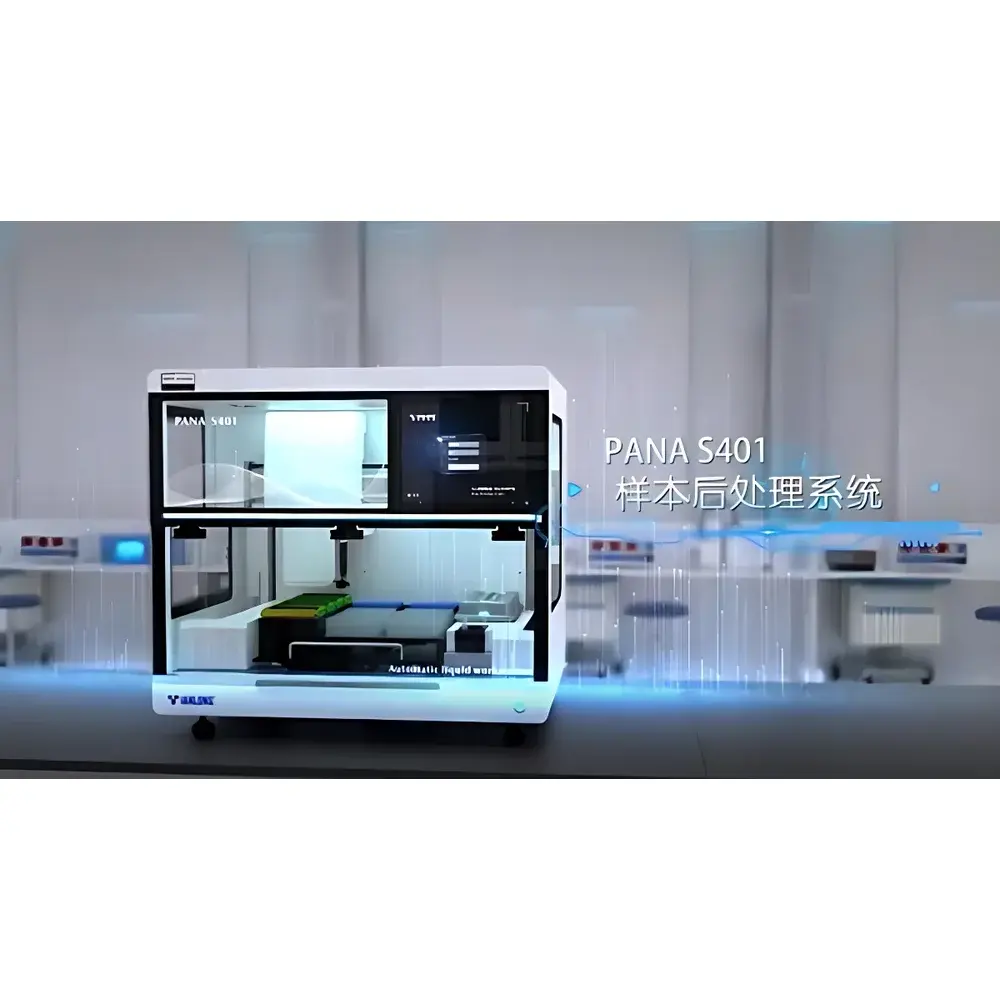
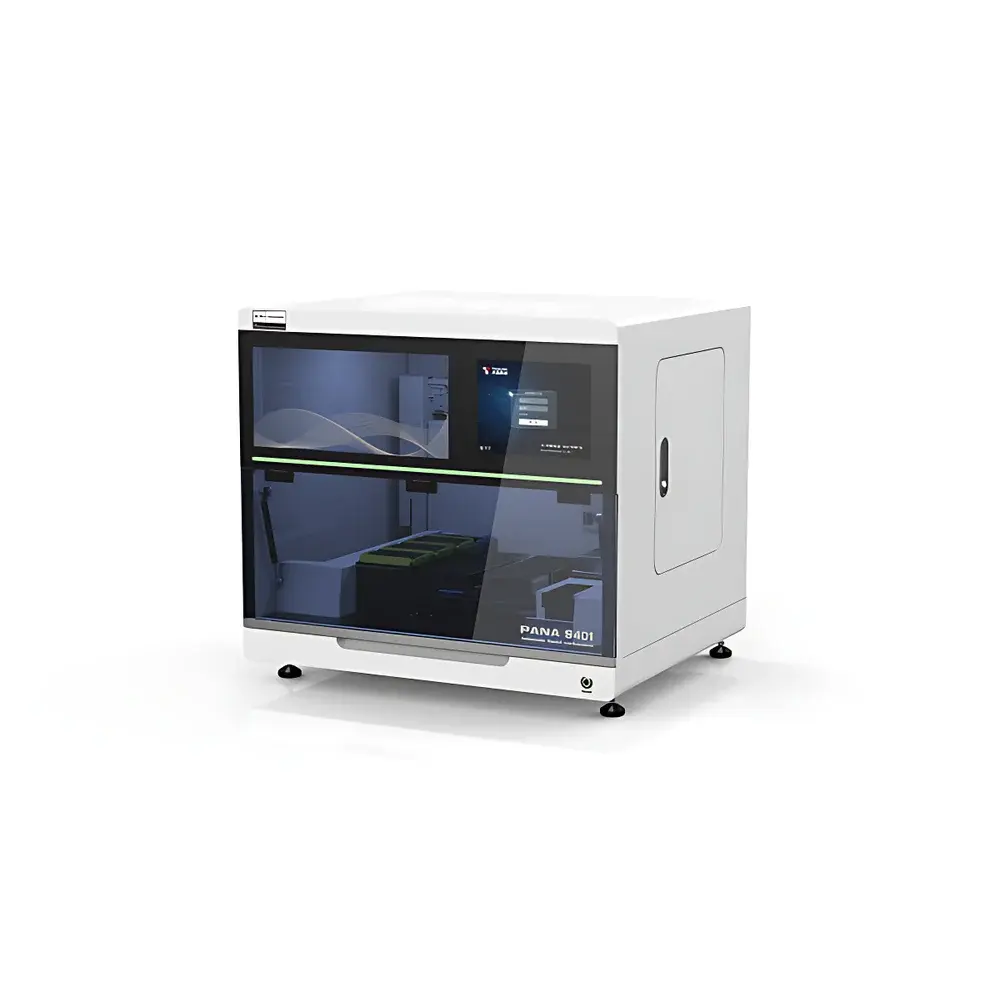
TIANLONG PANA S401 Liquid Handling Workstation for Automated PCR Setup
| Brand | TIANLONG |
|---|---|
| Origin | Shaanxi, China |
| Manufacturer Type | Original Equipment Manufacturer (OEM) |
| Model | PANA S401 |
| Pipetting Range | 5–1000 µL |
| Accuracy (Er) | ≤2.0% (≤15 µL), ≤1.5% (15–50 µL), ≤1.0% (>50 µL) |
| Precision (CV) | ≤3.0% (≤15 µL), ≤1.5% (15–50 µL), ≤1.2% (>50 µL) |
| Sample Throughput | 1–96 samples per run |
| Dimensions | 860 mm (L) × 733 mm (W) × 746.5 mm (H) |
| Operating System | Windows 10 Pro (bilingual Chinese/English UI) |
| Liquid Level Detection | Pressure-sensing with real-time adaptive aspiration/dispense |
| Contamination Control | HEPA-filtered directional airflow, internal negative pressure, capacitive droplet detection, UV sterilization chamber, disposable waste cartridge, external liquid trap, customizable exhaust interface |
| Compatible Vessels | SBS-standard deep-well plates, 96-well PCR plates, 0.1 mL & 0.2 mL strip tubes |
| Interface | USB, RS232 |
| Power | AC 220 V, 50 Hz |
| Weight | 103 kg |
| Ambient Conditions | 15–35 °C, 35–70% RH |
Overview
The TIANLONG PANA S401 Liquid Handling Workstation is an integrated, benchtop automation platform engineered for high-fidelity, high-throughput nucleic acid testing workflows—specifically optimized for automated PCR reaction setup. Based on positive-displacement pipetting with pressure-sensing liquid level detection, the system delivers precise, reproducible reagent dispensing and sample transfer across variable volumes (5–1000 µL) without cross-contamination risk. Its modular architecture enables seamless integration into end-to-end molecular diagnostic pipelines: upstream with automated nucleic acid extraction systems (e.g., TIANLONG NP series), and downstream with real-time fluorescence PCR instruments (e.g., TIANLONG SLAN series). Unlike closed-platform liquid handlers, the PANA S401 operates as an open reagent system—supporting third-party master mixes, enzymes, probes, and consumables compliant with SBS footprint standards. This design preserves laboratory autonomy while enforcing standardized, audit-ready execution of assay protocols.
Key Features
- Four independent, high-precision pipetting channels with dual-tip compatibility (5–50 µL and 50–1000 µL ranges), enabling parallel processing of multiple assay configurations.
- Scalable throughput architecture: standard 96-sample configuration expandable to 768 samples via multi-deck staging and sequential plate handling—achieving full 96-well PCR master mix preparation in under 10 minutes.
- Integrated contamination mitigation suite: HEPA-filtered unidirectional airflow, dynamically regulated internal negative pressure (−10 to −20 Pa), capacitive/voltage-based drip detection, onboard 254 nm UV-C sterilization cycle (≥30 min exposure), single-use waste cartridge, and optional external aerosol capture module.
- Adaptive liquid level sensing: real-time pressure feedback adjusts aspiration depth during reagent draw, compensating for meniscus variance, viscosity shifts, and tip wear—critical for low-volume (<15 µL) master mix preparation.
- Bilingual Windows 10 Pro HMI with intuitive workflow builder: drag-and-drop protocol editor, version-controlled method storage, electronic signature support, and configurable audit trail logging aligned with GLP/GMP documentation requirements.
Sample Compatibility & Compliance
The PANA S401 accommodates standard SBS-format labware including 96-well deep-well plates (0.5–2.2 mL), skirted and semi-skirted 96-well PCR plates, 0.1 mL and 0.2 mL 8-strip tubes, and custom tube racks. All liquid handling operations comply with ISO 8655-6 (gravimetric verification of piston pipettes) and CLSI EP15-A3 guidelines for precision and accuracy assessment. The system supports traceable calibration using certified reference standards (NIST-traceable weights and volumetric flasks). Its software architecture includes user role management (admin/operator/auditor), password-protected method editing, and immutable event logs—including timestamped records of pipette calibration, UV cycle activation, waste cartridge replacement, and protocol execution—enabling compliance with FDA 21 CFR Part 11 and ISO/IEC 17025 requirements for accredited testing laboratories.
Software & Data Management
The embedded control software provides a validated, standalone environment for protocol development, validation, and deployment. Users define multi-step workflows—including reagent pre-aliquoting, template addition, internal control spiking, and plate sealing confirmation—with conditional logic (e.g., “if volume < 10 µL, pause 0.5 s before dispense”). All methods are stored with metadata (author, date, revision number, instrument ID) and exportable in CSV or XML format. Audit trails record every operator action, system event, and environmental parameter (temperature/humidity from onboard sensors). Data integrity is enforced via SHA-256 hashing of method files and digital signatures tied to Windows Active Directory credentials. Raw log files are archived in encrypted ZIP containers with automatic daily backup to network drives or NAS devices.
Applications
- High-volume diagnostic PCR setup for infectious disease testing (e.g., SARS-CoV-2, influenza A/B, RSV, HPV genotyping).
- Pre-analytical standardization in clinical research studies requiring batched sample processing across multiple gene targets.
- Automated master mix preparation for qPCR-based expression profiling, SNP genotyping, and methylation analysis.
- Quality control workflows: serial dilution series generation, calibrator curve setup, and inter-laboratory proficiency testing sample distribution.
- Biobanking applications: aliquoting extracted nucleic acids into long-term storage formats with minimal freeze-thaw cycles.
FAQ
What regulatory standards does the PANA S401 support for clinical diagnostics?
The system meets ISO 13485 design control requirements for IVD instrumentation and supports implementation of quality management systems compliant with CAP, CLIA, and CNAS accreditation criteria. Software features—including electronic signatures, audit trails, and method versioning—are validated for use in environments governed by FDA 21 CFR Part 11.
Can the PANA S401 be integrated with LIMS or hospital information systems?
Yes—via RS232 or USB-to-serial emulation, the workstation accepts ASCII command sets for remote job initiation and status polling. Custom API wrappers (Python/C#) are available under NDA for HL7/FHIR-compliant middleware integration.
How is pipetting accuracy verified and maintained over time?
Accuracy is verified gravimetrically per ISO 8655-6 using Class E1 weights and calibrated balances. The system includes built-in calibration routines for tip ejection force, vertical positioning, and pressure sensor zeroing—all documented in the instrument’s calibration log.
Does the workstation require dedicated exhaust ducting?
No—standard operation uses recirculated HEPA-filtered air. Optional external exhaust kits (with static pressure compensation) are available for BSL-2+ environments or volatile reagent handling.
What maintenance intervals are recommended?
Daily: UV chamber wipe-down and waste cartridge replacement. Quarterly: Tip carriage lubrication, HEPA filter inspection, and pressure sensor recalibration. Annual: Full mechanical alignment and firmware validation against release notes.



