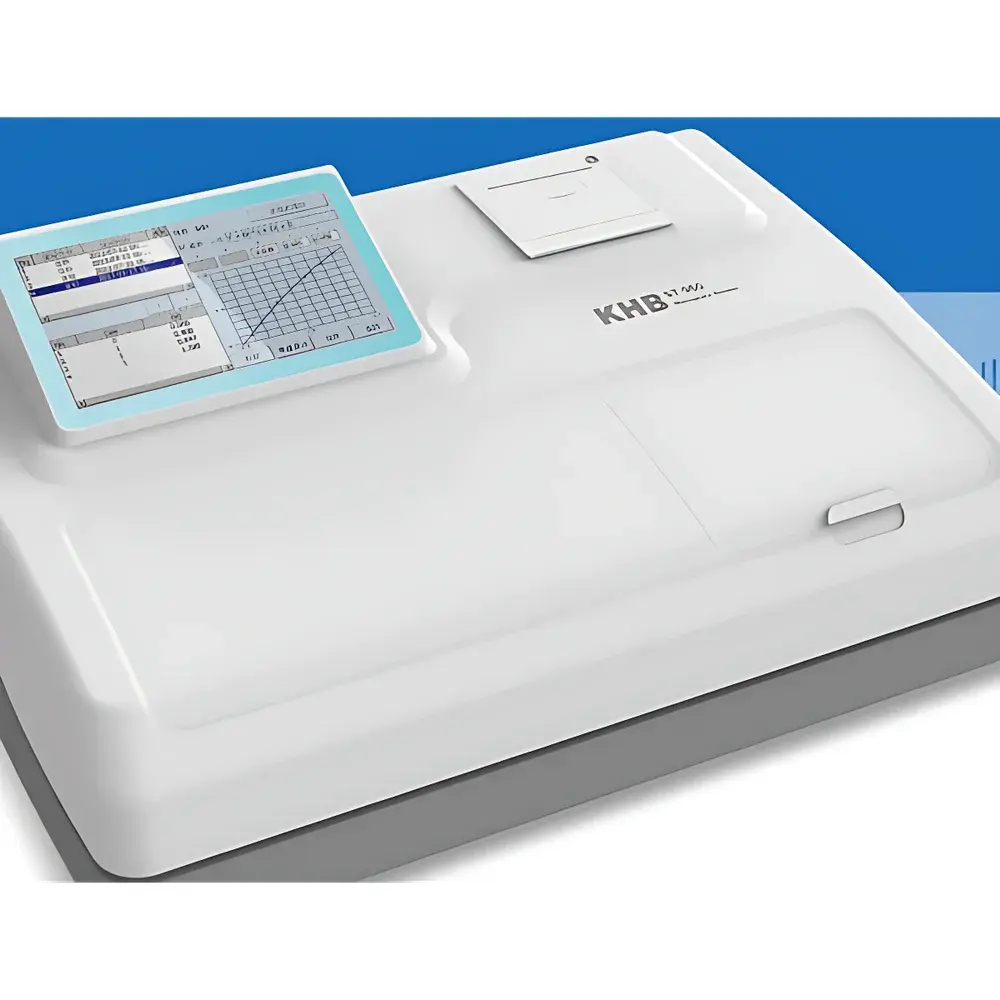
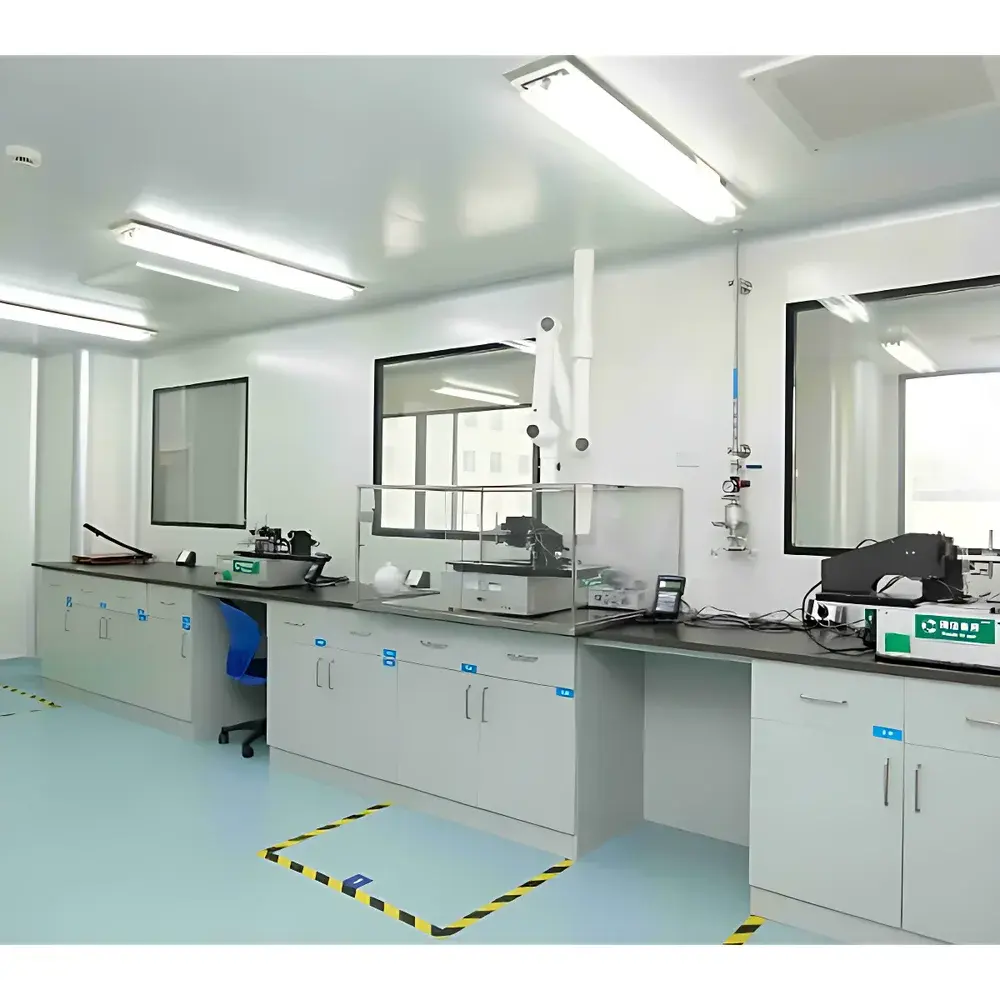

Kehua Biosciences ST-960 Microplate Reader
| Brand | Kehua Biosciences (KHB) |
|---|---|
| Origin | Shanghai, China |
| Model | ST-960 |
| Detection Method | Absorbance (Photometric) |
| Function Type | Multifunctional |
| Automation Level | Fully Automatic |
| Measurement Modes | Absorbance, Factor Calculation, Standard Concentration, Standard Curve, Single-Threshold, Dual-Threshold, Categorical Classification, Column Subtraction, Point-to-Point |
| Optical System | 8-Channel High-Precision Fiber Optic Path |
| Wavelength Range | 400–1000 nm |
| Absorbance Range | 0.000–4.500 Abs |
| Linearity Range | 0.000–3.000 Abs |
| Wavelength Accuracy | ±5 nm (at center wavelength) |
| Detection Speed | <5 seconds per 96-well plate (single or dual wavelength) |
| Resolution | 0.001 Abs |
| Light Source | Long-Life LED Cold Light Source |
| Display | 7-inch True-Color Touchscreen (840 × 480 resolution) |
| Filter Positions | 8 positions |
| Data Storage | Internal high-capacity memory |
Overview
The Kehua Biosciences ST-960 Microplate Reader is a fully automated, absorbance-based photometric instrument engineered for precision and reproducibility in life science laboratories conducting routine ELISA, cell viability, cytotoxicity, enzyme kinetics, and protein quantification assays. Built upon an 8-channel fiber-optic optical architecture, the ST-960 delivers rapid, parallel detection across all wells of a 96-well microplate—enabling high-throughput screening while maintaining strict photometric integrity. Its LED cold light source ensures thermal stability and long-term spectral consistency, eliminating lamp drift commonly observed with halogen sources. The system operates across a broad spectral range (400–1000 nm), supporting common chromogenic substrates such as TMB (450 nm), pNPP (405 nm), and ABTS (405/625 nm), and accommodates both single- and dual-wavelength measurements to correct for background interference or turbidity. Designed for integration into regulated environments, the ST-960 supports audit-ready data capture and complies with fundamental requirements for laboratory instrumentation used in GLP and GMP-aligned workflows.
Key Features
- Fully automatic operation with embedded computing system—no external PC required for basic assay execution or result calculation.
- 8-channel fiber-optic detection path ensuring uniform illumination and signal acquisition across all wells, minimizing inter-channel variability.
- True-color 7-inch touchscreen interface (840 × 480 resolution) with intuitive navigation, real-time graphing, and on-device protocol editing.
- Five standard interference filters (405, 450, 490, 545, 625 nm) installed in an 8-position filter wheel; additional filters can be user-installed within the 400–1000 nm range.
- High-speed readout: completes full 96-well plate measurement in under 5 seconds for both single- and dual-wavelength protocols.
- Extended dynamic range: linear response from 0.000 to 3.000 Abs, with measurable absorbance up to 4.500 Abs—supporting highly concentrated samples without manual dilution.
- Resolution of 0.001 Abs enables precise discrimination between low-signal biological endpoints, critical for low-abundance antigen detection.
Sample Compatibility & Compliance
The ST-960 is compatible with standard ANSI/SLAS-format 96-well microplates—including flat-bottom, U-bottom, and V-bottom configurations—as well as opaque and clear polystyrene, polypropylene, and quartz plates. It supports common assay formats including endpoint, kinetic, and wavelength-scan modes (via sequential filter selection). While not certified to ISO/IEC 17025 or FDA 21 CFR Part 11 out-of-the-box, its internal data logging, timestamped results, and user-accessible calibration logs provide foundational traceability required for internal quality control, ISO 9001-aligned processes, and preclinical research documentation. The instrument meets CE marking requirements for laboratory equipment (2014/30/EU EMC Directive and 2014/35/EU LVD Directive) and conforms to IEC 61010-1 safety standards for electrical equipment used in laboratory environments.
Software & Data Management
The ST-960 runs proprietary firmware with integrated assay management software, enabling on-device creation and storage of custom protocols—including multi-step calculations (e.g., standard curve fitting using 4-parameter logistic regression), threshold-based classification, column-wise normalization, and point-to-point delta analysis. All raw absorbance values, processed results, and metadata (operator ID, date/time stamp, filter used, plate layout) are stored internally with no dependency on external software. Data export is supported via USB 2.0 port in CSV and PDF report formats—compatible with LIMS integration through manual import or third-party middleware. Audit trail functionality includes operator login tracking and immutable result history, supporting compliance with GLP principles and internal QA/QC documentation standards.
Applications
- Enzyme-Linked Immunosorbent Assay (ELISA) for infectious disease serology, cytokine profiling, and therapeutic antibody titer determination.
- Cell-based assays including MTT, XTT, and WST-1 for proliferation and cytotoxicity assessment.
- Protein quantification via Bradford, Lowry, or BCA methods.
- Enzyme activity monitoring (e.g., LDH, ALP, HRP) using chromogenic substrates.
- Microbial growth kinetics and antimicrobial susceptibility testing (AST) in 96-well format.
- Quality control of reagents, standards, and conjugates in diagnostic kit manufacturing environments.
FAQ
Does the ST-960 support kinetic measurements?
Yes—the instrument supports time-resolved absorbance readings at user-defined intervals, enabling real-time monitoring of enzymatic reactions or cell metabolic activity.
Can I install custom filter sets beyond the standard five?
Yes—three additional filter positions are available for user-supplied interference filters spanning 400–1000 nm, provided they conform to standard 12.5 mm diameter and 3.5 mm thickness specifications.
Is remote control or network connectivity supported?
No native Ethernet or Wi-Fi interface is included; however, exported CSV files can be transferred via USB for centralized analysis in Excel, GraphPad Prism, or laboratory information management systems (LIMS).
What calibration procedures are recommended?
Kehua recommends daily verification using neutral density filters or NIST-traceable absorbance standards (e.g., potassium dichromate solutions); full optical alignment service is advised annually or after physical relocation.
Does the ST-960 comply with FDA 21 CFR Part 11?
The device does not include electronic signature capability or role-based access control required for full Part 11 compliance; it is intended for use in non-GxP research or as a secondary instrument in validated workflows where data are subsequently reviewed and signed off in compliant software.