
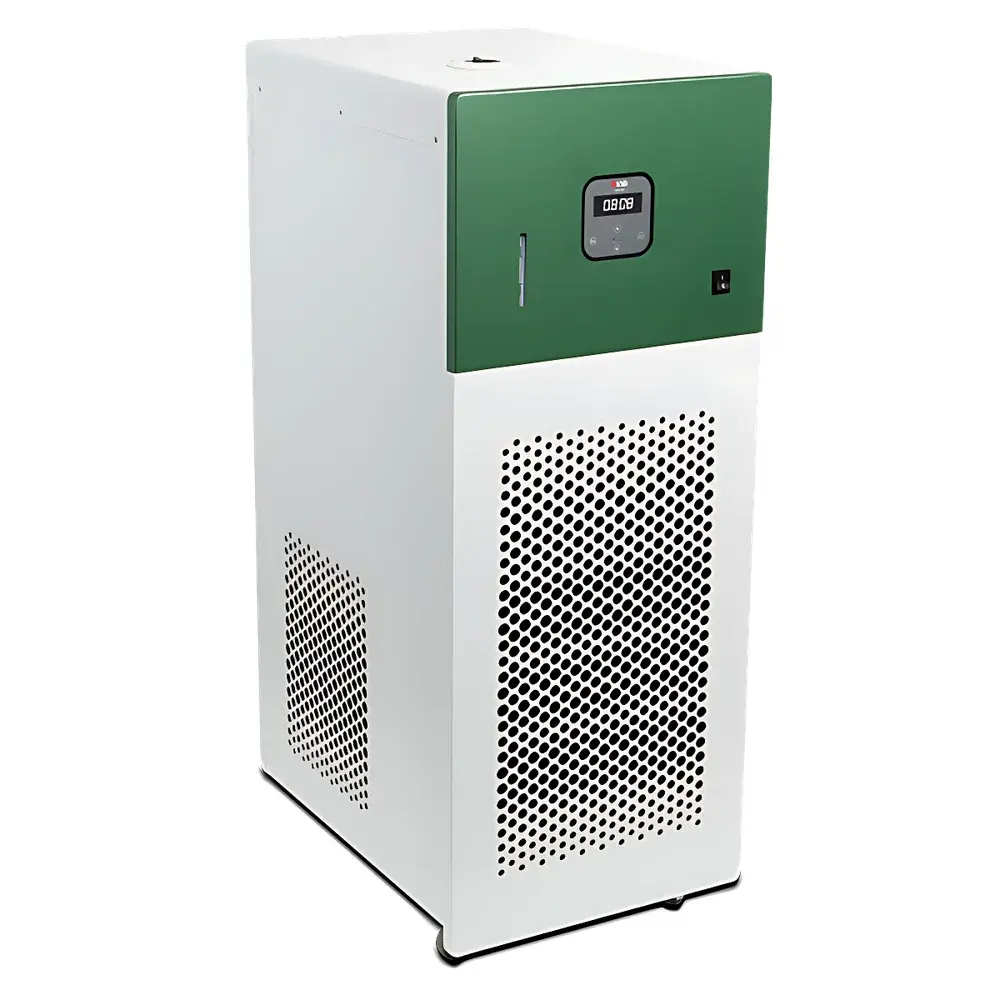
DLAB DCP-20 Benchtop Low-Temperature Circulating Chiller
| Brand | DLAB |
|---|---|
| Origin | Beijing, China |
| Manufacturer Type | Direct Manufacturer |
| Product Type | Integrated Circulating Chiller |
| Cooling Method | Water-Cooled |
| Temperature Range | −20 °C to Ambient |
| Temperature Stability | ±0.5 °C |
| Circulation Pump Pressure | 1.0 bar |
| Circulation Flow Rate | 22 L/min |
| Reservoir Volume | 20 L |
| Display | LED with 0.1 °C Resolution |
| Temperature Sensor | PT100 |
| Refrigerant | R404a |
| Refrigeration Capacity @ 20 °C | 3200 W |
| Power Supply | 100–120 V / 200–240 V, 50/60 Hz |
| Max. Power Consumption | 1500 W |
| Max. Current | 7.5 A |
| Dimensions (W×D×H) | 450 × 600 × 1100 mm |
| Weight | Approx. 98 kg |
| Operating Environment | 5–40 °C, ≤80% RH |
| Inlet/Outlet Port ID | 10 mm |
| Enclosure Type | Floor-Standing |
| Continuous Operation | Yes |
Overview
The DLAB DCP-20 is an integrated low-temperature circulating chiller engineered for precision thermal management in demanding laboratory and industrial environments. It operates on a closed-loop refrigeration cycle using R404a—a non-toxic, ozone-friendly refrigerant approved under current EPA SNAP and EU F-Gas regulations—and delivers stable cooling from −20 °C up to ambient temperature. The unit employs proportional refrigeration control, dynamically modulating compressor output in response to real-time thermal load and setpoint deviation. This architecture ensures energy-efficient operation without sacrificing response speed or temperature fidelity. Unlike air-cooled chillers, the DCP-20 utilizes water-cooled condensation, enabling consistent performance in confined or heat-sensitive spaces—such as fume hoods, cleanrooms, or shared instrument racks—where ambient air circulation is restricted. Its compact floor-standing footprint (450 × 600 × 1100 mm) and top-access reservoir design facilitate integration into space-constrained workflows while maintaining full serviceability.
Key Features
- High-stability PID temperature control with PT100 platinum resistance sensor, delivering ±0.5 °C stability across the full operating range and 0.1 °C display resolution
- Proportional refrigeration system that adjusts compressor power continuously—reducing mechanical wear, minimizing thermal overshoot, and extending service life
- Robust circulation subsystem: 22 L/min flow rate at 1.0 bar maximum pressure, optimized for low-pressure-drop external loops (e.g., rotary evaporators, condensers, spectrometers)
- 20 L insulated stainless-steel reservoir with level indicator, overflow protection, rear drain valve, and top-fill port for rapid coolant replenishment
- Low-noise operation (<62 dB(A) at 1 m), suitable for open-lab environments and adjacent analytical workspaces
- Front-panel filter access and tool-free front panel removal simplify routine maintenance and particulate filtration servicing
- Thermal insulation layer minimizes parasitic heat ingress, improving energy efficiency and reducing compressor cycling frequency
- Integrated thermal overload and dry-run protection safeguards pump and refrigeration circuit during abnormal operating conditions
Sample Compatibility & Compliance
The DCP-20 is designed to interface with standard laboratory equipment requiring liquid-based thermal regulation—including rotary evaporators (e.g., Buchi R-300, IKA RV 10), jacketed reactors, cold traps, FTIR and UV-Vis spectrometer Peltier coolers, and HPLC column ovens. Its 10 mm internal-diameter fluid ports comply with ISO 8536-4 tubing standards and support common silicone, Viton®, and EPDM-compatible hoses. The chiller meets IEC 61010-1:2010 for electrical safety in laboratory equipment and conforms to EMC Directive 2014/30/EU. While not certified for GMP or FDA 21 CFR Part 11 out-of-the-box, its deterministic temperature logging (via optional RS485/Modbus RTU interface) supports audit-ready data capture when integrated into validated systems adhering to GLP or ISO/IEC 17025 requirements.
Software & Data Management
The DCP-20 features a dedicated embedded controller with LED interface—no external PC required for basic operation. Parameter settings (setpoint, pump enable/disable, alarm thresholds) are stored in non-volatile memory and retained after power loss. For advanced integration, the optional RS485 port enables Modbus RTU communication, allowing remote monitoring and setpoint adjustment via LabVIEW, Python (pySerial), or SCADA platforms. Temperature logs can be timestamped and exported at user-defined intervals (1–60 min), supporting traceability in quality-critical applications. All firmware updates are performed via USB flash drive, ensuring secure, offline validation of control logic revisions.
Applications
- Laboratory instrumentation cooling: Maintains constant bath temperature for rotary evaporation, reflux condensation, and cryogenic sample handling in analytical chemistry labs
- Chemical synthesis: Enables exothermic reaction control in jacketed glass reactors, preventing thermal runaway and improving yield reproducibility
- Pharmaceutical R&D: Supports lyophilization pre-cooling, enzyme kinetics assays at sub-zero temperatures, and cold-chain validation studies
- Materials science: Provides thermal stabilization for XRD sample stages, DSC calibration, and polymer crystallization experiments
- Electronics testing: Cools laser diodes, photodetectors, and RF amplifiers during parametric characterization under controlled thermal bias
FAQ
What is the minimum ambient temperature required for reliable operation?
The DCP-20 is rated for continuous operation between 5 °C and 40 °C ambient. Below 5 °C, condensate formation and oil viscosity changes may impair compressor lubrication and refrigerant return.
Can the chiller operate with ethylene glycol/water mixtures?
Yes—up to 30% v/v ethylene glycol is compatible; higher concentrations reduce heat capacity and increase viscosity, requiring flow rate derating and periodic pump inspection.
Is remote start/stop supported via digital I/O?
Not natively; however, the RS485 Modbus interface supports discrete command registers for pump and refrigeration enable/disable functions when integrated with programmable logic controllers.
How often should the circulation filter be cleaned?
Under normal use with deionized water or inhibited coolant, inspect and clean the inlet filter every 3 months; more frequent cleaning is recommended if particulate contamination is observed in the reservoir.
Does the unit include a factory calibration certificate?
A basic verification report (including PT100 offset check and stability test at −10 °C and 20 °C) is provided with shipment; NIST-traceable calibration is available as an optional add-on service.



