
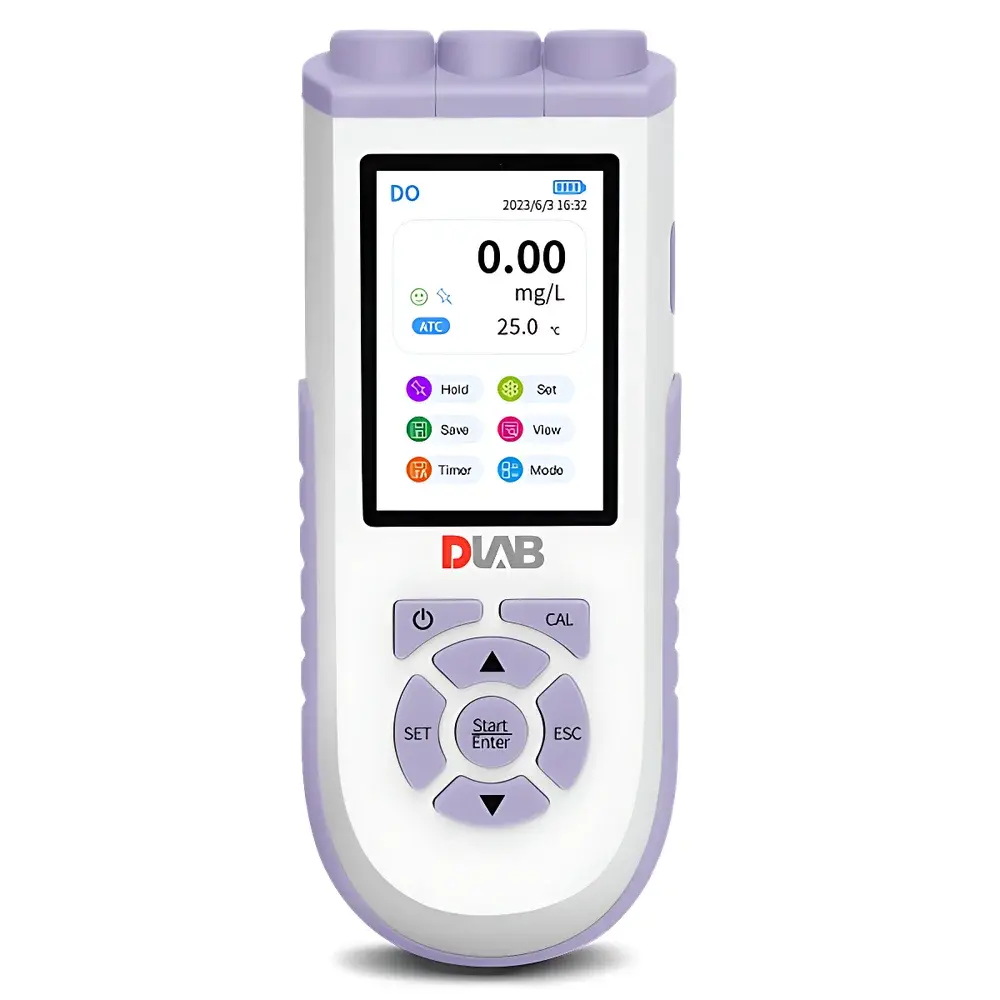
DLAB DDO10 Portable Polarographic Dissolved Oxygen Meter
| Brand | DLAB |
|---|---|
| Origin | Beijing, China |
| Manufacturer Type | Manufacturer |
| Product Origin | Domestic (China) |
| Model | DDO10 |
| Pricing | Upon Request |
| Display | 3.5-inch TFT color LCD |
| UI | Modern graphical interface with intuitive navigation |
| Operating System | Embedded intelligent firmware with timer measurement, parameter configuration, and data hold functions |
| Data Storage | Up to 3,000 measurement records |
| Calibration | Electrode calibration and standard solution calibration supported |
| Power Supply | Rechargeable lithium-ion battery (pre-installed DH10-LI01) |
| Charging Interface | USB Type-C (compliant with latest EU regulatory requirements) |
| Ingress Protection | IP57 (dust-protected |
| DO Measurement Range | 0.00–20.00 mg/L |
| DO Accuracy | ±0.30 mg/L |
| DO Saturation Range | 0.0–200.0 % |
| Atmospheric Pressure Compensation | Automatic, 0–200.0 kPa |
| Temperature Compensation | Automatic, 0.0–50.0 °C (32.0–122.0 °F) |
| Salinity Compensation | Manual, 0–45 ppt |
| Temperature Measurement Range | −10.0–135.0 °C (14.0–275.0 °F) |
| Temperature Accuracy | ±0.2 °C |
| Standard Accessories | DDO01-2M-H polarographic DO electrode (2 m cable, integrated temperature sensor), DDOS-01 electrolyte solution (30 mL), DDOSC membrane caps (3 pcs), carrying case (33 × 27.2 × 8.2 cm) |
Overview
The DLAB DDO10 is a field-deployable, single-parameter portable dissolved oxygen (DO) meter engineered for precision electrochemical measurement in environmental monitoring, wastewater treatment, aquaculture, and laboratory-based water quality assessment. It employs the classical Clark-type polarographic principle: molecular oxygen diffuses through a gas-permeable polytetrafluoroethylene (PTFE) membrane and undergoes reduction at a cathode (typically gold or platinum) held at a fixed polarizing voltage (−0.6 V to −0.8 V vs. Ag/AgCl). The resulting diffusion-limited current is linearly proportional to the partial pressure of dissolved oxygen, enabling quantitative determination in mg/L and % saturation. Built-in automatic temperature compensation (0.0–50.0 °C) and optional manual salinity correction (0–45 ppt) ensure accuracy across diverse aqueous matrices—from freshwater streams to brackish estuaries. The instrument’s robust architecture, IP57-rated enclosure, and low-power embedded system support extended unattended operation in challenging outdoor conditions.
Key Features
- 3.5-inch high-resolution TFT color display with anti-glare coating and optimized contrast for daylight readability
- Intuitive graphical user interface (GUI) supporting multilingual menu navigation and context-sensitive help prompts
- Embedded real-time clock enabling time-stamped logging and scheduled measurement intervals
- Comprehensive data management: 3,000 internal storage slots with timestamp, temperature, DO value, saturation, pressure, and calibration status
- USB Type-C charging port compliant with IEC 62684 and EU Directive 2022/2380—enabling universal charger compatibility and rapid 2-hour full recharge
- Integrated lithium-ion battery (DH10-LI01) with smart power management, auto-sleep mode, and non-volatile memory retention during power loss
- Polarographic DO sensor (DDO01-2M-H) featuring a dual-layer PTFE membrane, built-in thermistor for simultaneous temperature measurement, and replaceable electrolyte (DDOS-01) and cap assembly (DDOSC)
- Automatic barometric pressure compensation via onboard pressure sensor (0–200.0 kPa), eliminating manual altitude input errors
Sample Compatibility & Compliance
The DDO10 is validated for use with natural waters (rivers, lakes, groundwater), treated effluents, process streams, and aquarium systems. Its polarographic sensor exhibits minimal interference from common ions (e.g., Cl⁻, NO₃⁻, SO₄²⁻) and negligible response to redox-active species such as sulfide or ferrous iron under typical environmental concentrations. The instrument meets IP57 per IEC 60529 for dust resistance and temporary water immersion, supporting deployment in rain, splashing, or shallow submerged scenarios. While not certified to ISO/IEC 17025 for accredited testing, its calibration traceability aligns with ASTM D888-22 (Standard Test Methods for Dissolved Oxygen in Water) and supports GLP-compliant documentation when paired with external audit-ready data export workflows.
Software & Data Management
Data retrieval occurs via USB Type-C connection to a host PC running DLAB’s proprietary DDO-Link software (Windows/macOS compatible), which enables CSV export, trend visualization, calibration history review, and batch report generation. All stored records include metadata: date/time stamp, measured DO (mg/L and % sat), temperature (°C), compensated pressure (kPa), salinity setting (ppt), electrode status flag, and last calibration date. Firmware updates are delivered via signed binary packages to maintain integrity and support future regulatory alignment (e.g., enhanced audit trails for FDA 21 CFR Part 11–aligned environments).
Applications
- Field-based compliance monitoring per national discharge permits (e.g., China’s GB 3838–2002, US EPA Method 360.1)
- Biochemical oxygen demand (BOD) incubation tracking in wastewater laboratories
- Aquaculture pond health diagnostics and feeding optimization
- Drinking water distribution system integrity verification
- Educational demonstrations of aquatic respiration and eutrophication dynamics
- Research-grade profiling in limnological and marine surveys
FAQ
What electrode type does the DDO10 use, and how often must the membrane be replaced?
The DDO10 uses a polarographic (Clark-type) sensor (model DDO01-2M-H) with a replaceable PTFE membrane cap (DDOSC). Under normal field use, membrane replacement is recommended every 2–3 months or after 50–100 measurements—more frequently in turbid or organic-rich samples.
Does the instrument support GLP/GMP data integrity requirements?
While the DDO10 lacks built-in electronic signatures or role-based access control, its timestamped, immutable internal log and exportable CSV files enable manual reconstruction of audit trails. Integration with LIMS via DDO-Link satisfies basic GLP record-keeping needs.
Can the DDO10 measure DO in high-salinity seawater without error?
Yes—manual salinity compensation (0–45 ppt) corrects for oxygen solubility depression due to ionic strength. For best accuracy in seawater, calibrate using air-saturated seawater at in-situ temperature and salinity.
Is the battery replaceable by the end user?
No—the DH10-LI01 battery is factory-installed and sealed. Replacement requires authorized service to maintain IP57 integrity and calibration validity.
How is atmospheric pressure measured and applied?
An integrated piezoresistive pressure sensor continuously monitors ambient pressure (0–200.0 kPa) and automatically adjusts DO calculations in real time—no manual entry or external barometer required.




