
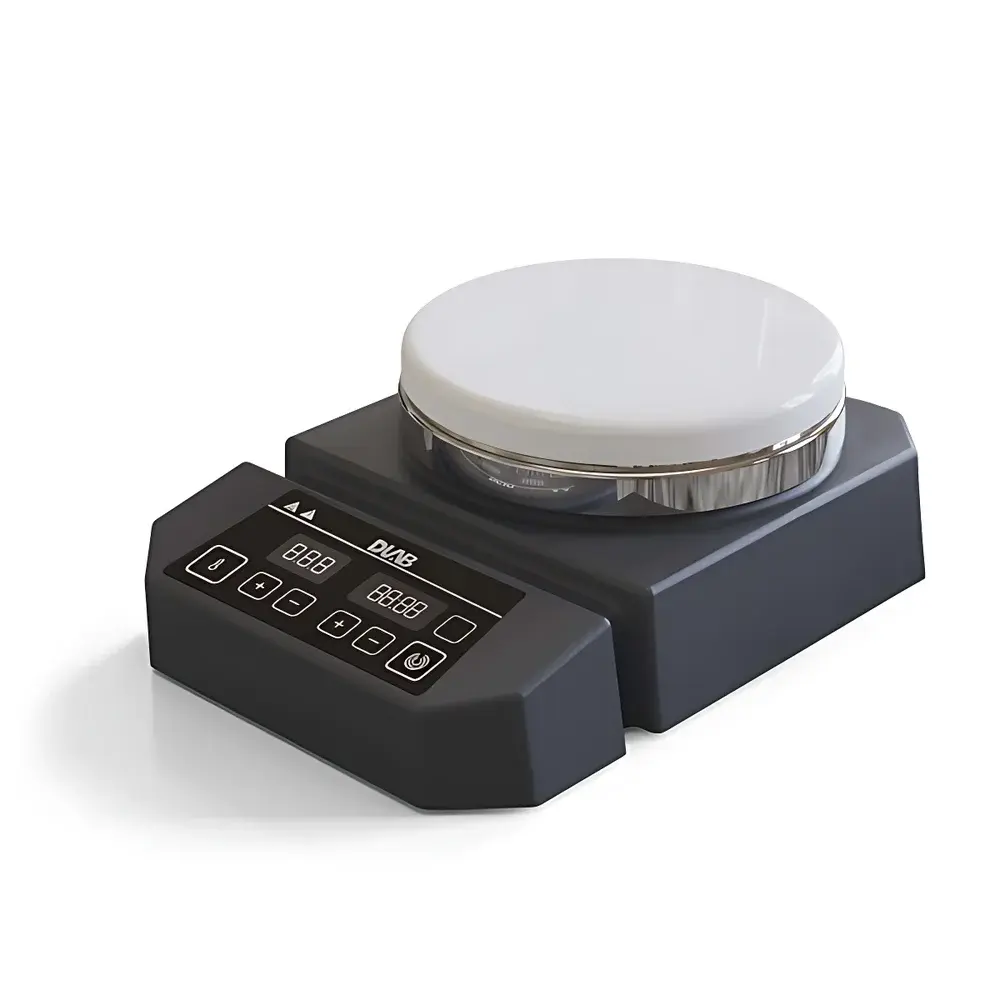
DLAB DMS5-280/120 LED Digital Display 5-inch Heated Magnetic Stirrer
| Brand | DLAB |
|---|---|
| Origin | Beijing, China |
| Manufacturer | DLAB |
| Model | DMS5-280/120 |
| Maximum Stirring Volume | 5 L |
| Speed Range | 50–1500 rpm (10 rpm increments) |
| Heating Temperature Range | Ambient to 280 °C (DMS5-280) / Ambient to 120 °C (DMS5-120) |
| Control Accuracy | ±1 °C (<100 °C) or ±1% of setpoint (>100 °C) |
| Temperature Display Resolution | ±1 °C |
| External Sensor | PT1000 (±0.2 °C) |
| Overheat Protection Threshold | 320 °C |
| Residual Heat Warning | Activates at 50 °C |
| Plate Material | Ceramic-coated aluminum |
| Plate Diameter | Ø135 mm |
| Motor Type | Brushless DC |
| Power Input | 100–120 V / 200–240 V, 50/60 Hz |
| Total Power Consumption | 610 W |
| Heating Output | 600 W |
| Dimensions (L×W×H) | 260 × 150 × 100 mm |
| Net Weight | 1.8 kg |
| IP Rating | IP21 |
| Operating Environment | 5–40 °C, ≤80% RH |
Overview
The DLAB DMS5-280/120 is a precision-engineered heated magnetic stirrer designed for reproducible thermal mixing in research, quality control, and routine laboratory workflows. It operates on the principle of rotating magnetic fields generated by a brushless DC motor beneath a thermally robust ceramic-coated aluminum plate, inducing synchronous rotation of PTFE- or glass-coated magnetic stir bars within vessels. Unlike basic hotplates, this dual-parameter instrument integrates independent real-time monitoring and closed-loop regulation of both rotational speed and surface/solution temperature—enabling controlled reaction kinetics, dissolution studies, sample homogenization, and pre-heating protocols requiring thermal stability and mechanical consistency. Its compact footprint (260 × 150 × 100 mm), IP21-rated enclosure, and 1.8 kg mass support benchtop deployment in ISO 17025-accredited labs, GLP-compliant environments, and teaching laboratories where space efficiency and operational safety are prioritized.
Key Features
- LED digital display showing simultaneous real-time values for speed (50–1500 rpm, adjustable in 10 rpm steps) and plate/solution temperature (ambient to 280 °C or 120 °C depending on model)
- Ceramic-coated aluminum heating plate (Ø135 mm) offering high thermal conductivity, chemical resistance to acids, bases, and organic solvents, and long-term structural integrity under sustained elevated temperatures
- Dual temperature sensing architecture: integrated plate sensor + optional external PT1000 probe (±0.2 °C accuracy) for direct solution-phase feedback, supporting ASTM E2465 and ISO 8573-1 traceable thermal validation
- Intelligent thermal safety system: residual heat warning (“HOT” flash) activates when plate surface exceeds 50 °C—even after power-off—and automatic cut-off triggers at 320 °C to prevent thermal runaway
- Brushless DC motor delivering consistent torque across the full speed range, minimizing vibration and ensuring stable stir bar rotation in viscous or dense media up to 5 L (water-equivalent)
- Capacitive touch control panel with intuitive icon-based navigation, eliminating mechanical switches prone to wear or contamination in humid or solvent-rich settings
Sample Compatibility & Compliance
The DMS5 series accommodates standard borosilicate glass beakers (50–1000 mL), stainless steel reactors, and polypropylene containers compatible with magnetic stirring. Its 40 mm maximum stir bar length specification ensures compatibility with common laboratory-grade stir bars (e.g., cross-shaped, oval, or flea-type). The device meets IEC 61010-1:2010 safety requirements for electrical equipment used in laboratory environments and conforms to electromagnetic compatibility standards EN 61326-1. For regulated environments, its stable temperature ramping profile and audit-ready parameter logging (when paired with optional PC interface software) support alignment with FDA 21 CFR Part 11 data integrity expectations and internal SOPs governing thermal process validation.
Software & Data Management
While the DMS5-280/120 operates as a standalone instrument, it supports optional RS-232 or USB-to-serial connectivity for integration into centralized lab management systems. Third-party LabVIEW or Python-based scripts can acquire timestamped speed and temperature readings at user-defined intervals (e.g., every 5 s), enabling export to CSV for statistical process control (SPC) analysis or inclusion in electronic lab notebooks (ELN). Firmware updates—distributed via DLAB’s secure technical portal—maintain compliance with evolving cybersecurity best practices per NIST SP 800-160 and ensure continued interoperability with modern operating systems.
Applications
- Kinetic studies requiring precise temperature ramping while maintaining constant agitation (e.g., polymerization onset, enzyme activity assays)
- Solubility testing per USP and Ph. Eur. 2.9.35, where uniform dispersion and thermal equilibrium are critical for dissolution profile reproducibility
- Preparation of calibration standards and reference materials under GLP conditions, with documented thermal history and mixing parameters
- Heating and stirring of viscous reagents (e.g., glycerol-water mixtures, silicone oils) without stir bar stalling or vortex instability
- Teaching labs conducting calorimetry, acid-base titrations, or crystallization experiments demanding visual confirmation of parameter stability via LED display
FAQ
What is the difference between the DMS5-280 and DMS5-120 models?
The primary distinction lies in maximum heating capacity: DMS5-280 supports plate temperatures up to 280 °C for high-boiling-point solvents or annealing applications, whereas DMS5-120 is rated to 120 °C—sufficient for aqueous buffers, most organic solvents, and standard sterilization protocols.
Can the external PT1000 sensor be calibrated independently?
Yes; the instrument allows user-initiated two-point calibration using certified reference thermometers traceable to NIST or national metrology institutes, with calibration constants stored in non-volatile memory.
Is the ceramic coating resistant to hydrofluoric acid exposure?
No—the ceramic layer provides broad resistance to common lab chemicals but is not HF-compatible; use glass or PTFE-coated vessels and avoid direct contact with concentrated hydrofluoric acid.
Does the device support continuous operation at maximum temperature and speed?
It is rated for uninterrupted duty at 280 °C and 1500 rpm under ambient conditions ≤35 °C and relative humidity ≤60% RH, per IEC 60068-2-2 thermal endurance testing.
How is data integrity ensured during power interruption?
All active setpoints and elapsed time counters reset upon loss of mains power; however, no volatile data is retained—consistent with ALCOA+ principles for raw instrument data, which must be manually or automatically captured externally prior to shutdown.



