
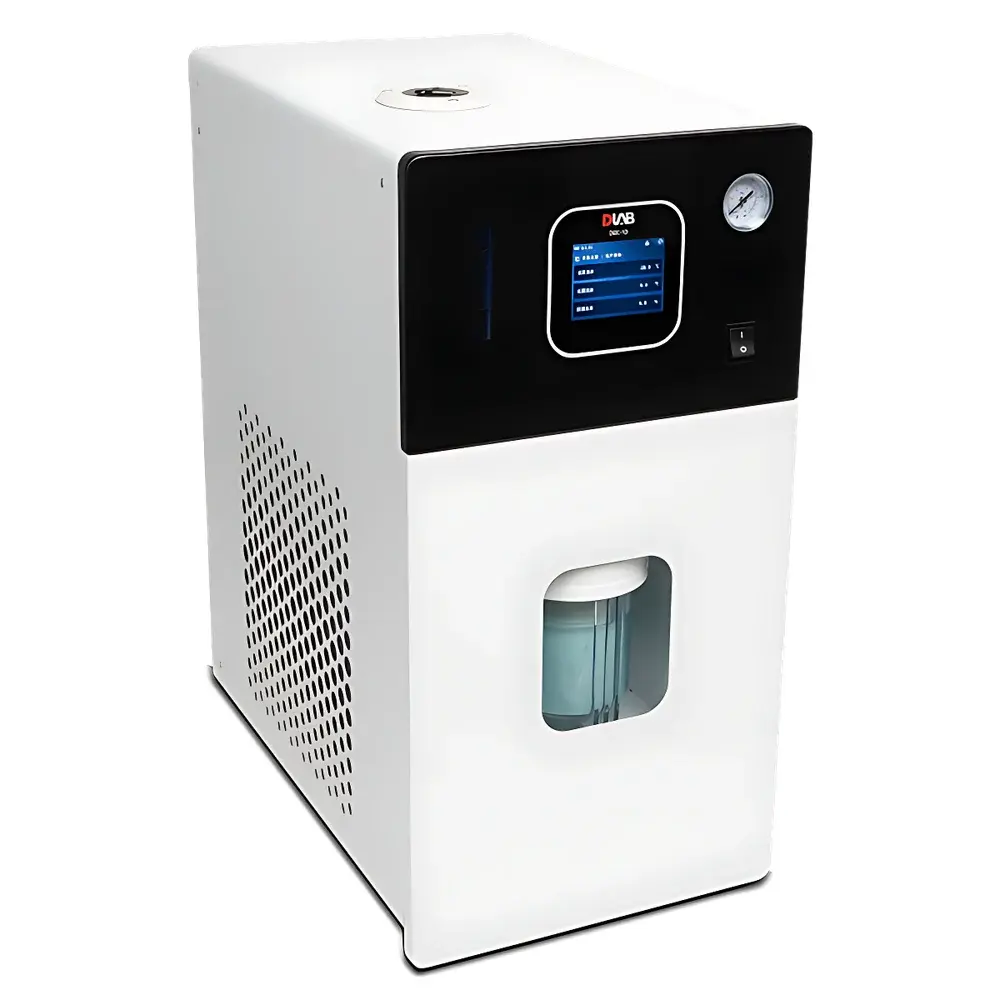
DLAB DUC-10 High-Precision Circulating Chiller
| Brand | DLAB |
|---|---|
| Origin | Beijing, China |
| Manufacturer Type | Direct Manufacturer |
| Equipment Type | Integrated Circulating Chiller |
| Cooling Method | Water-Cooled |
| Temperature Control Range | 5–35 °C |
| Temperature Stability | ±0.1 °C |
| Circulation Pump Pressure | 1.3 bar |
| Circulation Flow Rate | 2–20 L/min (adjustable) |
| Reservoir Capacity | 7 L |
| Display | 3.5″ LCD Touchscreen |
| Temperature Resolution | 0.1 °C |
| Control Algorithm | Intelligent PID |
| Sensor Type | PT100 Platinum Resistance Thermometer |
| Refrigerant | R404a |
| Refrigeration Capacity @ 20 °C | 1000 W |
| Power Supply | 100–120 V / 200–240 V, 50/60 Hz |
| Max. Power Consumption | 650 W |
| Max. Current | 3.5 A |
| Ambient Operating Conditions | 5–40 °C, ≤80% RH |
| External Connection Port ID | 10 mm |
| Dimensions (W×D×H) | 310×650×530 mm |
| Weight | Approx. 42 kg |
| Mounting | Floor-Standing with Lockable Casters |
| Duty Cycle | Continuous 100% Operation |
Overview
The DLAB DUC-10 High-Precision Circulating Chiller is an integrated, water-cooled temperature control system engineered for laboratory applications demanding exceptional thermal stability and reproducibility. It operates on a dual-mode thermoregulation principle—combining a high-efficiency hermetic compressor with a precision resistive heater—enabling both active cooling and heating within a single unit. The system employs proportional refrigeration control, dynamically modulating compressor output and heater power in real time based on feedback from a calibrated PT100 sensor. This architecture ensures minimal thermal overshoot, rapid load compensation, and sustained temperature uniformity across the entire fluid loop. Designed for integration with jacketed reactors, spectrophotometers, HPLC column ovens, and analytical instrumentation requiring external coolant circulation, the DUC-10 delivers ±0.1 °C stability over its full operational range of 5–35 °C—meeting stringent requirements for polymer synthesis, nanomaterial growth, protein purification, and enzyme kinetics studies where even sub-degree fluctuations directly impact molecular weight distribution (PDI), particle size anisotropy, or assay reproducibility.
Key Features
- Intelligent PID temperature control with adaptive tuning and user-adjustable hysteresis for optimized response to dynamic thermal loads
- Proportional refrigeration technology minimizing compressor cycling and energy consumption while maintaining precise setpoint adherence
- High-flow, pressure-stable circulation pump (1.3 bar max, 2–20 L/min adjustable) ensuring uniform coolant delivery to multi-port or high-backpressure systems
- 7-liter insulated reservoir with front-facing level indicator, top-fill port, rear drain valve, and overflow outlet for safe, maintenance-efficient operation
- 3.5-inch capacitive touchscreen interface supporting intuitive parameter entry, real-time trend visualization, and one-touch activation of circulation and temperature regulation
- Multi-stage fluid filtration system—including particulate and corrosion inhibitors—protecting downstream equipment and extending pump service life
- Acoustically optimized design: low-RPM compressor and ultra-quiet axial fans achieve <52 dB(A) at 1 m, suitable for noise-sensitive analytical laboratories
- Robust thermal insulation and low-thermal-conductivity housing reduce ambient heat exchange, improving energy efficiency and long-term stability
- Floor-standing configuration with lockable swivel casters and compact footprint (310×650×530 mm) for flexible placement in space-constrained lab environments
Sample Compatibility & Compliance
The DUC-10 circulates deionized water or water-glycol mixtures compatible with standard laboratory tubing (ID 10 mm). Its closed-loop architecture prevents contamination of sensitive instruments such as chromatographic columns, calorimeters, or optical benches. All wetted materials—including pump head, reservoir liner, and internal piping—are chemically resistant (316 stainless steel, EPDM, and PPS components) and compliant with ISO 10993 biocompatibility guidelines for incidental contact. The unit meets IEC 61010-1:2010 safety standards for laboratory electrical equipment and conforms to RoHS Directive 2011/65/EU regarding hazardous substances. While not certified for medical device use under FDA 21 CFR Part 820, its temperature logging capability (via optional RS485/Modbus RTU interface) supports GLP-compliant audit trails when integrated into validated workflows per ISO/IEC 17025 requirements.
Software & Data Management
The DUC-10 operates autonomously via its embedded microcontroller and does not require host PC software for basic function. However, it supports Modbus RTU communication over RS485 for integration into centralized lab management systems (e.g., LabVantage, Thermo Fisher SampleManager). Users can remotely monitor real-time temperature, flow rate, compressor status, and error codes; configure alarm thresholds; and export timestamped temperature logs (CSV format) for post-hoc analysis. When deployed in regulated environments, the system’s deterministic control logic and non-volatile parameter storage align with ALCOA+ data integrity principles—ensuring attributable, legible, contemporaneous, original, accurate, complete, consistent, enduring, and available records per FDA 21 CFR Part 11 expectations for electronic records used in GxP applications.
Applications
- Polymer chemistry: RAFT-mediated controlled radical polymerization requiring jacketed reactor temperature control at 30 ± 0.1 °C to maintain narrow dispersity (Đ < 1.1)
- Nanomaterial synthesis: Seed-mediated growth of anisotropic nanoparticles under isothermal conditions (e.g., 25 ± 0.1 °C for 12 h) to achieve <3% coefficient of variation in aspect ratio
- Protein biochemistry: Affinity chromatography column temperature stabilization at 10 ± 0.1 °C to suppress aggregation and improve elution recovery (>92% vs. <78% with ±1 °C chillers)
- Enzyme kinetics: Microplate-based fluorometric assays (e.g., 96-well format) requiring inter-well thermal uniformity <0.2 °C to achieve CV <2% in initial rate calculations
- Materials testing: Thermal conditioning of viscometers, rheometers, and differential scanning calorimeters during method validation per ASTM D341 and ISO 2555
FAQ
What is the maximum allowable ambient temperature for continuous operation?
The DUC-10 is rated for uninterrupted duty at ambient temperatures up to 40 °C, provided adequate ventilation (≥150 mm clearance on all sides) and relative humidity remains ≤80% RH.
Can the chiller be used with organic solvents?
No. The DUC-10 is designed exclusively for aqueous or water/glycol (≤30% v/v) coolants. Organic solvents may degrade seals, damage the pump, or compromise refrigerant compatibility.
Is remote monitoring supported out of the box?
Yes—the unit includes RS485 Modbus RTU as standard. No additional hardware is required to integrate with SCADA or LIMS platforms supporting this protocol.
How often should the filter cartridge be replaced?
Under typical lab usage with deionized water, replace the integrated particulate filter every 6 months or after 2000 operating hours—whichever occurs first.
Does the DUC-10 support external temperature feedback from a process sensor?
Yes. An optional external PT100 input allows cascade control mode, where the chiller regulates based on the temperature measured at the point of use rather than at the reservoir.



