
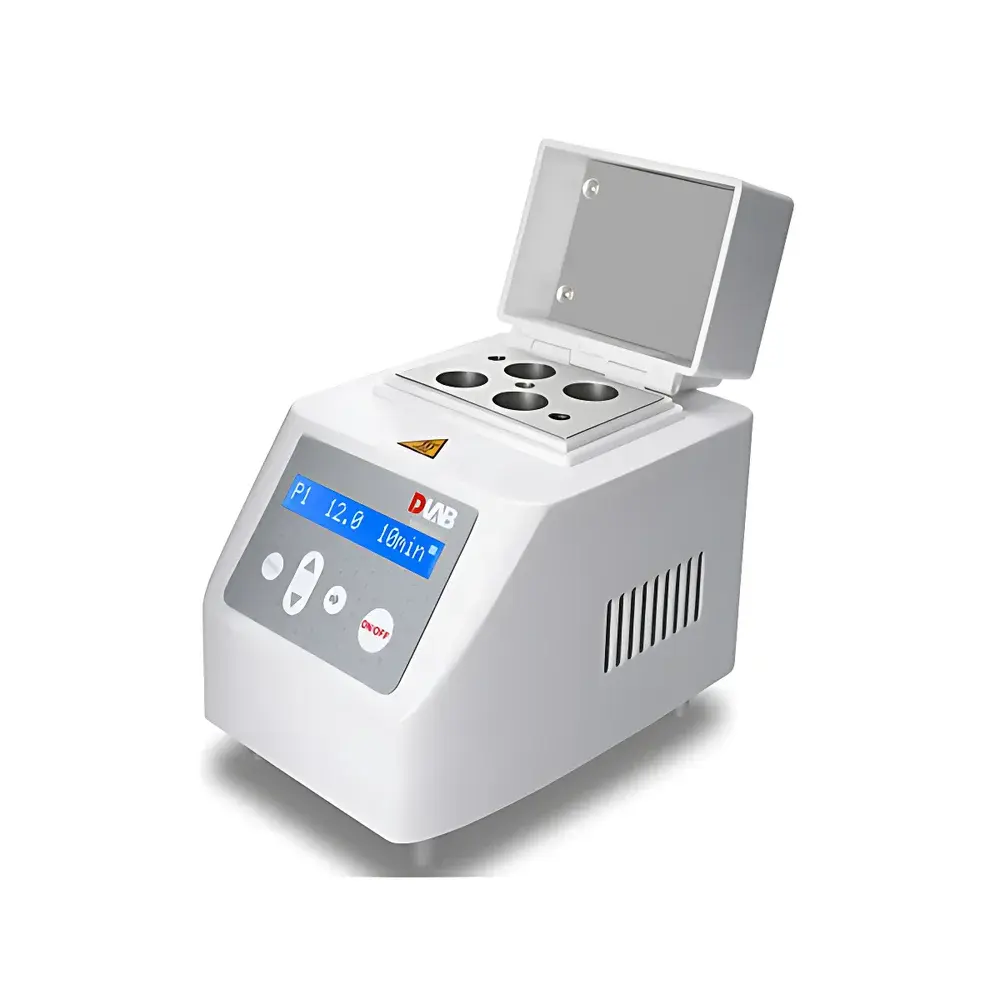
DLAB MiniH 100 Compact Digital Metal Block Heater
| Brand | DLAB |
|---|---|
| Model | MiniH 100 |
| Temperature Range | Ambient +5°C to 100°C |
| Temperature Accuracy | ±0.5°C |
| Heating Time (25°C → 100°C) | ≤20 min |
| Dimensions (L×W×H) | 110 × 162 × 140 mm |
| Net Weight | 1.85 kg |
| Power Supply | 100–240 V AC, 50/60 Hz |
| Max Power | 60 W |
| Display | LCD |
| Temp Resolution | 0.1°C |
| Timer Range | 0–999 min / 0–999 sec |
| Programmable Protocols | 9 programs (2-segment each) |
| Calibration Mode | Built-in user calibration |
| Safety | Over-temperature protection |
| Module Interchangeability | Yes (7 standard block configurations supported) |
| Operating Environment | 10–40°C, ≤80% RH |
Overview
The DLAB MiniH 100 is a compact, digitally controlled metal block heater engineered for precision thermal incubation of small-volume samples in research, clinical, and quality control laboratories. Unlike water baths or heating plates, the MiniH 100 employs solid-state aluminum heating blocks with high thermal conductivity and low thermal inertia—enabling rapid, uniform heat transfer directly to sample tubes via conductive contact. Its design follows the fundamental principle of conductive thermal equilibrium: temperature stability is achieved by maintaining constant power delivery to the block while continuously monitoring surface temperature via a high-stability NTC thermistor embedded beneath the block surface. This architecture eliminates convective variability and condensation risks associated with liquid-based systems, making it especially suitable for applications requiring dry, contamination-free, and vibration-free incubation—such as enzyme reactions, DNA denaturation, antigen retrieval, and reagent pre-warming prior to PCR or ELISA workflows.
Key Features
- Compact footprint (110 × 162 × 140 mm) and lightweight construction (1.85 kg) enable benchtop portability and field deployment—including use with DC-to-AC inverters for vehicle-mounted operation.
- Digital PID temperature control with 0.1°C resolution and ±0.5°C accuracy across the full operating range (ambient +5°C to 100°C), verified per ISO/IEC 17025 traceable calibration procedures.
- LCD interface displays real-time block temperature, setpoint, elapsed time, and active program status—supporting intuitive parameter entry and visual feedback during protocol execution.
- Built-in user calibration mode allows periodic offset adjustment using an external reference thermometer, ensuring long-term thermal consistency without requiring factory service.
- Over-temperature safety cutoff activates at ≥105°C, halting power delivery and displaying error code E01—a fail-safe mechanism compliant with IEC 61010-1 for laboratory electrical equipment.
- Modular heating block system supports seven interchangeable aluminum inserts (including formats for 0.2 mL, 0.5 mL, 1.5 mL, 2 mL, 5 mL, 15 mL, and 50 mL tubes), enabling rapid adaptation to diverse assay geometries without hardware replacement.
- Programmable timer supports dual-segment protocols (e.g., 5 min at 70°C followed by 10 min at 95°C), with memory retention for up to nine user-defined routines—facilitating reproducible multi-step thermal treatments.
Sample Compatibility & Compliance
The MiniH 100 accommodates standard microcentrifuge tubes, PCR strips, and conical vials across common volumes (0.2–50 mL), with block inserts designed to minimize air gaps and maximize thermal coupling. All aluminum modules are anodized for chemical resistance and mechanical durability. The device conforms to electromagnetic compatibility (EMC) requirements per EN 61326-1 and electrical safety standards per EN 61010-1. While not certified for IVD or GMP manufacturing environments, its programmable logging capability (via optional USB data export) supports GLP-aligned documentation when paired with validated SOPs. It meets general-purpose laboratory equipment requirements under ISO 15195 for reference measurement systems and aligns with ASTM E2252–17 guidelines for thermal performance verification of dry block heaters.
Software & Data Management
The MiniH 100 operates as a standalone instrument with no proprietary software dependency. All configuration and operation occur via the front-panel interface. However, the integrated USB port (USB-B type) enables firmware updates and optional time-stamped temperature log export (CSV format) when used with third-party terminal emulation tools—supporting audit-ready recordkeeping in regulated settings. Error codes (e.g., E01: over-temp, E02: sensor fault, E03: communication timeout) are displayed with diagnostic clarity, reducing troubleshooting time. No cloud connectivity or remote control functionality is implemented, preserving data sovereignty and minimizing cybersecurity attack surface—consistent with institutional IT policies governing edge laboratory instrumentation.
Applications
- Pre-heating reagents (e.g., restriction enzymes, ligases, master mixes) to optimal reaction temperatures prior to pipetting.
- Controlled denaturation of nucleic acids and proteins in molecular biology workflows, including RNA integrity preservation steps where moisture-sensitive conditions are critical.
- Antigen unmasking in immunohistochemistry (IHC), particularly for heat-induced epitope retrieval (HIER) protocols requiring precise 95–100°C exposure windows.
- Cell lysis optimization studies involving detergent-based or enzymatic disruption methods sensitive to thermal ramp rate and plateau stability.
- Calibration verification of thermocouples and digital thermometers using NIST-traceable reference standards placed within calibrated blocks.
- Field-deployable sample conditioning for environmental testing (e.g., soil extract incubation, water microbiology prep) where access to stable AC power is limited.
FAQ
What is the maximum recommended operating altitude for the MiniH 100?
The unit is rated for operation up to 2000 meters above sea level; above this elevation, derating of maximum temperature setpoint by 1°C per 100 m is advised due to reduced convective cooling efficiency.
Can the MiniH 100 be used with refrigerated blocks or cooling modules?
No—the MiniH 100 is a heating-only device. For combined heating/cooling functionality, refer to the DLAB MiniHC100 or MiniHCL100 models, which integrate Peltier-based thermoelectric elements.
Is the aluminum block material compatible with organic solvents such as chloroform or acetone?
Anodized aluminum exhibits good resistance to short-term incidental exposure but is not recommended for prolonged immersion or vapor-phase contact with strong halogenated solvents; consult DLAB’s Chemical Compatibility Matrix (Ref. DLAB-CCM-2023) for validated exposure limits.
Does the device support 21 CFR Part 11-compliant electronic records?
Not natively—the MiniH 100 lacks user authentication, audit trail generation, or electronic signature capabilities. However, exported CSV logs may be incorporated into Part 11–compliant LIMS or ELN systems when governed by institutionally approved procedural controls.
How often should user calibration be performed?
DLAB recommends quarterly verification against a certified reference thermometer (±0.1°C accuracy); more frequent calibration may be required in high-throughput or regulated environments where thermal drift impact assessments are mandated by internal QA protocols.



