
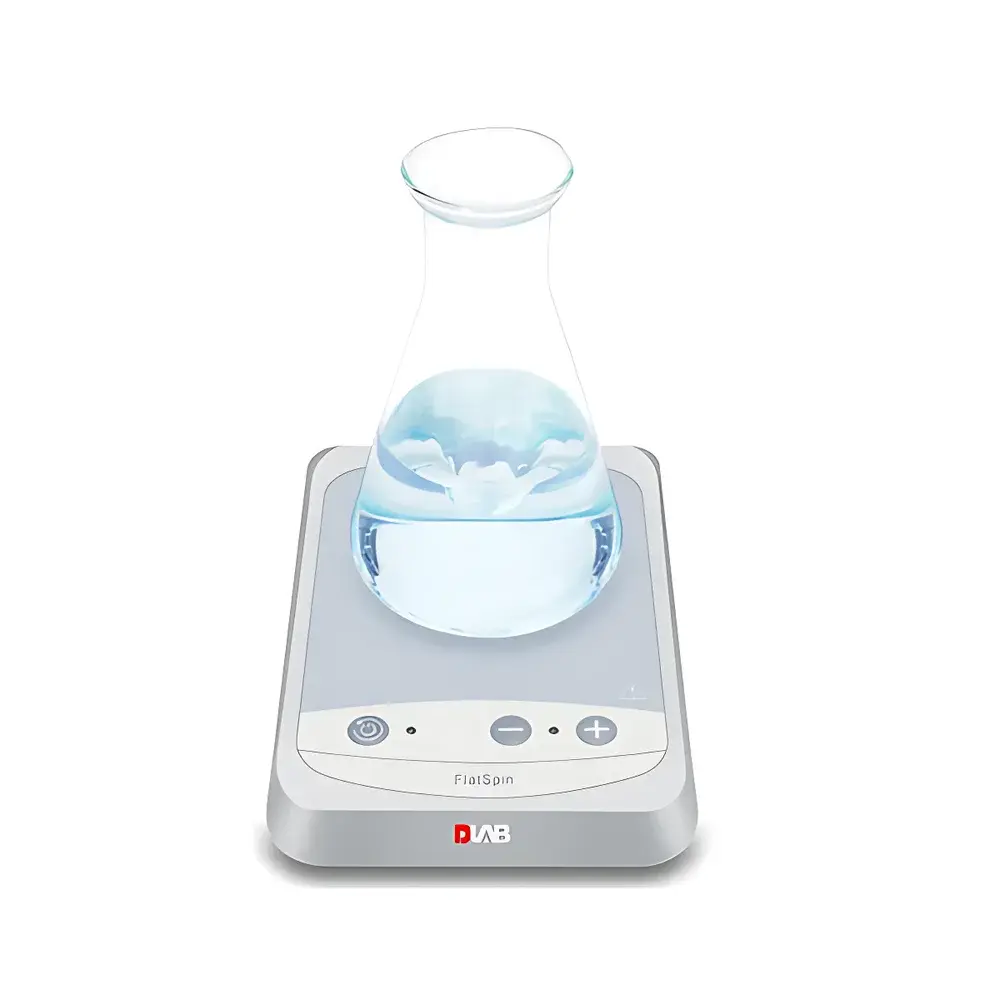
DLAB FlatSpin Ultra-Thin Magnetic Stirrer
| Brand | DLAB |
|---|---|
| Origin | Beijing, China |
| Manufacturer Type | Original Equipment Manufacturer (OEM) |
| Product Category | Domestic |
| Model | FlatSpin |
| Instrument Type | Magnetic Stirrer |
| Maximum Stirring Volume | 0.8 L (water) |
| Speed Range | 15–1500 rpm |
| Temperature Control | None |
| Workplate Diameter | Ø90 mm |
| Workplate Material | PET-coated |
| Motor Type | Motorless (contactless induction drive) |
| Output Power | 3 W |
| Rated Power | 5 W |
| Voltage | 100–120 V / 200–240 V, 50/60 Hz |
| Stirring Position | Single |
| Max Stir Bar Length | 40 mm |
| Speed Adjustment | Push-button digital control |
| Enclosure Protection Rating | IP21 |
| Dimensions (L×W×H) | 120 × 175 × 15 mm |
| Weight | 0.3 kg |
| Operating Environment | 5–40 °C, ≤80% RH |
| Safety Certifications | CE, cTUVus, FCC, compliant with DIN/EN 60529 |
Overview
The DLAB FlatSpin Ultra-Thin Magnetic Stirrer is an engineered solution for precision liquid homogenization in space-constrained laboratory environments. Unlike conventional magnetic stirrers employing rotating motors and mechanical gear trains, the FlatSpin utilizes a contactless electromagnetic induction architecture—eliminating mechanical wear, audible noise, and vibration transmission. Its core operation relies on time-varying magnetic fields generated by planar coil arrays beneath a chemically inert PET-coated ceramic workplate (Ø90 mm), which actuate standard PTFE- or glass-coated magnetic stir bars via Lorentz force coupling. This design enables stable, repeatable agitation across the full speed range of 15–1500 rpm, with bidirectional alternation capability to prevent vortex lock and enhance mixing uniformity—particularly critical during endpoint-sensitive analytical procedures such as volumetric titration where flask positioning and stability are paramount.
Key Features
- Motorless electromagnetic drive system ensures silent operation (<25 dB[A] at 1 m) and zero mechanical vibration—ideal for integration beneath analytical balances, spectrophotometers, or automated titration stations.
- PET-surfaced workplate provides exceptional resistance to acids (e.g., HCl, HNO₃), bases (e.g., NaOH), and organic solvents (e.g., acetone, ethanol), maintaining dimensional stability and surface integrity under repeated exposure.
- Digital push-button interface enables precise, stepwise speed selection without analog drift; memory retention preserves last-used setting after power cycle.
- Ultra-low profile (15 mm height) and compact footprint (120 × 175 mm) facilitate placement inside fume hoods, laminar flow cabinets, or multi-tiered benchtop configurations.
- Compliance with international safety standards: CE marking per EU Machinery Directive 2006/42/EC and Low Voltage Directive 2014/35/EU; cTUVus certification for North American markets (UL 61010-1); FCC Part 15 Class B for electromagnetic compatibility; and ingress protection rating IP21 (limited protection against vertically falling solids and dripping water).
Sample Compatibility & Compliance
The FlatSpin supports standard cylindrical and oval stir bars up to 40 mm in length and 8 mm in diameter, compatible with volumes from 10 mL to 800 mL of aqueous or low-viscosity organic solutions (≤50 mPa·s). It is not rated for viscous media (e.g., polymer melts, glycerol >80%), high-density suspensions, or sealed/vacuum vessels requiring hermetic sealing. The device meets essential requirements for GLP-compliant laboratories: no firmware-based audit trail is implemented (as no data logging occurs), but its deterministic mechanical behavior, certified electrical safety, and documented material compatibility support traceable method execution per ISO/IEC 17025:2017 clause 7.2.2 (selection of test methods). It is routinely deployed in ISO 9001-certified QC labs for reagent preparation, buffer equilibration, and sample conditioning prior to HPLC, ICP-OES, or titrimetric analysis.
Software & Data Management
The FlatSpin operates as a standalone hardware instrument with no embedded microprocessor, firmware, or connectivity interfaces (USB, Bluetooth, Ethernet). Consequently, it does not generate, store, or transmit operational data—eliminating cybersecurity concerns and simplifying validation in regulated environments. No software installation, driver configuration, or calibration certificate management is required. Speed settings are manually selected and retained via non-volatile logic circuitry; no timestamping, user authentication, or electronic recordkeeping functionality is present. This architecture aligns with FDA 21 CFR Part 11 “excluded systems” criteria for instruments that neither create nor modify electronic records, reducing qualification burden in pharmaceutical and clinical testing workflows.
Applications
- Volumetric titration setups where flask stability and absence of vibration prevent meniscus disturbance during burette reading.
- Preparation of calibration standards and reference solutions requiring homogeneous dispersion without introducing particulate contamination from motor brushes or gear debris.
- Cell culture media conditioning in biosafety cabinets, where low acoustic emission minimizes stress on sensitive eukaryotic cells.
- Electrochemical cell agitation during cyclic voltammetry or potentiometric measurements, avoiding electromagnetic interference from brushed DC motors.
- Teaching laboratories emphasizing fundamental principles of electromagnetic actuation and fluid dynamics, supported by transparent operational mechanics and absence of hidden firmware layers.
FAQ
Does the FlatSpin require periodic calibration?
No. As a purely electromechanical device with no sensors, feedback loops, or analog-to-digital conversion, it does not undergo metrological calibration. Verification of performance consists of confirming speed accuracy using an external tachometer and verifying consistent torque delivery with a standardized stir bar in water.
Can it be used with metal stir bars?
No. Only PTFE- or glass-coated magnetic stir bars are permitted. Bare stainless steel or neodymium rods may overheat due to eddy current induction and compromise PET surface integrity.
Is the workplate replaceable?
The PET-coated workplate is not field-replaceable; however, its chemical resistance ensures service life exceeding 5 years under typical academic or industrial usage conditions (per DLAB MTBF documentation, Issue Rev. 2023-09).
What is the expected lifetime of the induction coils?
Rated for continuous operation at rated voltage and ambient temperature (≤40 °C) with an L₁₀ life of ≥50,000 hours, based on accelerated thermal aging tests conducted per IEC 60068-2-64.
Does it meet RoHS and REACH requirements?
Yes. All materials—including PET substrate, copper windings, FR-4 PCB base, and housing polycarbonate—are certified compliant with EU Directive 2011/65/EU (RoHS 2) and Regulation (EC) No. 1907/2006 (REACH), with full SVHC declaration available upon request.



