
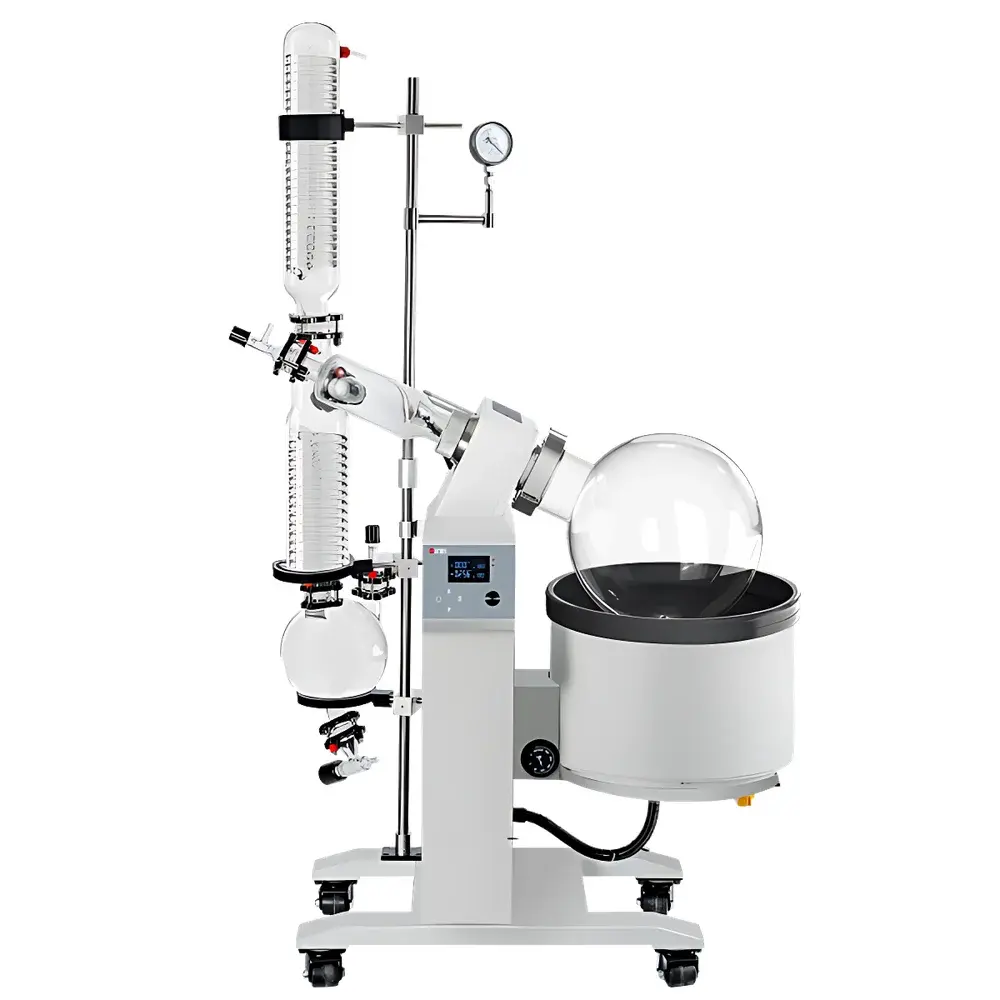
DLAB RE1000-E LCD Digital Rotary Evaporator
| Brand | DLAB |
|---|---|
| Origin | Beijing, China |
| Manufacturer Type | Direct Manufacturer |
| Product Origin | Domestic (China) |
| Model | RE1000-E |
| Capacity | 10 L |
| Ultimate Vacuum | 9 mbar |
| Rotation Speed | 20–180 rpm |
| Temperature Range | Water Bath: 20–100 °C |
| Oil Bath | 20–180 °C (optional) |
| Temperature Control Accuracy | ±1 °C |
| Evaporation Rate (Ethanol) | Up to 3.5 L/h |
| Lift Stroke | 200 mm |
| Heating Power | 3000 W |
| Power Supply | 220 V, 50/60 Hz |
| Dimensions (L×W×H) | 790 × 480 × 1130 mm |
| IP Rating | IP20 |
| Safety Protections | Overcurrent, leakage current, overload lift, dry-run, and overtemperature protection |
| Display | LCD (simultaneous readout of temperature, rotation speed, direction, timer) |
| Timer Range | 0–999 min |
| Motor Types | DC brushed lift motor |
| Bath Interior Coating | PTFE-coated |
| Condenser | Dual-layer vertical condenser with anti-backflow design |
| Sealing | PTFE gaskets |
| Vacuum Interface | Optional vacuum controller compatibility |
| Steam Temperature Sensor | Integrated digital vapor temperature probe |
Overview
The DLAB RE1000-E LCD Digital Rotary Evaporator is an engineered solution for efficient, reproducible solvent removal and sample concentration in research laboratories, quality control environments, and pilot-scale purification workflows. Designed around the fundamental principles of reduced-pressure distillation, the system rotates a sample-containing flask under controlled thermal and vacuum conditions to increase surface area and lower boiling points—enabling gentle yet rapid evaporation of heat-sensitive compounds. Its 10 L evaporation capacity supports both batch and semi-continuous processing, while the dual-mode heating architecture (standard water bath + optional oil bath) accommodates a broad range of solvent volatilities—from low-boiling diethyl ether (34.6 °C) to high-boiling dimethyl sulfoxide (189 °C). The unit operates under a stable ultimate vacuum of 9 mbar, sufficient for most organic solvents at moderate bath temperatures, and integrates real-time vapor temperature monitoring to support dynamic vacuum optimization.
Key Features
- High-resolution LCD interface displaying simultaneous real-time values for bath temperature, rotation speed, direction (forward/reverse), and countdown timer—eliminating manual parameter cross-checking.
- PID-based microprocessor temperature control delivering ±1 °C stability across the full 20–100 °C water bath range (or 20–180 °C with optional oil bath), minimizing thermal overshoot during ramping.
- Automated lift mechanism with 200 mm stroke and DC brushed motor drive—ensuring smooth, low-noise vertical movement synchronized with vacuum and rotation status.
- Dual-layer vertical condenser with enlarged cooling surface area and patented anti-backflow geometry, preventing condensed solvent reflux into the evaporation flask during pressure transients or power interruption.
- PTFE-coated bath interior and PTFE sealing gaskets provide chemical resistance against aggressive solvents (e.g., chlorinated hydrocarbons, strong acids/bases) and facilitate residue-free cleaning—critical for GLP-compliant multi-analyte workflows.
- Reversible rotation function enables uniform suspension of particulate-laden or viscous samples (e.g., crude natural product extracts, polymer solutions), reducing bumping and improving mass transfer efficiency.
- Integrated digital steam temperature sensor mounted at the condenser inlet provides direct feedback on vapor-phase thermal state—supporting empirical correlation between vapor temperature, bath setpoint, and vacuum level for method development.
Sample Compatibility & Compliance
The RE1000-E accommodates standard ISO/KPG ground-glass joints (e.g., 29/32, 35/20) and is compatible with borosilicate glassware up to 10 L volume. Its PTFE-sealed vapor path and inert bath coating ensure compatibility with common organic solvents (acetone, methanol, ethyl acetate, hexane), aqueous buffers, and mildly corrosive reagents. The system meets IEC 61010-1 safety requirements for laboratory electrical equipment, and its IP20 enclosure rating aligns with typical indoor lab environmental classifications. While not certified for hazardous area use, its comprehensive safety suite—including dry-run detection, overtemperature cutoff, lift overload sensing, and residual-current device (RCD)—supports compliance with institutional EH&S protocols and ISO/IEC 17025 documentation requirements for instrument qualification.
Software & Data Management
The RE1000-E operates as a standalone instrument with embedded firmware; no external PC or proprietary software is required for basic operation. All operational parameters—including temperature setpoints, rotation profiles, timer logs, and lift position—are stored in non-volatile memory and persist through power cycles. For laboratories requiring audit-ready records, the optional vacuum controller (sold separately) provides analog 0–10 V or digital RS485 output, enabling integration with SCADA systems or LIMS platforms that support Modbus RTU or analog signal logging. The built-in timer supports repeatable run scheduling (0–999 min), and the LCD display retains last-used settings—reducing setup time between consecutive batches without compromising traceability.
Applications
- Routine solvent removal in synthetic organic chemistry labs following Grignard, Suzuki, or esterification reactions.
- Concentration of thermolabile natural product extracts (e.g., flavonoids, terpenes) under mild vacuum and controlled bath temperature.
- Preparative purification of pharmaceutical intermediates where residual solvent limits must comply with ICH Q3C guidelines.
- Removal of volatile reaction byproducts (e.g., HCl gas, SO₂) from acid-catalyzed cyclizations using reverse rotation to suspend precipitated salts.
- Parallel evaporation support in analytical labs preparing calibration standards or QC reference materials for GC-MS or HPLC analysis.
- Process development studies evaluating evaporation kinetics across solvent families—leveraging vapor temperature feedback to model enthalpy-driven phase transitions.
FAQ
What vacuum level is required for optimal ethanol removal?
For ethanol (BP 78.4 °C at 1 atm), a vacuum of 9 mbar reduces the boiling point to ~20 °C—enabling efficient removal at 30–40 °C bath temperature. The RE1000-E’s 9 mbar ultimate vacuum is sufficient for this application without requiring secondary vacuum pumps.
Can the RE1000-E be used with corrosive solvents like concentrated HCl or nitric acid?
The PTFE-coated bath and PTFE gaskets offer resistance to many acids, but prolonged exposure to hot, fuming mineral acids is not recommended. Always consult DLAB’s chemical compatibility chart and implement secondary containment for such applications.
Is the oil bath truly optional—or is it required for certain solvents?
The oil bath is optional but necessary for solvents with boiling points above 100 °C (e.g., DMF, DMSO, ethylene glycol) or when higher thermal inertia is needed for temperature stability during large-volume evaporation.
Does the system support 21 CFR Part 11 compliance?
As a standalone hardware controller without electronic signature or audit trail functionality, the base RE1000-E does not meet 21 CFR Part 11 requirements. However, when integrated with validated third-party data acquisition systems via its analog/digital outputs, it may be included in a broader compliant workflow under appropriate SOPs.
How is the anti-backflow condenser physically implemented?
The dual-layer condenser features an inner cooling coil surrounded by an outer jacket with independent coolant flow paths and a gravity-assisted vapor deflection baffle—preventing condensed liquid from migrating upward during vacuum fluctuations or pump shutdown.



