
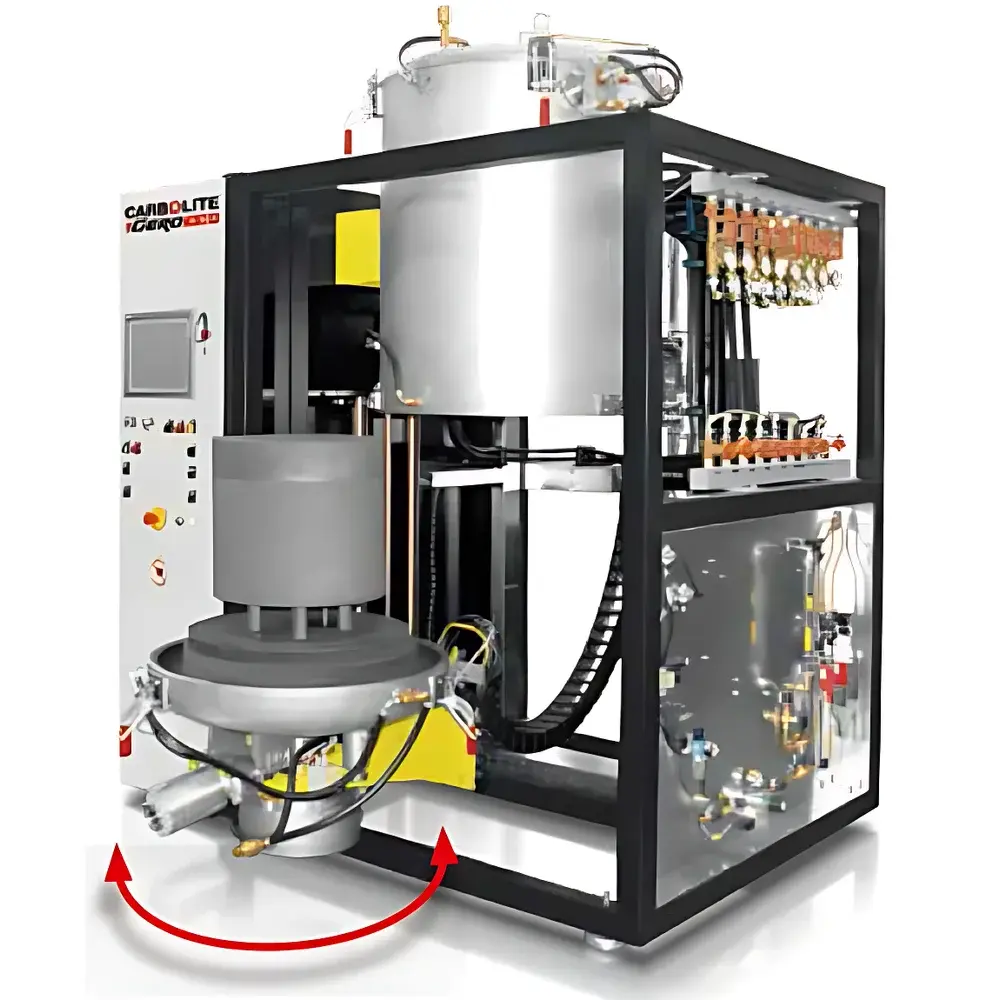
Carbolite Gero HTBL Series Bottom-Loading High-Temperature Vacuum Tube Furnace
| Brand | Carbolite Gero |
|---|---|
| Origin | Germany |
| Instrument Type | Bottom-Loading Vertical Tube Furnace |
| Max Operating Temperature | 2200 °C |
| Heating Elements | Graphite, Molybdenum, or Tungsten |
| Vacuum Capability | High Vacuum (10⁻⁵ mbar) and Ultra-High Vacuum (UHV) compatible |
| Cooling System | Integrated Water-Cooled Double-Wall Chamber with Flow Monitoring & Temperature Display |
| Safety | Dual Independent Over-Temperature Protection (PID Controller + Redundant Thermocouple) |
| Sample Loading Capacity | Up to 600 kg |
| Internal Volume Range | 50–200 L |
| Atmosphere Options | Inert (N₂, Ar), Reducing (H₂, CO), Vacuum, or High Vacuum |
| Compliance | Designed for GLP/GMP environments |
Overview
The Carbolite Gero HTBL Series is a precision-engineered bottom-loading vertical tube furnace designed for high-temperature thermal processing under controlled vacuum or reactive atmospheres. Utilizing a dual-wall water-cooled chamber architecture, the HTBL achieves stable thermal isolation while enabling rapid cooldown and extended service life of critical components. Its core operational principle relies on resistive heating via high-purity graphite, molybdenum, or tungsten elements—each selected based on maximum temperature, purity, and chemical compatibility requirements. Unlike conventional top-loading muffle furnaces, the HTBL’s vertical bottom-access configuration eliminates thermal gradient distortion during loading/unloading and ensures reproducible positioning of large or heavy samples (up to 600 kg). The furnace operates across a broad thermal envelope—from ambient to 2200 °C—with vacuum integrity maintained down to 10⁻⁵ mbar (and optionally lower with UHV upgrades), making it suitable for applications demanding ultra-clean processing environments, such as crystal growth, metal injection molding (MIM) debinding, and advanced ceramic sintering.
Key Features
- Bottom-loading vertical design minimizes thermal disturbance during sample insertion and enables precise alignment of large crucibles or fixtures.
- Water-cooled double-wall chamber with real-time flow monitoring, adjustable flow control, and integrated coolant temperature display ensures consistent thermal management and system reliability.
- Dual independent over-temperature protection: primary PID controller paired with a physically isolated backup thermocouple and dedicated safety relay—fully compliant with IEC 61508 SIL 2 functional safety principles.
- Modular heating element options: graphite (for vacuum/inert/reducing atmospheres up to 2200 °C), molybdenum (for high-purity vacuum up to 1800 °C), or tungsten (for ultra-high vacuum and extreme purity applications up to 2200 °C).
- Expandable auxiliary systems: optional dust extraction units (ATEX-certified), flame combustion modules for catalytic off-gas treatment, supplementary top/bottom heating zones to widen uniformity zones (±1 °C over 300 mm axial length), and integrated gas purging lines for atmosphere exchange.
- Robust mechanical construction with reinforced stainless-steel frame, ceramic fiber-free hot zone (in metal-element variants), and ISO-KF or CF flange interfaces for seamless integration into vacuum train assemblies.
Sample Compatibility & Compliance
The HTBL accommodates a wide range of sample geometries and containment systems—including siliconized quartz crucibles, graphite boats, refractory metal trays, and custom-designed MIM green part carriers. Its absence of organic insulation materials (e.g., ceramic fiber) in molybdenum/tungsten configurations prevents outgassing contamination, satisfying stringent purity requirements for semiconductor-grade sintering and single-crystal synthesis. The system supports full traceability workflows: temperature profiles are logged with timestamped data (including setpoint, actual, and safety circuit status), meeting FDA 21 CFR Part 11 audit trail requirements when paired with Carbolite Gero’s optional validated software package. It conforms to ISO/IEC 17025 calibration traceability standards and is routinely deployed in laboratories accredited to ISO 9001, ISO 14001, and AS9100.
Software & Data Management
The HTBL integrates with Carbolite Gero’s C-Gero Control Suite—a Windows-based platform supporting multi-stage ramp-soak programs, real-time graphing, and automated report generation (PDF/CSV). All temperature, pressure, flow, and alarm events are time-stamped and stored with SHA-256 hashing for data integrity verification. Optional 21 CFR Part 11 compliance mode enables electronic signatures, role-based access control, and immutable audit logs. Remote monitoring via Ethernet/IP or Modbus TCP allows integration into centralized lab infrastructure (e.g., LIMS or MES), while OPC UA support facilitates interoperability with industrial automation systems.
Applications
- Thermal debinding and sintering of metal and ceramic injection molded (MIM/CIM) components
- Vacuum or hydrogen-atmosphere carburization, nitriding, and silicidation of advanced alloys
- High-purity crystal growth (e.g., sapphire, SiC, GaN) under ultra-high vacuum conditions
- Controlled pyrolysis of polymer-derived ceramics and carbon composites
- Atmospheric brazing and diffusion bonding of refractory metals and superalloys
- Outgassing and vacuum annealing of optical substrates and particle accelerator components
- Rapid thermal processing (RTP) for thin-film precursor decomposition and catalyst activation
FAQ
Can the HTBL operate in air?
No—the graphite and metal heating elements are not rated for oxidizing atmospheres. Operation requires inert, reducing, or vacuum conditions only.
What vacuum level can be achieved without optional pumps?
Standard configuration includes a turbomolecular pump capable of reaching ≤1×10⁻⁵ mbar. UHV versions (≤1×10⁻⁸ mbar) require cryo- or ion-pump add-ons.
Is furnace calibration performed per ISO/IEC 17025?
Yes—factory calibration certificates include uncertainty budgets traceable to NPL or PTB standards, and on-site recalibration services are available with accredited providers.
How is temperature uniformity verified?
Uniformity mapping is conducted per ASTM E220 using at least nine calibrated thermocouples across the hot zone; typical results show ±1 °C over 300 mm (axial) × 150 mm (radial) at 1800 °C.
Are spare parts and technical support available globally?
Carbolite Gero maintains regional service centers in the US, UK, Germany, Japan, and China, with >95% critical spares stocked locally and 48-hour dispatch for urgent replacements.



