
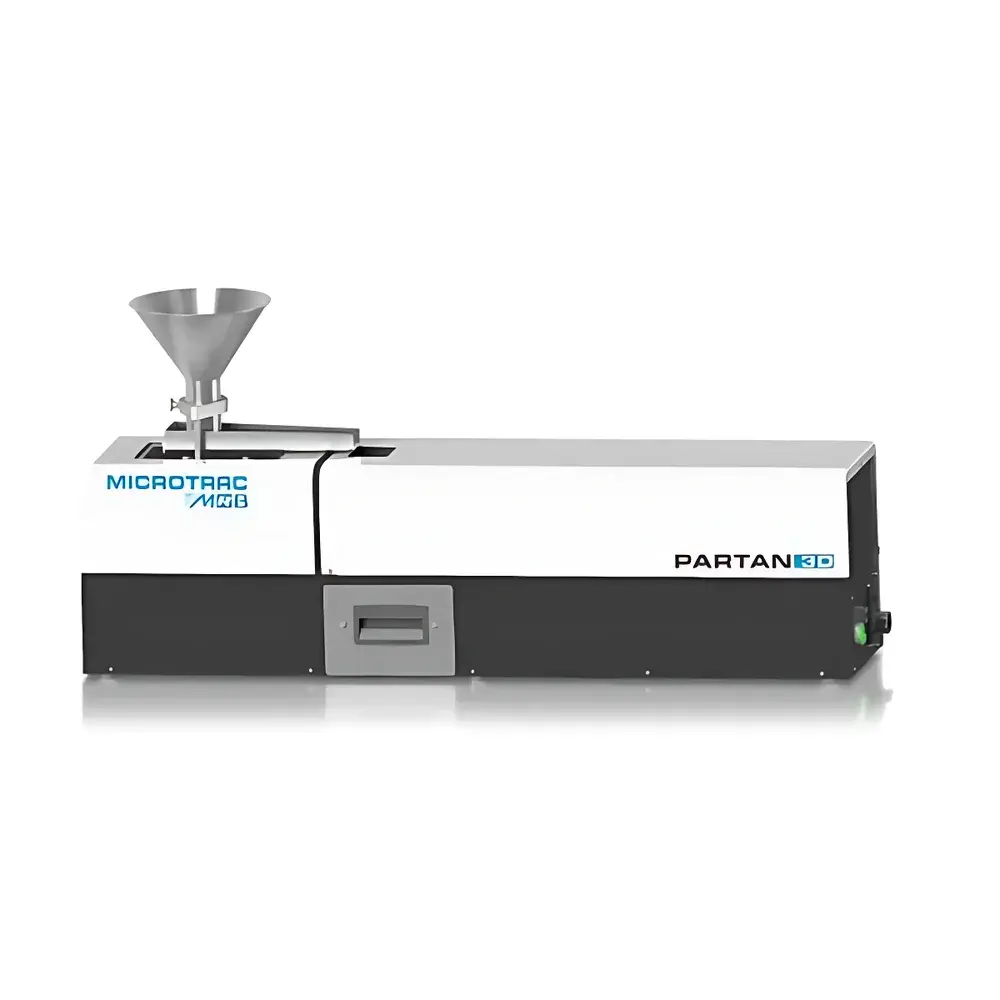
Microtrac MRB PARTAN 3D Image-Based 3D Particle Size and Shape Analyzer
| Brand | Microtrac MRB |
|---|---|
| Origin | Germany |
| Manufacturer Type | Authorized Distributor |
| Product Origin | Imported |
| Model | PARTAN 3D |
| Application Sector | Pharmaceutical |
| Instrument Type | Dynamic |
| Measurement Range | 22 µm – 35 mm |
| Camera Resolution | 2560 × 2048 pixels |
| Measured Parameters | Dimensional (length, width, thickness), Shape (13 descriptors), Surface Roughness (3 parameters), Density, Transparency, 3D Morphology |
Overview
The Microtrac MRB PARTAN 3D is a high-performance, dynamic image-based particle analyzer engineered for comprehensive 3D morphological characterization of dry, free-flowing particulates. Unlike conventional 2D imaging systems or laser diffraction instruments, the PARTAN 3D employs synchronized high-speed stereoscopic imaging combined with proprietary 3D reconstruction algorithms to capture and quantify true volumetric geometry—including length, width, and thickness—for each individual particle in real time. This enables rigorous, ISO 13322-2 compliant morphometric analysis across an exceptionally wide size range—from 22 µm up to 35 mm—making it uniquely suited for pharmaceutical excipients, catalysts, metal powders, mineral aggregates, and granulated food products. The system operates on the principle of multi-angle silhouette projection and depth-map triangulation, delivering metrologically traceable 3D data without reliance on assumptions about particle symmetry or sphericity.
Key Features
- True 3D particle measurement: Simultaneous acquisition of length, width, and thickness—enabling calculation of aspect ratios (e.g., thickness/width, length/thickness) not possible with planar imaging.
- High-speed dynamic analysis: 62 fps frame rate at full 2560 × 2048 resolution ensures statistically robust sampling (>10,000 particles per minute) even for fast-moving streams.
- 40 standardized morphological parameters: Including 15 dimensional descriptors (e.g., Feret max/min, Martin diameter, projected area), 13 shape factors (circularity, convexity, solidity, elongation), 3 surface roughness indices, bulk density estimation, transparency classification, and full 3D volume reconstruction.
- Self-cleaning sample delivery module: Integrated air-assisted vibration and anti-static coating minimize carryover and reduce manual intervention between runs—critical for GLP-compliant labs handling multiple formulations.
- Rugged, benchtop-integrated architecture: Designed for stable operation under variable ambient conditions (15–30 °C, 30–70% RH); no external environmental enclosures required.
- SOP-driven workflow engine: Supports user-defined filtering logic, channel configuration, and report templates—ensuring method reproducibility across shifts and operators.
Sample Compatibility & Compliance
The PARTAN 3D is validated for dry, non-cohesive, optically discernible particles exhibiting sufficient contrast against the background. It accommodates irregular, angular, fibrous, and porous materials—provided they remain freely suspended during transit through the measurement zone. The system complies with key international standards including ISO 13322-2 (Particle size analysis — Image analysis methods — Part 2: Dynamic image analysis), ASTM E2457 (Standard Test Method for Determining Particle Size Distribution of Powders Using Dynamic Image Analysis), and supports audit-ready documentation aligned with FDA 21 CFR Part 11 requirements when paired with optional secure software licensing. All calibration procedures follow NIST-traceable protocols using certified reference particle sets.
Software & Data Management
The proprietary PARTAN 3D software suite provides a fully integrated environment for acquisition, segmentation, feature extraction, statistical reporting, and export. Each analysis generates a structured dataset containing raw image sequences, per-particle metadata (including all 40 parameters), and population-level distributions. Filtering functions allow users to isolate subsets based on any combination of parameters—e.g., “particles >100 µm AND circularity 0.8”—with results exportable as CSV, Excel, or XML for LIMS integration. SOPs are saved as encrypted, version-controlled files with timestamped change logs. Image libraries support metadata-tagged search and comparative overlay analysis across batches or timepoints. All reports include instrument identification, operator ID, date/time stamps, and uncertainty estimates derived from pixel-resolution limits and optical magnification tolerances.
Applications
- Pharmaceutical solid dosage development: Quantifying granule sphericity, friability indicators, and blend uniformity via 3D shape clustering.
- Advanced material qualification: Assessing additive manufacturing feedstocks (e.g., Ti-6Al-4V, Inconel) for flowability predictors such as convexity and aspect ratio distribution.
- Quality control of industrial abrasives: Differentiating sharp-edged vs. rounded grains via surface roughness and angularity metrics.
- Geotechnical and construction materials: Classifying crushed rock aggregates by flakiness index (thickness/length) and elongation ratio per EN 933-3.
- Food powder optimization: Correlating 3D morphology with dissolution rate, compressibility, and hygroscopic behavior.
FAQ
What distinguishes PARTAN 3D from conventional 2D dynamic image analyzers?
It captures true three-dimensional geometry using dual-camera stereoscopy—not inferred projections—enabling thickness measurement and volumetric parameter derivation.
Can the system analyze wet or agglomerated samples?
No—it is designed exclusively for dry, free-flowing particles; slurry or cohesive materials require prior drying and deagglomeration steps.
Is calibration traceable to national standards?
Yes—calibration uses NIST-traceable spherical and irregular reference particles, with documented uncertainty budgets per ISO/IEC 17025 guidelines.
How does the system handle transparent or semi-transparent particles?
Transparency classification is performed via edge contrast gradient analysis and intensity profile modeling, allowing discrimination between glass, polymer, and crystalline phases.
Does the software support automated pass/fail decision logic based on user thresholds?
Yes—SOPs can embed conditional rules that trigger alerts or auto-classify batches into categories (e.g., “Accept”, “Review”, “Reject”) based on configurable parameter limits.



