
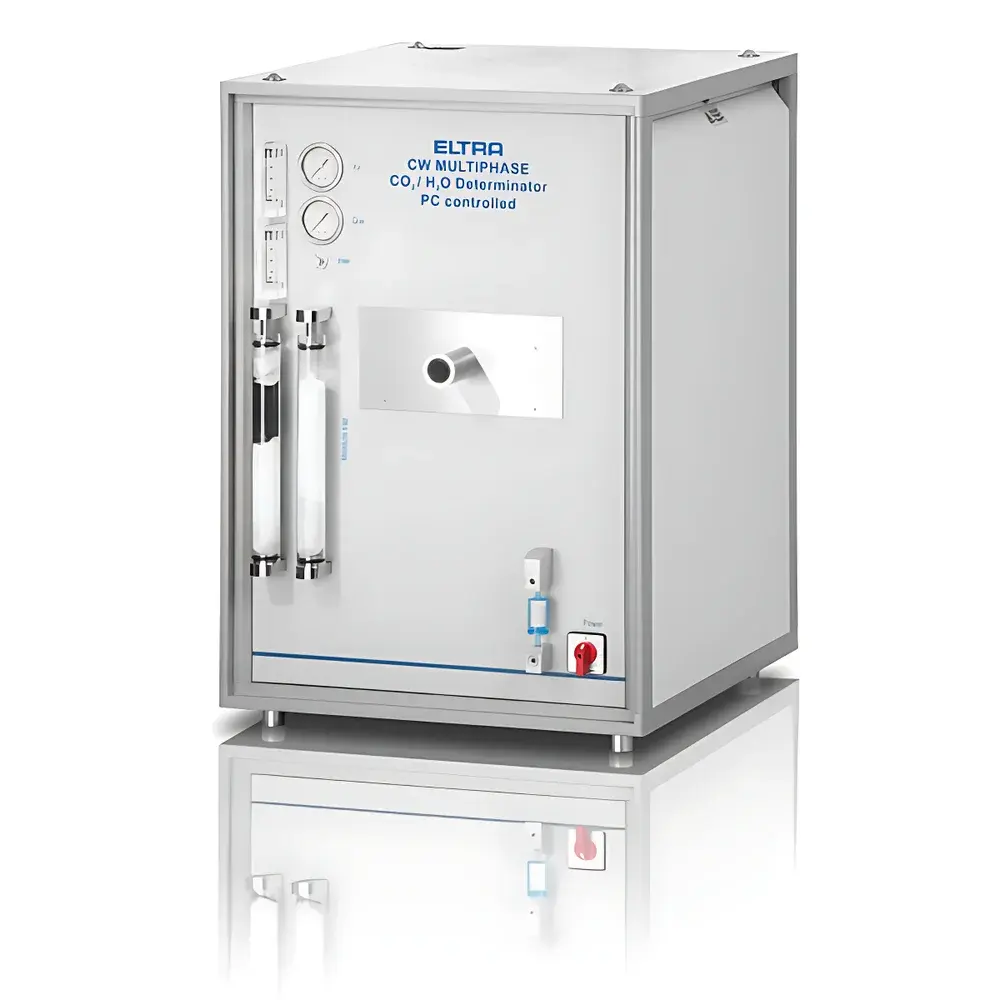
ELTRA CW-800M Carbon and Water Determinator
| Brand | ELTRA |
|---|---|
| Origin | Germany |
| Model | CW-800M |
| Measurement Principle | Infrared Absorption |
| Heating System | Resistance Furnace |
| Temperature Range | Up to 1000 °C (adjustable in 1 °C increments) |
| CO₂ Measurement Range | 0–70 % |
| H₂O Measurement Range | 0–20 % |
| Sensitivity | 0.0001 % for both CO₂ and H₂O |
| Accuracy | ±0.02 % |
| Analysis Time | 2–30 minutes |
| Detection Cells | Dual independent gold-coated IR cells |
| Atmosphere Options | O₂ or inert gas (e.g., N₂) |
| Programmable Temperature Steps | Up to 5 per method |
| Compliance | Designed for GLP/GMP environments |
Overview
The ELTRA CW-800M Carbon and Water Determinator is a high-precision, dual-channel elemental analyzer engineered for the simultaneous quantitative determination of total carbon (as CO₂) and moisture (as H₂O) in solid inorganic and mineralogical samples. Based on non-dispersive infrared (NDIR) absorption spectroscopy, the instrument quantifies evolved CO₂ and H₂O gases following controlled thermal decomposition in a programmable resistance furnace. Unlike conventional TOC analyzers requiring acidification or catalytic oxidation, the CW-800M directly measures carbon content via combustion—enabling accurate assessment of both organic and inorganic carbon fractions (TOC and TIC) without chemical pretreatment. Its robust architecture integrates dual gold-coated infrared detection cells, each optimized for spectral specificity and long-term stability under corrosive conditions—particularly critical when analyzing halogen-rich, acidic, or sulfate-bearing matrices such as slag, gypsum, cement clinker, or metallurgical residues.
Key Features
- Dual independent NDIR detectors with gold-plated optical cells for high selectivity and resistance to corrosion from halogens, SOₓ, and acidic vapors
- Programmable 5-step temperature ramping (up to 1000 °C, adjustable in 1 °C increments), enabling method-specific thermal release profiling for differentiated carbon speciation (e.g., carbonate vs. organic carbon)
- Electronic mass flow control for carrier and oxygen gases—ensuring reproducible purge conditions without mechanical regulators or manual calibration
- Automated quartz boat handling and gravimetric sample introduction, compatible with standard analytical balances (0.01 mg resolution recommended)
- Zero-maintenance optical path design: no moving parts in the detector assembly, no consumable filters or desiccants required
- Full compliance-ready software architecture supporting electronic signatures, audit trails, and role-based user permissions aligned with FDA 21 CFR Part 11 and ISO/IEC 17025 documentation requirements
Sample Compatibility & Compliance
The CW-800M accommodates heterogeneous solid matrices across geoscience, construction materials, metallurgy, and waste characterization sectors. Validated applications include limestone, dolomite, gypsum, Portland cement, blast furnace slag, fly ash, bauxite, iron ore, contaminated soils, and municipal solid waste incineration residues. Sample mass ranges from 10 mg to 1 g depending on expected carbon/water concentration—enabling high sensitivity for trace-level analysis while maintaining linearity up to 100 % carbon in calcite or 20 % moisture in hygroscopic minerals. The system operates under either oxidative (O₂) or inert (N₂/Ar) atmospheres, permitting selective decomposition pathways—for instance, distinguishing thermally labile organics from refractory carbonates. All methods are fully traceable to certified reference materials (CRMs) including NIST SRM 278, BAM S101, and ELTRA’s proprietary calibration standards. Instrument validation protocols support IQ/OQ/PQ execution per ASTM D5373, ISO 1171, and EN 15407.
Software & Data Management
ELTRA’s proprietary WinCW software provides a multilingual, modular interface for method development, real-time process monitoring, and compliant data export. Each analysis generates a time-resolved “thermal evolution profile” displaying CO₂ and H₂O signal intensities versus furnace temperature—facilitating peak deconvolution and speciation diagnostics. Calibration routines support single-point verification or multi-point linear/nonlinear regression using up to 12 standards per element. Raw data files (.cwdat) retain full metadata: operator ID, timestamp, furnace program, gas flow logs, and detector baseline history. Export formats include CSV, PDF analytical reports (with optional lab logo and QA/QC flags), and XML for LIMS integration. All data modifications are logged with immutable timestamps and user attribution—meeting GLP audit requirements for pharmaceutical excipient testing and environmental soil certification workflows.
Applications
- Quality control of cementitious materials: rapid quantification of free lime (CaO), carbonate content, and residual moisture affecting setting behavior
- Mineral processing: grade estimation of carbonate-hosted ores (e.g., siderite, magnesite) and evaluation of roasting efficiency in metallurgical feedstocks
- Environmental compliance: determination of total organic carbon in contaminated soils per EPA Method 9060A and inorganic carbon in alkaline waste streams
- Waste-to-energy facilities: monitoring carbon burnout efficiency and moisture-related calorific value loss in RDF/SRF feedstock
- Research laboratories: kinetic studies of thermal decomposition pathways in layered double hydroxides, clays, and hydrated salts
FAQ
Does the CW-800M require acid digestion or catalysts to measure total organic carbon (TOC)?
No. The instrument quantifies TOC through high-temperature combustion (>900 °C) in oxygen atmosphere, eliminating need for persulfate oxidation or platinum catalysts.
Can it distinguish between carbonate carbon and organic carbon in a single run?
Yes—via programmable multi-stage heating profiles, users can isolate low-temperature organic decomposition (800 °C).
Is the gold-coated IR cell resistant to sulfur compounds commonly found in coal ash or flue gas desulfurization residues?
Yes—the electroplated gold surface resists sulfidation and maintains optical integrity over >10,000 analyses under routine operation with sulfur-rich samples.
What level of regulatory compliance does the software support?
WinCW meets FDA 21 CFR Part 11 requirements for electronic records and signatures, including audit trail generation, user access tiers, and data immutability controls.
How is calibration verified between scheduled maintenance intervals?
Daily verification uses a certified quartz sand blank and a mid-range CRM; drift correction is applied automatically if signal deviation exceeds ±0.005 % for CO₂ or H₂O.
Related Products






