
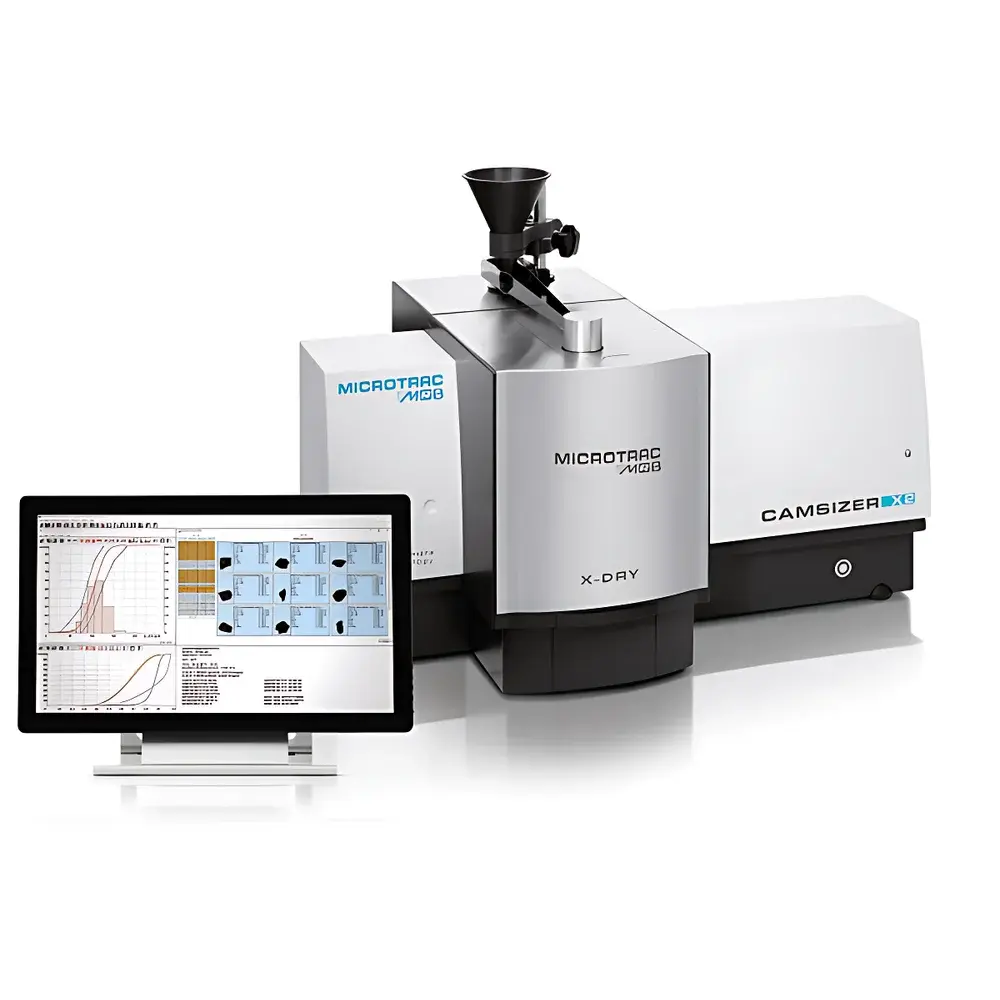
Microtrac MRB CAMSIZER X2 Image-Based Particle Size and Shape Analyzer
| Brand | Microtrac MRB |
|---|---|
| Origin | Germany |
| Manufacturer Type | Authorized Distributor |
| Product Category | Imported Instrument |
| Model | CAMSIZER X2 |
| Application Fields | Pharmaceutical, Chemical, Materials Science, Additive Manufacturing, Battery Materials |
| Instrument Type | Dynamic Imaging Analyzer |
| Number of Lenses | Dual-Lens System (ISO 13322-2 Compliant) |
| Measurement Range | 0.8 µm – 8 mm |
| Sample Dispersion Methods | X-Jet (Compressed Air Jet Disperser), X-Flow (Wet Dispersion with Ultrasonic Agitation), X-Fall (Gravity-Based Free-Fall Dry Dispersion) |
| Optical Resolution | 0.8 µm per pixel (effective particle detection limit) |
| Measured Morphological Parameters | Aspect Ratio, Symmetry, Sphericity, Convexity, Solidity, Circularity, Elongation, Roundness, Compactness, Transparency Index, Density Estimation (via grayscale calibration) |
Overview
The Microtrac MRB CAMSIZER X2 is a high-performance dynamic image analysis system engineered for simultaneous, non-invasive measurement of particle size distribution (PSD) and multidimensional morphological parameters. Operating on the principle of high-speed digital imaging under controlled illumination and precise particle trajectory capture, the instrument complies fully with ISO 13322-2:2013 for image-based particle characterization. Unlike static or laser diffraction methods, the CAMSIZER X2 captures individual particle silhouettes in motion—enabling statistically robust quantification of both dimensional and shape-related descriptors across an exceptionally wide dynamic range (0.8 µm to 8 mm). Its dual-lens optical architecture provides orthogonal magnification paths, eliminating parallax error and ensuring sub-micron resolution fidelity even at the lower detection limit. Designed specifically for quality-critical environments—including pharmaceutical powder processing, ceramic feedstock evaluation, and battery cathode/anode material qualification—the system delivers traceable, reproducible data suitable for regulatory submission and process validation.
Key Features
- Dual-lens imaging system compliant with ISO 13322-2, delivering calibrated pixel resolution down to 0.8 µm and minimizing edge distortion across all magnifications
- Three interchangeable dispersion modules: X-Fall (gravity-fed dry dispersion for fragile or electrostatic-sensitive powders), X-Jet (adjustable pressure and nozzle geometry for controlled pneumatic deagglomeration), and X-Flow (wet dispersion with integrated ultrasonic probe and recirculation pump)
- Next-generation pulsed LED illumination with optimized spectral profile and microsecond-level synchronization, enhancing contrast and reducing motion blur for fast-moving particles
- Real-time particle tracking algorithm capable of resolving >1000 size classes per measurement, with simultaneous output of size distribution, count-weighted morphology indices, transparency coefficient, and estimated particle density
- Robust mechanical design rated for industrial laboratory environments—dust-resistant enclosure, vibration-damped optical bench, and self-cleaning airflow pathways minimize maintenance intervals
- Full password protection, user-level access control, and audit-trail-enabled software architecture aligned with FDA 21 CFR Part 11 requirements for electronic records and signatures
Sample Compatibility & Compliance
The CAMSIZER X2 accommodates a broad spectrum of particulate materials—from cohesive nanostructured oxides and spray-dried API aggregates to coarse metal powders used in additive manufacturing. Its modular dispersion strategy ensures minimal mechanical stress during sample introduction: X-Fall preserves delicate dendritic or hollow structures; X-Jet enables tunable shear forces for breaking weak agglomerates without fracturing primary particles; X-Flow supports refractive-index-matched liquid suspensions for transparent or high-aspect-ratio particles. All measurement protocols are documented per ISO 13322-2, and raw image archives, metadata logs, and calibration certificates are retained for GLP/GMP-compliant audits. The system supports direct correlation with legacy sieve analysis data through built-in conversion matrices referenced to ASTM E11 and ISO 3310-1 standards.
Software & Data Management
CAMSIZER Control Software v6.x provides an intuitive, multilingual interface (including English, German, Japanese, and Simplified Chinese) with wizard-guided method setup, real-time preview, and automated report generation. Each measurement session generates a comprehensive dataset including: volumetric and number-based PSD histograms, scatter plots of sphericity vs. aspect ratio, convexity–solidity correlation maps, and statistical summaries (D10/D50/D90, span, skewness, kurtosis). Data export options include CSV, PDF, XML, and SQL-compatible formats. Raw image stacks are stored with timestamped EXIF metadata and can be reprocessed using updated algorithms without re-measurement. The software includes full version control, electronic signature fields, and configurable audit trails meeting ALCOA+ principles for data integrity.
Applications
- Pharmaceutical solid dosage development: Quantifying granule sphericity and surface roughness to predict flowability, compressibility, and blend uniformity
- Advanced ceramics and catalysts: Correlating pore structure proxies (e.g., convexity loss) with sintering behavior and catalytic surface area
- Lithium-ion battery materials: Characterizing NMC/NCM cathode morphology and graphite anode flake geometry to optimize electrode slurry rheology and coating homogeneity
- Food and nutraceutical powders: Assessing crystallinity-induced shape changes during milling or drying to ensure dissolution consistency
- 3D printing metal powders: Verifying spherical morphology and detecting satellite particles or oxide films that impair layer fusion
FAQ
What standards does the CAMSIZER X2 comply with for particle characterization?
It conforms to ISO 13322-2:2013 for image analysis, and its dispersion modules support method alignment with ASTM D6377 (dry dispersion), ASTM D7216 (wet dispersion), and USP <429> for pharmaceutical particle testing.
Can the system differentiate between broken particles and naturally irregular shapes?
Yes—by combining high-resolution edge detection with convexity/solidity metrics and user-defined thresholding, the software distinguishes fracture features (sharp angularity, high local curvature gradients) from inherent morphological heterogeneity.
Is calibration traceable to national metrology institutes?
All optical calibrations use NIST-traceable stage micrometers and certified reference particle sets (e.g., NIST SRM 1980), with calibration certificates issued per ISO/IEC 17025 requirements.
How is data integrity ensured during long-term deployment in regulated environments?
The software enforces role-based permissions, immutable audit logs, electronic signatures, and automatic backup to network drives—all configurable to satisfy FDA 21 CFR Part 11 and EU Annex 11 validation criteria.
Does the system support method transfer between laboratories?
Yes—measurement methods, dispersion settings, and analysis templates are fully exportable/importable as encrypted .camx files, enabling consistent cross-site implementation and inter-laboratory comparability studies.



