
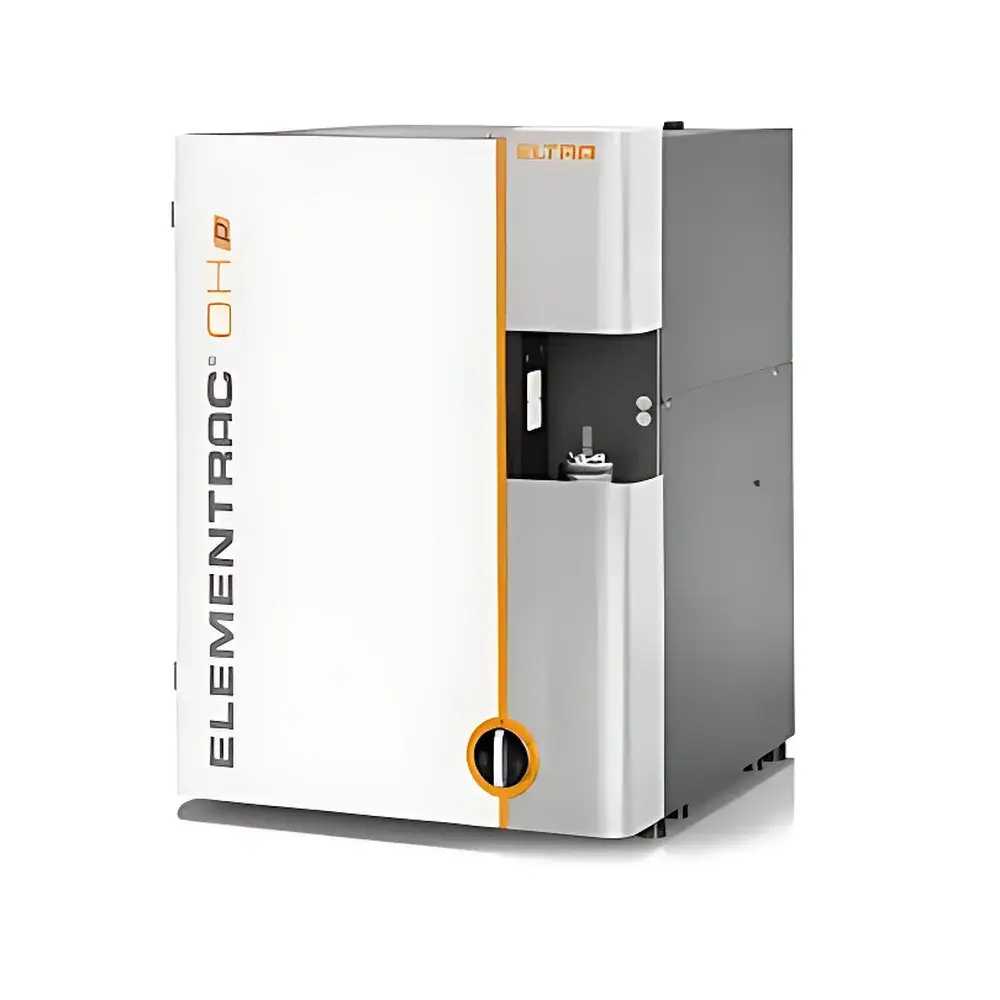
ELTRA ELEMENTRAC OH-p 2 Oxygen and Hydrogen Analyzer
| Brand | ELTRA |
|---|---|
| Origin | Germany |
| Model | OH-p 2 |
| Instrument Type | Oxygen/Hydrogen Analyzer |
| Analysis Time | 120–180 s |
| Pulse Furnace Power | Up to 8,500 W |
| Detection Principle | Non-Dispersive Infrared (NDIR) for Oxygen, Thermal Conductivity Detection (TCD) for Hydrogen |
| Sample Form Compatibility | Solid rods, granules, powders |
| Max. Sample Weight | 2 g |
| Compliant Standards | ASTM E1019, DIN EN 3976 |
| Carrier Gas Options | Argon (economical), Helium |
| Optional | Automatic Graphite Crucible Cleaner |
Overview
The ELTRA ELEMENTRAC OH-p 2 is a high-performance, solid-state elemental analyzer engineered for the precise and reproducible quantification of oxygen (O) and hydrogen (H) in inorganic materials. It operates on a dual-detection principle: oxygen is measured via high-sensitivity non-dispersive infrared (NDIR) spectroscopy following quantitative combustion in a graphite crucible, while hydrogen is determined using a calibrated thermal conductivity detector (TCD) after thermal extraction under inert atmosphere. The instrument employs a high-power pulse furnace (up to 8,500 W) to achieve rapid, complete liberation of interstitial and bound O/H species from refractory matrices—including steels, cast irons, copper alloys, ceramics, slags, and geological samples. Its vertical sample introduction mechanism and integrated pulse-degassing stage ensure consistent sample positioning and minimized memory effects, supporting robust trace-level detection (sub-ppm range) as well as high-concentration analysis (up to several weight percent) with excellent linearity and long-term stability.
Key Features
- High-power pulse furnace (8,500 W) enabling rapid heating rates (>1,000 °C/s) and full decomposition of thermally stable oxides and hydrides
- Vertical, gravity-fed sample introduction system with automated crucible handling—optimized for rods, granules, and fine powders up to 2 g
- Dual-detector architecture: NDIR cell with temperature-stabilized optics for oxygen; precision TCD with flow-compensated reference channel for hydrogen
- Closed-loop gas circuit design minimizing carrier gas consumption (argon or helium) while enhancing signal-to-noise ratio and baseline stability
- Optional automatic graphite crucible cleaner reduces manual maintenance and improves inter-run reproducibility in high-throughput labs
- Integrated pressure regulation, flow control, and real-time gas purity monitoring to ensure analytical integrity across extended operation cycles
Sample Compatibility & Compliance
The OH-p 2 is validated for use with a broad spectrum of metallurgical and ceramic materials, including low-alloy and stainless steels, titanium alloys, nickel-based superalloys, aluminum and copper matrices, fused silica, alumina ceramics, blast furnace slags, and mineral ores. Its methodology conforms to internationally recognized test standards including ASTM E1019 (Standard Test Methods for Determination of Carbon, Sulfur, Nitrogen, and Oxygen in Steel, Iron, Nickel, and Cobalt Alloys), DIN EN 3976 (Metallic materials — Determination of oxygen content — Infrared absorption method after fusion), and ISO 14284 (Steel and iron — Sampling and preparation of samples for the determination of chemical composition). The system supports GLP-compliant operation through audit-trail-enabled software, electronic signature capability, and configurable user access levels aligned with FDA 21 CFR Part 11 requirements.
Software & Data Management
Control and data evaluation are performed via ELTRA’s proprietary WinElement software, a Windows-based platform offering full instrument automation, method library management, calibration curve generation (linear and polynomial), and statistical reporting (mean, SD, RSD, confidence intervals). All raw detector signals, furnace temperature profiles, gas flow logs, and calibration metadata are timestamped and stored in a secure, encrypted database. Export options include CSV, PDF, and XML formats compatible with LIMS integration. The software provides built-in validation tools for system suitability testing (SST), drift correction, and carryover assessment—critical for routine QC/QA workflows in certified metallurgical testing laboratories.
Applications
- Quality control of specialty steels where hydrogen embrittlement risk demands sub-2 ppm H specification
- Oxygen content verification in high-purity copper used for semiconductor interconnects and superconducting wire fabrication
- Process optimization in powder metallurgy, where residual O/H affects sintering behavior and final density
- Characterization of ceramic matrix composites (CMCs) for aerospace applications requiring strict stoichiometric control
- Research-grade analysis of hydrogen storage materials (e.g., metal hydrides) and oxide-ion conductors (e.g., YSZ, CGO)
- Regulatory compliance testing for scrap metal recycling facilities adhering to ISO 14001 environmental management protocols
FAQ
What carrier gases are compatible with the OH-p 2?
Argon is the standard, cost-effective carrier gas; helium may be selected for enhanced hydrogen sensitivity or when analyzing highly reactive samples.
Can the OH-p 2 analyze molten or liquid samples?
No—it is designed exclusively for solid, dry, non-volatile inorganic specimens. Liquids, organics, or volatile compounds must be excluded to prevent damage to the furnace and detectors.
Is external cooling water required for operation?
Yes—a continuous supply of deionized cooling water (15–25 °C, 2–4 bar) is mandatory for furnace and detector thermal management during high-power pulses.
How often does the graphite crucible require replacement?
Crucible lifetime depends on sample matrix and frequency; typical service life ranges from 100–500 analyses. The optional automatic cleaner extends this by >30% under routine steel analysis conditions.
Does the system support remote diagnostics or preventive maintenance alerts?
Yes—WinElement includes predictive health monitoring for furnace performance, detector response decay, and gas system integrity, with configurable email notifications for scheduled service events.




