
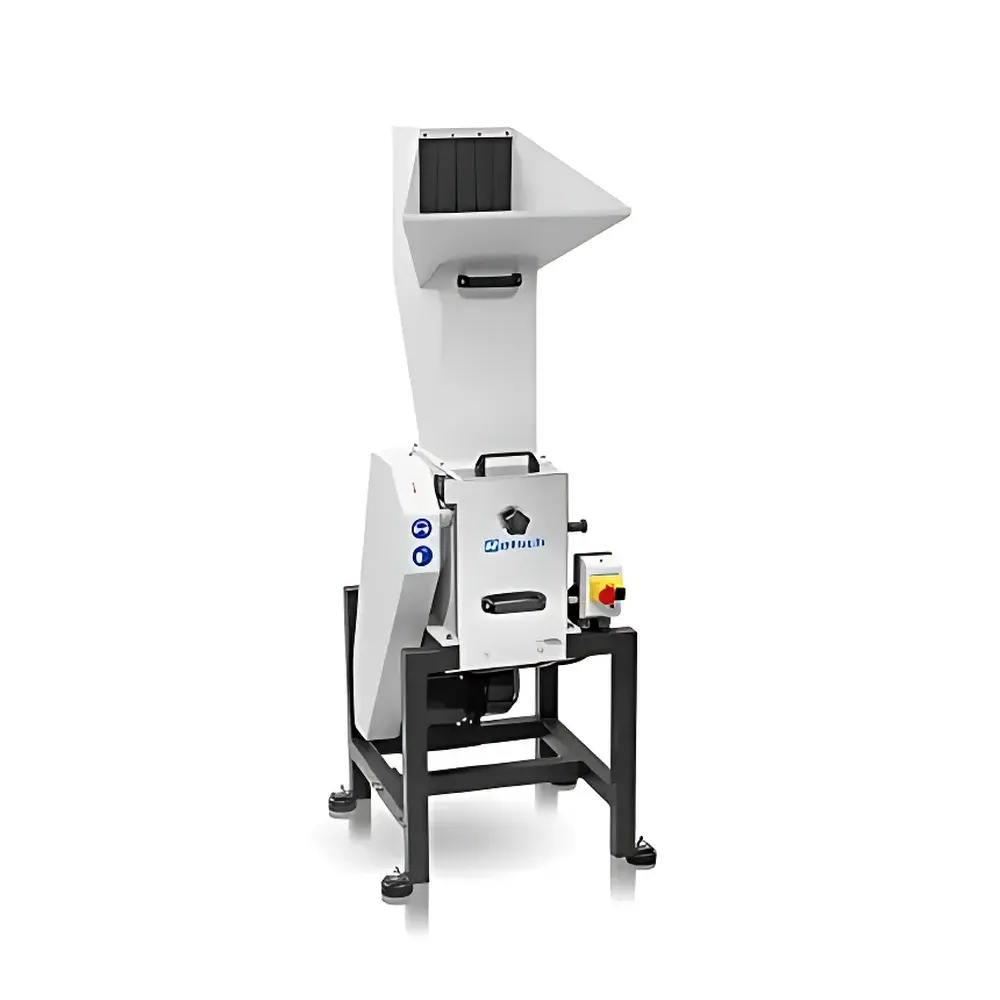
Retsch SM400 Cutting Mill
| Brand | Retsch |
|---|---|
| Origin | Germany |
| Model | SM400 |
| Instrument Type | Cutting Mill |
| Sample Type | Soft, medium-hard, elastic, fibrous, and heterogeneous materials |
| Maximum Feed Size | < 170 × 220 mm |
| Final Particle Size Range | 1–20 mm |
| Sieve Aperture Options | Trapezoidal holes (1.00 / 2.00 mm) |
| Grinding Chamber Volume | ~7.45 L |
| Rotor Diameter | 152 mm |
| Rotor Tip Speed | 2.25 m/s |
| Nominal Speed | 280 rpm (50/60 Hz) |
| Drive Motor | Three-phase, 3 kW |
| Collection Capacity | 5 L container |
| Protection Rating | IP54 |
| Dimensions (W × H × D) | 695 × 1399 × 719 mm |
| Net Weight | ~180 kg |
| Compliance | CE-marked, designed and manufactured in accordance with EU Machinery Directive 2006/42/EC and Low Voltage Directive 2014/35/EU |
Overview
The Retsch SM400 Cutting Mill is a high-capacity, industrial-grade cutting mill engineered for reproducible size reduction of soft, medium-hard, elastic, fibrous, and heterogeneous materials. Operating on the principle of high-torque shear cutting, the SM400 employs a robust rotating knife rotor paired with fixed counter knives to achieve controlled particle size reduction through mechanical shearing rather than impact or compression. Its design prioritizes thermal management—critical for heat-sensitive biological, pharmaceutical, and food samples—by minimizing residence time and avoiding excessive frictional heating. With a maximum feed dimension of 170 × 220 mm, the SM400 accommodates bulky, irregularly shaped specimens without pre-cutting, enabling single-step processing from raw sample to final granulate. The mill’s rigid cast-iron housing, precision-machined rotor assembly, and modular sieve system ensure long-term dimensional stability and consistent throughput across extended operational cycles.
Key Features
- 3 kW three-phase motor delivering high torque at low rotational speed (280 rpm), optimized for shear-dominated size reduction with minimal heat generation
- Large-diameter rotor (152 mm) with parallel cutting blades made from hardened steel or optional tungsten carbide—engineered for wear resistance and longevity in abrasive applications
- Fully accessible grinding chamber (~7.45 L volume) with smooth internal surfaces and foldable feed hopper for rapid cleaning and residue-free sample changeover
- Interchangeable trapezoidal and round-hole sieves (1.00–20.00 mm aperture) mounted beneath the cutting zone to define final particle size distribution
- IP54-rated enclosure ensuring protection against dust ingress and water splashing—suitable for routine use in analytical laboratories, QA/QC environments, and pilot-scale preparation labs
- CE-compliant construction meeting essential health and safety requirements per EU Machinery Directive 2006/42/EC and Electromagnetic Compatibility Directive 2014/30/EU
Sample Compatibility & Compliance
The SM400 is validated for processing diverse organic and synthetic matrices including plant tissues, polymers, rubber compounds, textiles, compost, soil aggregates, and pharmaceutical excipients. It supports regulatory workflows aligned with ISO 17025-accredited testing laboratories, particularly where sample homogeneity and particle size control are prerequisites for downstream analysis (e.g., elemental analysis by ICP-OES, moisture determination per ISO 18810, or leaching tests per EN 12457). While not intrinsically compliant with FDA 21 CFR Part 11, its mechanical operation allows full integration into GxP environments when coupled with documented SOPs, calibration records, and operator training logs. All critical components—including rotor, knives, and sieve holders—are traceable via serial-numbered parts documentation supplied with each unit.
Software & Data Management
As a standalone mechanical instrument, the SM400 does not incorporate embedded digital controls or firmware. However, it is fully compatible with laboratory information management systems (LIMS) and electronic lab notebooks (ELN) through manual entry of operational parameters (e.g., sieve type, run duration, batch ID) and physical sample tracking. Optional accessories—including cyclone separators and vacuum feed modules—can be integrated into automated sample preparation lines governed by programmable logic controllers (PLCs). Routine maintenance intervals, blade sharpening schedules, and calibration verifications (e.g., sieve mesh certification per ISO 3310-1) are supported by Retsch’s global service network and documented in the provided technical manual.
Applications
- Environmental laboratories: Homogenization of heterogeneous waste streams, sludge, and compost prior to heavy metal analysis or organic pollutant screening
- Agricultural research: Preparation of cereal grains, forage crops, and root vegetables for NIR spectroscopy, starch quantification, or mycotoxin extraction
- Pharmaceutical development: Pre-processing of tablet binders, excipients, and herbal matrices prior to dissolution testing or content uniformity assessment
- Materials science: Size reduction of polymer blends, elastomers, and composite laminates for rheological characterization or thermal analysis (TGA/DSC)
- Food safety labs: Representative sampling of bulk food products (e.g., dried fruits, nuts, meat analogs) for microbiological or allergen testing per ISO 6887-1
FAQ
What types of materials are unsuitable for processing in the SM400?
Materials with extreme hardness (e.g., quartz, ceramics), high metal content (>5% ferrous), or excessive moisture (>15% w/w) may cause premature blade wear, clogging, or motor overload and are not recommended without prior drying or mechanical pre-conditioning.
Can the SM400 be used under inert atmosphere conditions?
No—the standard SM400 lacks gas-tight sealing or purge ports; for oxygen-sensitive or pyrophoric samples, alternative solutions such as cryogenic milling or glovebox-integrated mills should be considered.
Is sieve calibration traceable to national standards?
Yes—Retsch provides optional certified sieve sets with individual calibration certificates traceable to PTB (Physikalisch-Technische Bundesanstalt) or equivalent NMI-accredited bodies, compliant with ISO/IEC 17025 requirements.
How frequently should rotor knives be resharpened or replaced?
Under typical use with soft-to-medium-hard organic samples, knives require resharpening every 200–300 operating hours; tungsten carbide variants extend service life by up to 3× depending on abrasiveness and feed rate.
Does the SM400 meet explosion protection requirements for ATEX zones?
No—the base configuration is not ATEX-certified; however, Retsch offers customized versions with static-dissipative components and grounding provisions upon request for Zone 22 dust environments.



