
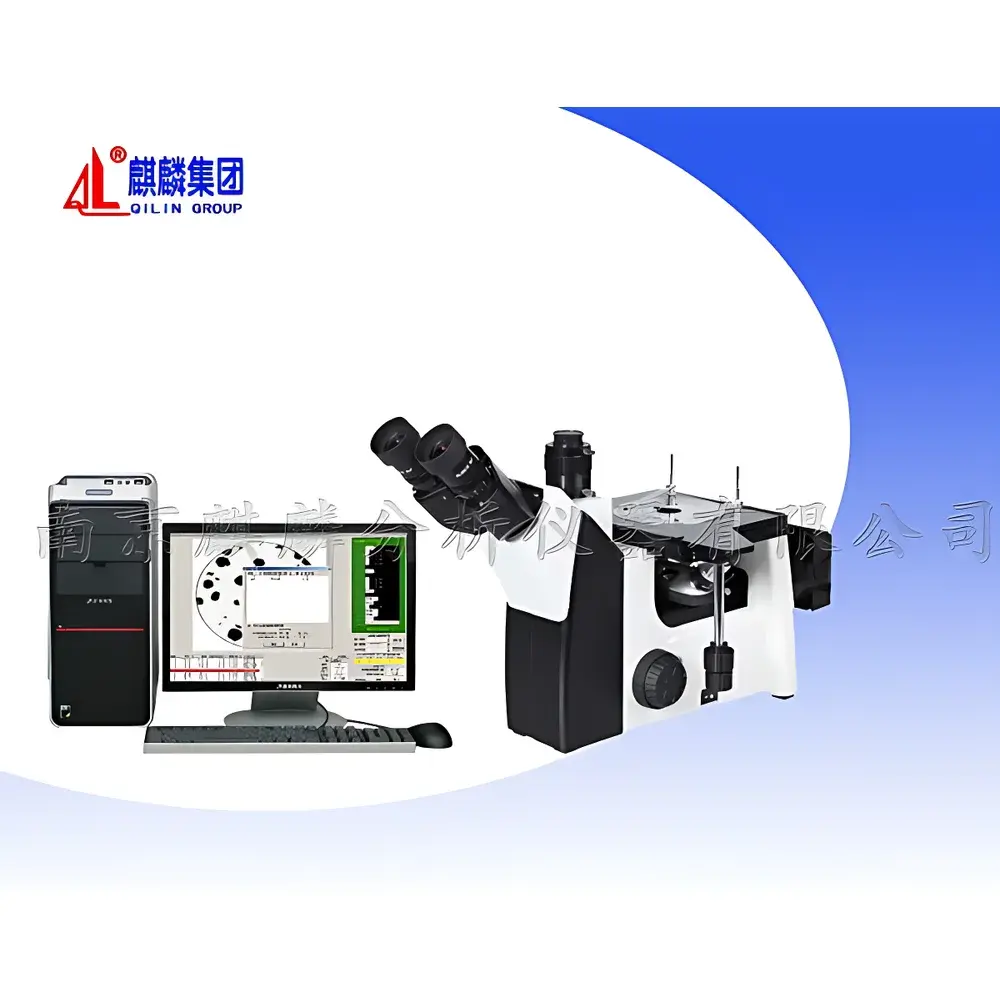
QL-DS3C Metallurgical Image Analysis System by Qilin
| Brand | Qilin (QL) |
|---|---|
| Origin | Jiangsu, China |
| Model | QL-DS3C |
| Magnification Range | 100×–1250× |
| Illumination | 6 V / 20 W Halogen Lamp |
| Focusing Travel | 26 mm |
| Fine Focus Graduation | 0.002 mm |
| Stage Travel | 75 mm × 50 mm |
| Objective Lenses | 10×, PL 40×, 100× (Oil Immersion) |
| Eyepieces | Wide-Field 10×, 12.5× |
| Digital Imaging Interface | USB 2.0 CMOS Camera Support |
| Software Compatibility | Windows-based metallurgical image analysis suite (optional) |
Overview
The QL-DS3C Metallurgical Image Analysis System is a modular, computer-integrated optical metrology platform engineered for quantitative microstructural characterization of metallic and advanced material specimens. Built upon the Qilin trinocular metallurgical microscope chassis, it incorporates high-fidelity digital imaging hardware—including a calibrated USB 2.0 CMOS camera—and interfaces directly with dedicated metallurgical image analysis software. The system operates on standard brightfield, darkfield, and polarized light contrast modes, enabling precise visualization and measurement of grain boundaries, phase distributions, inclusion morphology, precipitate size, and etch-pit geometry. Its optical path supports Köhler illumination and maintains parfocality across all objective magnifications (100× to 1250×), ensuring consistent focus and minimal aberration during multi-scale inspection workflows. Designed for laboratory environments where traceability and repeatability are critical—such as QC labs in foundries, aerospace component suppliers, and university materials science departments—the QL-DS3C delivers deterministic image acquisition aligned with ASTM E112 (grain size), ASTM E1245 (inclusion rating), and ISO 643 standards.
Key Features
- Trinocular optical head with 100% beam-splitting capability for simultaneous visual observation and digital capture
- Standard objective set: Plan achromatic 10×, PL 40×, and oil-immersion 100× objectives with numerical apertures optimized for resolution at 550 nm wavelength
- Wide-field eyepieces (10× and 12.5×) providing field numbers ≥22 mm for extended viewing comfort and reduced eye strain during prolonged analysis
- Coaxial coarse/fine focusing mechanism with 26 mm vertical travel and 0.002 mm fine-focus graduation for sub-micron Z-axis positioning control
- Mechanical stage with 75 mm × 50 mm travel range and vernier-scaled X/Y readouts for repeatable specimen navigation and coordinate mapping
- Stable halogen illumination (6 V / 20 W) with adjustable intensity and heat-absorbing filter to minimize thermal drift during extended imaging sessions
- USB 2.0 digital camera interface supporting real-time preview, frame buffering, and lossless TIFF/PNG export for archival integrity
Sample Compatibility & Compliance
The QL-DS3C accommodates standard metallurgical sample formats—including 25 mm, 30 mm, and 50 mm diameter polished mounts—as well as thin-sectioned PCB cross-sections, semiconductor wafers, ceramic fracture surfaces, and mineral thin sections. Specimen thickness up to 30 mm is supported via extended working distance compatibility. All optical components comply with ISO 8578 (microscope mechanical tolerances) and JIS B 7151 (metallurgical microscope performance testing). When configured with audit-trail-enabled software (e.g., optional Qilin ImagePro-Metallurgy Suite), the system supports GLP/GMP-aligned documentation workflows, including user-defined report templates, electronic signatures, and time-stamped metadata logging per FDA 21 CFR Part 11 requirements.
Software & Data Management
The optional metallurgical image analysis software provides calibrated pixel-to-micron conversion using stage micrometer calibration routines. Core functionalities include dynamic thresholding for phase segmentation, Feret diameter and equivalent circular diameter (ECD) calculation, aspect ratio and roundness metrics, linear and angular measurement tools with statistical summarization (mean, SD, min/max), and customizable overlay of ASTM/ISO reference charts (e.g., GB/T 6394, ASTM E112 comparison charts). Image datasets are stored in hierarchical folder structures with embedded EXIF metadata (magnification, objective ID, exposure time, lens aperture). Export options include PDF reports with embedded vector graphics, Excel-compatible CSV tables for statistical process control (SPC), and DICOM-compliant files for integration into enterprise LIMS platforms.
Applications
- Quantitative metallography: grain size distribution analysis (ASTM E112), inclusion rating (ASTM E45), and phase fraction measurement in ferrous/non-ferrous alloys
- Failure analysis: crack propagation path mapping, void coalescence assessment, and intergranular corrosion evaluation in welded joints and heat-affected zones
- Electronics manufacturing: solder joint integrity verification, wire bond pull-test cross-section analysis, and COG (Chip-on-Glass) alignment tolerance validation
- Geological and mineralogical research: quartz/feldspar grain boundary identification, porosity quantification in reservoir rocks, and ore mineral liberation analysis
- Advanced materials R&D: dispersion homogeneity assessment in metal matrix composites, carbide clustering analysis in tool steels, and oxide layer thickness measurement on coated substrates
FAQ
What is the maximum usable magnification for quantitative measurements?
At 1250× total magnification (100× objective + 12.5× eyepiece), the system achieves optimal resolution for features ≥0.2 µm under ideal Köhler illumination and oil immersion conditions. For statistically robust grain size analysis, magnifications between 100× and 400× are recommended per ASTM E112 guidelines.
Can the system be validated for ISO/IEC 17025 accredited laboratories?
Yes—when paired with NIST-traceable stage micrometers and documented calibration procedures, the QL-DS3C meets the metrological requirements for scope accreditation under ISO/IEC 17025:2017 clause 6.4 (equipment) and 6.5 (traceability). Full validation packages (IQ/OQ/PQ) are available upon request.
Is third-party software integration supported?
The camera driver complies with DirectShow and TWAIN protocols, enabling native integration with ImageJ/Fiji, MATLAB Image Processing Toolbox, and commercial platforms such as Olympus Stream or Zeiss ZEN via SDK extensions.
What maintenance is required for long-term optical stability?
Annual cleaning of optical surfaces with lens-grade solvents and re-alignment of condenser centering per manufacturer’s service manual is recommended. Halogen lamp replacement every 1,000 operating hours ensures consistent color temperature and illumination uniformity.





