
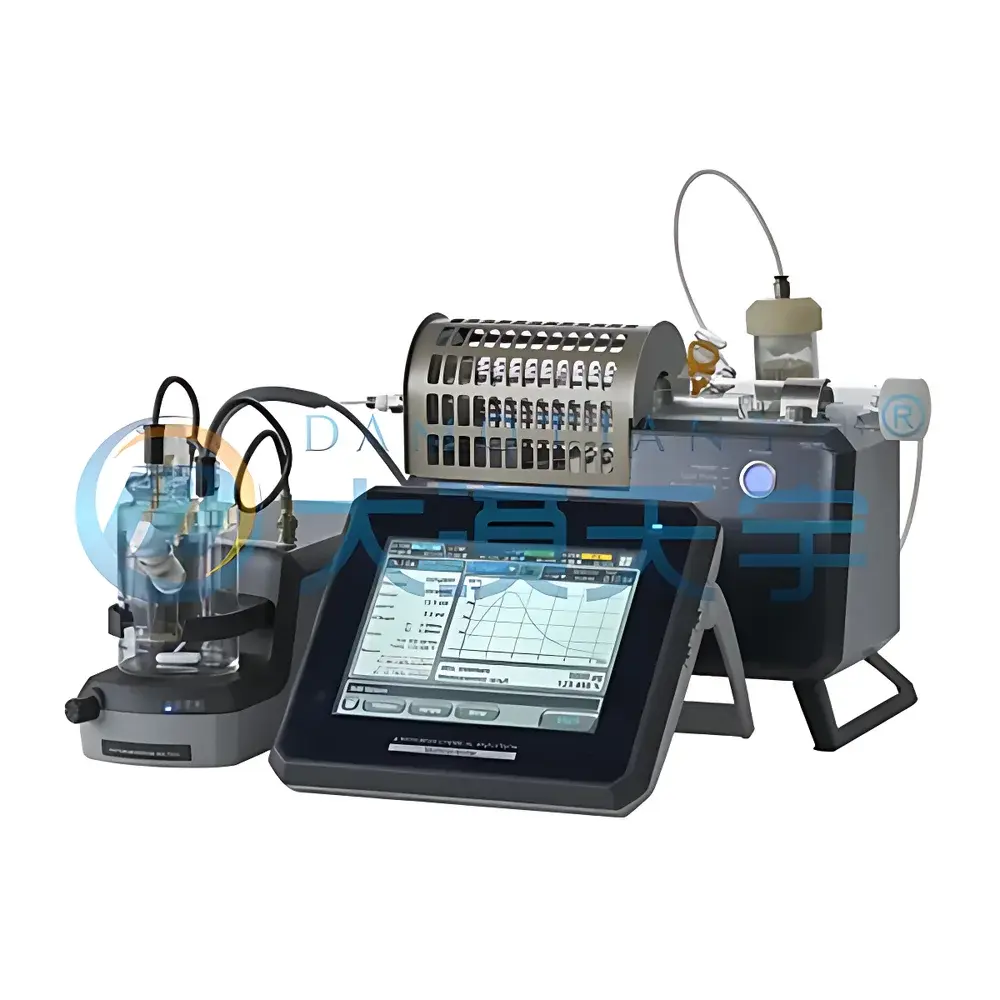
Nittoseiko Analytech CA-310SJ Coulometric Karl Fischer Moisture Analyzer
| Brand | Nittoseiko Analytech |
|---|---|
| Origin | Japan |
| Manufacturer Type | Authorized Distributor |
| Product Category | Imported Instrument |
| Model | CA-310SJ |
| Titration Method | Fully Automatic Coulometric Titration |
| Instrument Type | Coulometric Karl Fischer Moisture Analyzer |
| Measurement Resolution | ±0.1 µA |
| Water Content Range | 5 µg to 999.9999 mg |
| Accuracy | < 0.3% RSD (for samples > 1 mg H₂O) |
| Minimum Dispensing Volume | 1/2000 of burette volume |
| Titration Control Precision | 0.1 µL |
| Electrolysis Current | Up to 516 mA |
| Average Titration Speed | 2.2 mg H₂O/min (2.64 mg H₂O/min in High-Speed Mode) |
| Detection Sensitivity | 0.1 µg H₂O |
| Repeatability | ±3 µg (for 10–1000 µg H₂O) |
| Display | 8.4-inch Color TFT Touchscreen LCD |
| Data Storage Capacity | 9999 test records |
| Environmental Operating Range | 15–40 °C, ≤85% RH (non-condensing) |
| Power Supply | AC 230–240 V, 310 VA, 50/60 Hz |
| Dimensions (Main Unit) | 244 × 161 × 215 mm (W×D×H) |
| Weight (Main Unit) | 2.0 kg |
Overview
The Nittoseiko Analytech CA-310SJ is a high-precision coulometric Karl Fischer moisture analyzer engineered for trace-level water quantification in hygroscopic and thermally sensitive materials—particularly engineering plastics, polymer resins, pharmaceutical excipients, and electronic-grade solvents. Unlike volumetric KF systems, the CA-310SJ employs controlled-current coulometric electrolysis to generate iodine *in situ* within a sealed titration cell, eliminating reagent delivery variability and enabling absolute quantification of water mass down to 0.1 µg. Its design adheres to fundamental electrochemical principles defined in ASTM E203 and ISO 760, ensuring metrological traceability for regulatory submissions. The instrument’s core architecture integrates real-time polarization potential monitoring, adaptive current pulse control, and dynamic endpoint detection based on continuous current-potential differential analysis—enabling robust performance even under fluctuating ambient humidity or low-water-content conditions typical in polyamide (PA), polybutylene terephthalate (PBT), and polycarbonate (PC) quality control workflows.
Key Features
- Coulometric measurement principle with dual-electrode configuration (generator and detector), supporting both membrane-free and membrane-type electrodes for broad sample compatibility—including ketones, aldehydes, and low-hydroxyl acids.
- Stepwise temperature-controlled vaporization unit (Patent No. 3284783) that dynamically adjusts heating profile based on real-time evaporation kinetics, minimizing thermal degradation of heat-labile polymers during water release.
- Multi-channel expandability: Up to four independent measurement cells can be synchronized and controlled via a single master console—ideal for comparative analysis, method validation, or parallel QC testing across resin batches.
- Wireless channel control option (optional) enables remote operation and spatial separation between console and vaporization units, improving lab ergonomics and reducing cross-contamination risk.
- Automated SOP execution: Pre-programmed standard operating procedures guide users through sample weighing, injection, titration initiation, and data review—ensuring procedural consistency and reducing operator-induced variability.
- 8.4-inch full-color capacitive touchscreen interface with intuitive icon-based navigation, multilingual support (including English and Chinese), and real-time graphical display of titration curves, background drift, and polarization voltage.
- Auto-background correction algorithm continuously monitors and subtracts residual current offset, enhancing accuracy for sub-10 µg measurements when performed in ISO Class 5 (100) cleanroom-equivalent environments.
Sample Compatibility & Compliance
The CA-310SJ accommodates solid, liquid, and viscous samples—including unreinforced and glass-filled nylons, POM, PET, and epoxy prepolymers—via integration with Mitsubishi Chemical’s VA-series vaporizers (e.g., VA-300, VA-236S). Its electrode flexibility allows selection between membrane-free electrodes (compatible with single-component AQUAMICRON® reagents for simplified maintenance) and diaphragm-type electrodes (required for reactive matrices such as acetone, methyl ethyl ketone, or citric acid derivatives). The system complies with GLP and GMP data integrity requirements per FDA 21 CFR Part 11: audit trails record all user actions, parameter changes, calibration events, and result modifications with timestamped, non-erasable entries. All data files are stored in encrypted binary format with SHA-256 checksum verification; USB export supports CSV and PDF report generation compliant with internal QA documentation standards.
Software & Data Management
Embedded firmware provides comprehensive data handling without external PC dependency. Each test record stores raw current/potential time-series data, calculated water mass, sample weight, reagent lot number, operator ID, environmental conditions, and full titration curve metadata. Built-in statistical tools enable batch-wise RSD calculation, outlier detection (Dixon’s Q-test), and trend analysis across up to 9999 archived runs. Scheduled auto-start functionality permits unattended overnight operation—ideal for time-resolved moisture absorption studies. Four USB 2.0 ports support simultaneous connection to analytical balances (auto-weight import), flash drives (data backup/export), barcode scanners (sample ID logging), and peripheral printers. Optional LAN interface enables centralized instrument monitoring and remote diagnostics via secure HTTPS protocol.
Applications
- Quality assurance of hygroscopic engineering plastics prior to injection molding or extrusion—ensuring moisture levels remain below critical thresholds (< 0.02% w/w for PA66) to prevent hydrolytic degradation.
- Stability-indicating assays for moisture-sensitive APIs and excipients under ICH Q1A(R2) accelerated storage protocols.
- Validation of drying efficiency in fluid-bed dryers and desiccant hopper dryers used in compounding lines.
- Research into water diffusion coefficients in polymer films using sequential micro-sampling and kinetic modeling.
- Regulatory submission support for FDA IND/NDA dossiers requiring documented moisture specification compliance per USP <921> and Ph. Eur. 2.5.12.
FAQ
What distinguishes coulometric from volumetric Karl Fischer titration in polymer analysis?
Coulometric KF generates iodine electrochemically at the anode, enabling absolute quantification without burette calibration or reagent standardization—critical for detecting sub-10 µg water in small polymer pellets where volumetric precision degrades.
Can the CA-310SJ measure moisture in acetonitrile or acetone?
Yes—when equipped with a diaphragm-type generator electrode and appropriate KF reagent (e.g., Hydranal-Coulomat AG), it reliably quantifies water in ketonic solvents per ASTM D6304 Annex A2.
Is GLP-compliant audit trail functionality enabled by default?
Yes—the system logs all critical events (user login/logout, method edits, result approvals, calibration verifications) with immutable timestamps and operator authentication; no license key or add-on module required.
How does the stepwise temperature control improve reproducibility for nylon samples?
It prevents localized overheating by modulating heater output in response to real-time vapor pressure feedback—reducing charring and incomplete water release, thereby lowering inter-run RSD from >2.5% to <0.25% for 50 mg PA6 specimens.
What is the minimum recommended sample size for 5 µg detection?
For optimal precision at the 5 µg lower limit, use ≥10 mg of homogeneous material in a Class 5 environment with <30% RH; replicate analysis (n≥6) is advised for statistical confidence per ISO/IEC 17025:2017 Clause 7.7.






