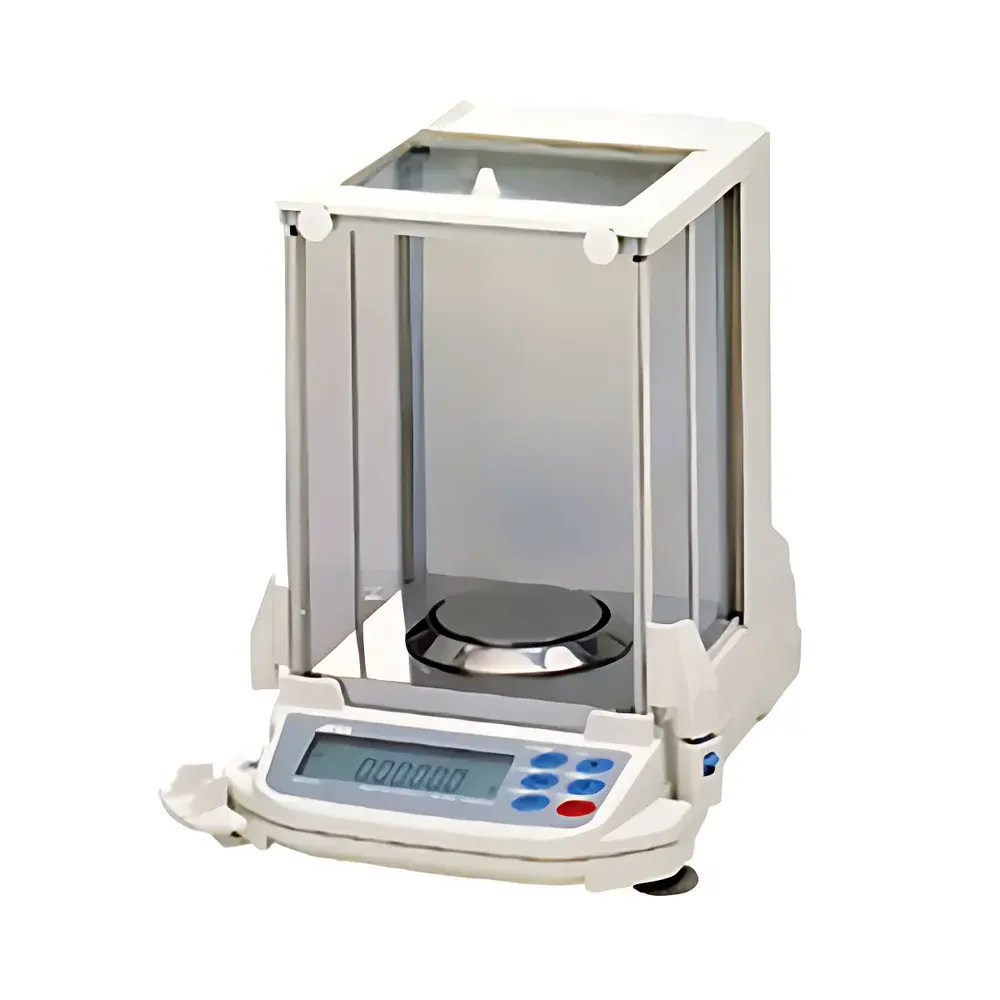
A&D GR200 Precision Analytical Balance
| Origin | Japan |
|---|---|
| Manufacturer Type | Authorized Distributor |
| Origin Category | Imported |
| Model | GR200 |
| Instrument Type | Analytical Balance |
| Capacity | 210 g |
| Readability | 0.1 mg |
| Calibration | Internal Automatic Calibration with Built-in Weights + External Calibration Support (50 g / 100 g / 200 g / 250 g) |
| Repeatability (SD) | 0.1 g |
| Linearity Error | ±0.2 g |
| Stabilization Time | 2 s |
| Sensitivity Drift | ±2 ppm/°C (10–30 °C) |
| Operating Environment | 5–40 °C, RH <85% non-condensing |
| Display Update Rate | 5 or 10 Hz |
| Counting Mode Minimum Unit | 0.1 mg |
| Sample Count Options | 10 / 25 / 50 / 100 units |
| Interface | RS-232C |
| Software Compatibility | WinCT Data Acquisition Suite |
| Pan Diameter | Ø85 mm |
| Draft Shield Dimensions | 249 × 330 × 328 mm (W×D×H) |
| Power Supply | AC Adapter (~11 VA), Region-Specific Input Voltage |
| Net Weight | ~6 kg |
Overview
The A&D GR200 Precision Analytical Balance is an ISO 17025-aligned laboratory-grade weighing instrument engineered for high-reproducibility mass measurement in regulated research, quality control, and pharmaceutical development environments. Utilizing electromagnetic force compensation (EMFC) transduction technology, the GR200 delivers stable, drift-compensated readings with 0.1 mg readability across its 210 g maximum capacity. Its core architecture integrates a temperature-compensated internal calibration system with factory-traceable built-in weights, enabling automatic recalibration triggered by time intervals, temperature shifts (>1.5 °C), or user command—fully compliant with GLP and GMP documentation requirements. The balance continuously monitors ambient thermal gradients (10–30 °C range) and applies real-time sensitivity correction (±2 ppm/°C), minimizing environmental influence on metrological performance. Designed for ISO/IEC 17025-accredited labs, it supports full audit trails when paired with WinCT software under FDA 21 CFR Part 11-compliant configurations.
Key Features
- Internal automatic calibration system with integrated reference weights—no manual intervention required for routine verification
- Environmental adaptive compensation: real-time thermal drift correction based on continuous ambient temperature sensing
- Dual display update rates (5 Hz standard / 10 Hz counting mode) optimized for dynamic weighing and piece-counting applications
- GLP/GMP-compliant data logging: timestamped weight records with operator ID, calibration status, and environmental metadata
- Underhook capability for density determination and below-balance weighing of suspended samples
- Multi-unit support: g, mg, oz, ct, lb, %, pcs—with configurable decimal places and zero-tracking thresholds
- Auto-power-on activation upon pan loading, reducing idle energy consumption without compromising readiness
- Robust mechanical design featuring stainless steel weighing pan (Ø85 mm) and modular draft shield (249 × 330 × 328 mm) with sliding doors for rapid sample access
Sample Compatibility & Compliance
The GR200 accommodates diverse sample forms—including powders, granules, liquids in tared vessels, and small solid components—within its draft shield enclosure. Its 210 g capacity and 0.1 mg resolution meet ASTM E898, USP , and ISO 9001 requirements for analytical balance qualification. The unit satisfies essential clauses of ISO/IEC 17025:2017 (Section 6.4.3 on equipment suitability) and supports full traceability through NIST-traceable external calibration using supplied 50 g, 100 g, 200 g, and 250 g Class M2 weights. All firmware operations—including calibration history, error logs, and configuration changes—are retained in non-volatile memory and exportable via RS-232C for regulatory review. The balance’s construction adheres to IEC 61010-1 safety standards and EMC Directive 2014/30/EU.
Software & Data Management
WinCT (Windows Communication Tool) serves as the certified data acquisition and reporting interface for the GR200. It enables real-time bidirectional communication, automated data capture with customizable field mapping (e.g., sample ID, batch number, analyst initials), and structured export to CSV, Excel, or LIMS-compatible XML formats. When configured with user authentication and electronic signature modules, WinCT supports 21 CFR Part 11 compliance—including audit trail generation, data integrity validation, and role-based access control. All calibration events—internal and external—are logged with digital signatures, timestamps, and deviation flags. Up to 1,000 measurement records can be stored onboard with date/time stamping, and memory is retained during power loss.
Applications
- Pharmaceutical formulation: active pharmaceutical ingredient (API) dispensing, excipient ratio verification, and tablet weight uniformity testing per USP
- Chemical synthesis: stoichiometric reagent weighing, catalyst dosage control, and yield calculation
- Materials science: density determination of metal alloys and polymer composites using hydrostatic weighing mode
- Food & beverage QC: nutritional labeling compliance (e.g., protein/fat content per serving), moisture analysis tare management
- Academic research: gravimetric preparation of standard solutions, micro-scale reaction monitoring, and nanoparticle mass quantification
- Environmental testing labs: filter weight gain analysis for PM2.5/PM10 particulate matter sampling
FAQ
Does the GR200 support external calibration with user-provided weights?
Yes—the balance accepts external calibration via RS-232C-triggered protocols using Class M2 or better weights (50 g, 100 g, 200 g, 250 g). Calibration certificates must be maintained per ISO/IEC 17025.
Is the internal calibration weight certified and traceable?
Yes—the built-in calibration mass is factory-adjusted and traceable to NMIJ (National Metrology Institute of Japan) standards, with documented uncertainty budgets available upon request.
Can the GR200 operate in high-humidity environments?
It is rated for operation up to 85% RH non-condensing. Prolonged exposure above 70% RH requires desiccant placement inside the draft shield chamber to prevent electrostatic drift.
What is the recommended warm-up time before critical measurements?
A minimum 30-minute stabilization period at constant ambient temperature is advised to achieve thermal equilibrium in the EMFC sensor and minimize drift-related uncertainty.
How does the GR200 handle draft-induced measurement noise?
The mechanically damped draft shield assembly, combined with adaptive filtering algorithms, suppresses airflow-induced oscillations—verified per OIML R76-1 Annex C vibration testing protocols.