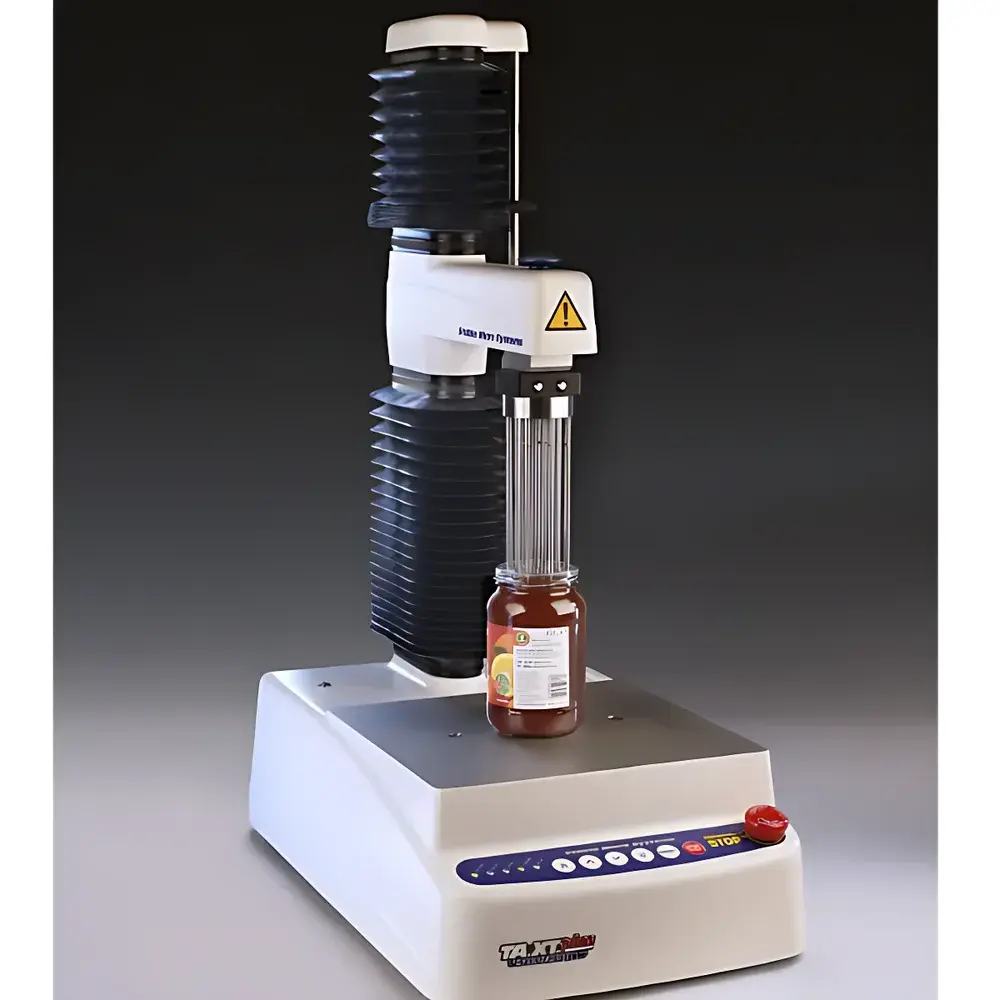
Stable Micro Systems TA.XTplus Texture Analyzer for Fruit & Vegetable Firmness Testing
| Brand | Stable Micro Systems |
|---|---|
| Origin | United Kingdom |
| Model | TA.XTplus |
| Force Range | 0.5–50 kgf |
| Force Resolution | 0.1 g |
| Test Speed | 0.01–40 mm/s |
| Maximum Travel Distance | 370 mm |
| Position Resolution | 0.001 mm |
| Data Acquisition Rate | >2,000 points/sec (4-channel synchronous sampling) |
Overview
The Stable Micro Systems TA.XTplus Texture Analyzer is a high-precision, motorized universal testing system engineered for objective mechanical property characterization of food materials—particularly fruits and vegetables—across research, quality control, and production environments. Operating on the principle of controlled uniaxial compression, penetration, bending, or cutting, the instrument quantifies biomechanical responses—including firmness, yield force, rupture energy, elasticity, and toughness—by applying programmable force profiles while recording real-time load–displacement curves. Its design adheres to fundamental rheological and material science principles consistent with ASTM F3196 (Standard Guide for Instrumental Texture Measurement of Fruits and Vegetables) and ISO 11357-3 (Plastics—Differential Scanning Calorimetry—Part 3: Determination of Melting and Crystallization Temperatures and Enthalpies), ensuring traceable, reproducible results aligned with international sensory and physical standards.
Key Features
- High-resolution dual-load-cell architecture supporting seamless switching between low-force (±0.1 g) and high-force (up to 50 kgf) measurement modes without recalibration.
- Programmable crosshead velocity from 0.01 to 40 mm/s with closed-loop servo control, enabling precise replication of physiological deformation rates relevant to consumer biting, chewing, or packaging stress conditions.
- Sub-micron positional resolution (0.001 mm) across a 370 mm vertical travel range, facilitating accurate detection of surface contact onset, skin puncture, and structural collapse events.
- Real-time synchronized 4-channel data acquisition at >2,000 Hz, capturing simultaneous signals from load, position, time, and optional auxiliary sensors (e.g., temperature, video trigger, or acoustic emission).
- Barcode-triggered test initiation via integrated USB scanner interface—eliminates manual protocol selection and reduces operator-induced variability in routine QC workflows.
- Remote operation capability via web-enabled software client compatible with iOS, Android, and Windows tablets—supports live monitoring, parameter adjustment, and automated email-based report distribution upon test completion.
Sample Compatibility & Compliance
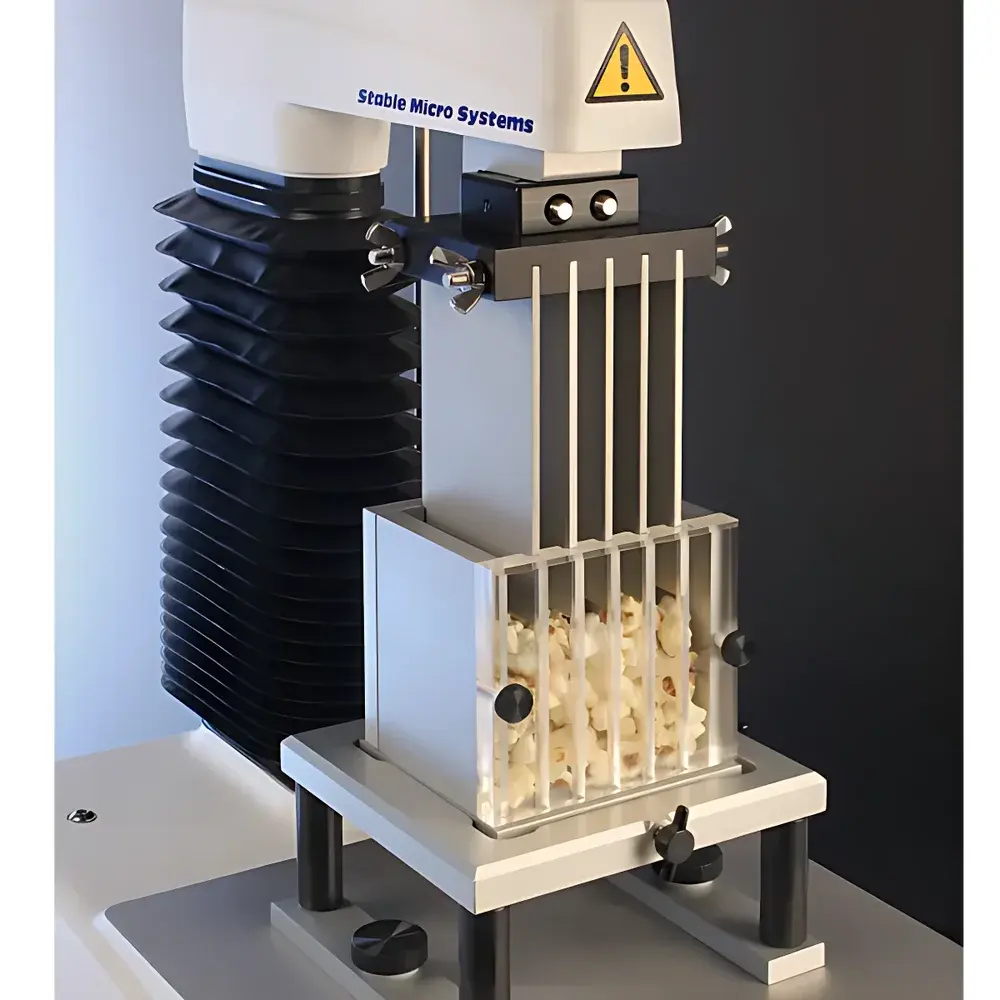
The TA.XTplus accommodates heterogeneous, irregular, and hydrated biological specimens—including whole apples, pear halves, tomato slices, carrot sticks, and leafy greens—using interchangeable probes (e.g., 2 mm stainless steel cylinder, 5 mm spherical tip, 3-point bend rig, or fruit-piercing needle). Sample holders are designed to minimize lateral movement during testing while permitting natural hydration loss simulation under ambient or controlled-humidity enclosures. The system complies with GLP documentation requirements through audit-trail-enabled software, full electronic signature support per FDA 21 CFR Part 11, and exportable raw data files (.txt, .csv) suitable for third-party statistical analysis. All firmware and calibration routines are validated against NIST-traceable reference standards.
Software & Data Management
Exponent Connect software provides an intuitive graphical interface for test method development, real-time curve visualization, and post-acquisition parameter extraction—including bioyield point, fracture force, work of shear, resilience ratio, and elastic modulus derived via Hookean or non-linear regression models. Over 400 peer-reviewed application notes and instructional videos are embedded directly within the software library, categorized by food matrix and texture attribute. Customizable report templates support automated generation of PDF/Excel outputs with embedded metadata (operator ID, sample ID, environmental conditions, calibration status). Data integrity is maintained through encrypted local storage, role-based user permissions, and version-controlled method archives.
Applications
- Quantitative maturity assessment of climacteric fruits (e.g., bananas, tomatoes) via longitudinal firmness tracking during ripening.
- Evaluation of post-harvest storage stability—correlating texture degradation with ethylene exposure, refrigerated transit duration, or modified-atmosphere packaging performance.
- Validation of breeding programs targeting improved shelf-life or mechanical durability in horticultural cultivars.
- Process optimization for thermal blanching, freezing, or high-pressure processing—measuring textural changes induced by cell wall pectin depolymerization or turgor loss.
- Regulatory compliance testing for USDA Grade Standards (e.g., US Grade A apple firmness ≥6.5 kgf) or EU Commission Regulation (EC) No 1221/2008 on fruit quality parameters.
- Cross-functional R&D integration with rheology, NIR spectroscopy, and digital image correlation platforms for multi-modal texture prediction modeling.
FAQ
What probe geometry is recommended for measuring apple firmness per USDA guidelines?
A 11 mm diameter cylindrical probe with flat tip, applied at 2 mm/s to a peeled equatorial section, is standardized for USDA Grade A compliance testing.
Can the TA.XTplus be integrated into an automated production line environment?
Yes—via Ethernet/IP or Modbus TCP communication protocols, the analyzer supports PLC-triggered test initiation and real-time pass/fail signal output to SCADA systems.
Is calibration traceable to national metrology institutes?
All factory calibrations are performed using NIST-traceable deadweight standards; certificate of calibration includes uncertainty budgets compliant with ISO/IEC 17025.
How does the system handle highly viscoelastic or heterogeneous samples like ripe mango pulp?
The dual-speed control algorithm automatically adjusts dwell time and relaxation intervals between compression cycles to account for time-dependent recovery behavior.
Does the software support statistical process control (SPC) charting?
Yes—built-in SPC module generates X-bar/R charts, capability indices (Cp/Cpk), and trend analysis reports aligned with AIAG MSA v4 requirements.