
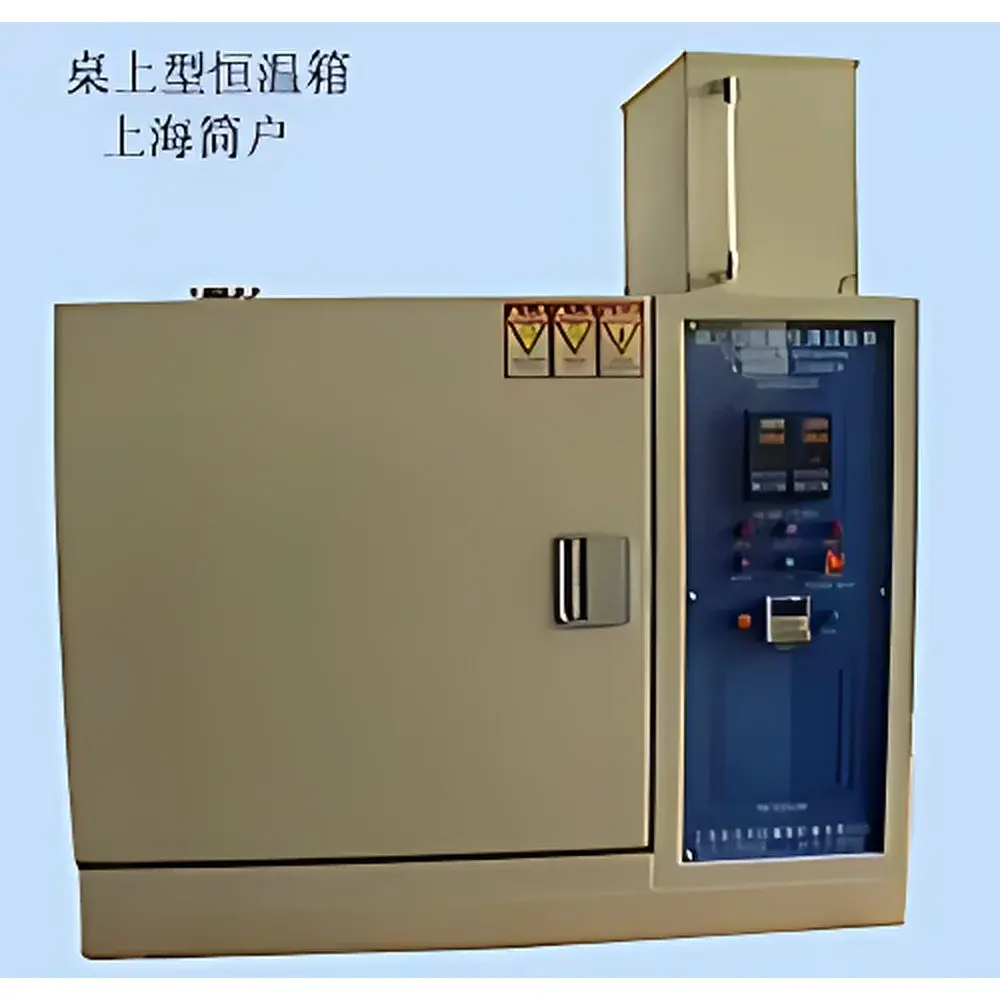
Jianhu JH-10-12A High-Temperature Muffle Furnace
| Brand | Jianhu |
|---|---|
| Origin | Shanghai, China |
| Type | Benchtop Resistance Muffle Furnace |
| Rated Power | 10 kW |
| Rated Voltage | 380/220 V |
| Temperature Range | Ambient to 1200 °C |
| Max Operating Temperature | 1200 °C |
| Chamber Dimensions (W×D×H) | 400 × 250 × 160 mm |
| External Dimensions (W×D×H) | 750 × 440 × 480 mm |
| Net Weight | 110 kg |
| Heating Element | Fe-Cr-Al Alloy Wire |
| Thermocouple Type | K-type (Chromel-Alumel) |
| Temperature Resolution | 0.1 °C |
| Temperature Uniformity | ±2 °C (at 1200 °C, steady state) |
| Control System | Microprocessor-based PID controller with auto-tuning, cold-junction compensation, and programmable ramp-soak profiles |
| Communication Interface | RS-232 (optional PC integration) |
| Safety Features | Independent over-temperature cut-off, door-interlocked power disconnect, thermal insulation with ceramic fiber lining |
Overview
The Jianhu JH-10-12A is a benchtop high-temperature muffle furnace engineered for precise, repeatable thermal processing in laboratory and light industrial environments. Based on resistive heating principles, it employs Fe-Cr-Al alloy heating elements embedded within a multi-layer ceramic fiber insulation chamber, enabling stable operation up to 1200 °C. Unlike convection ovens or drying cabinets, the JH-10-12A isolates the sample zone from combustion byproducts and airflow disturbances—making it suitable for ashing, calcination, sintering, heat treatment (annealing, tempering, hardening), and gravimetric analysis where atmospheric contamination must be minimized. Its muffle design ensures uniform thermal distribution across the 400 × 250 × 160 mm chamber, validated at ±2 °C under steady-state conditions per ISO 8573-1 and ASTM E1142 test protocols.
Key Features
- Microprocessor-controlled PID temperature regulation with auto-tuning, cold-junction compensation, and user-programmable ramp-soak cycles (up to 9 segments)
- K-type thermocouple integrated into the furnace wall for direct, real-time measurement of chamber temperature
- Ceramic fiber insulation (density ≥ 128 kg/m³) providing low thermal mass and rapid heat-up/cool-down response
- Robust stainless-steel muffle chamber with arc-welded seams and oxidation-resistant surface finish
- Independent mechanical over-temperature protection system (cut-off at 1250 °C) compliant with IEC 61000-4-2 and EN 60519-2 safety standards
- RS-232 serial interface for external data logging, remote setpoint adjustment, and GLP-compliant audit trail generation (when paired with validated software)
- Front-loading door with high-temperature silicone gasket and interlock switch to prevent operation during access
Sample Compatibility & Compliance
The JH-10-12A accommodates crucibles, boats, and ceramic trays conforming to ASTM E1529 and ISO 11358 standards for thermal stability testing. It supports silica, alumina, platinum, and nickel-chromium alloy sample containers rated for continuous exposure at ≤1200 °C. The furnace meets general laboratory safety requirements per UL 61010-1 and CE marking directives for electrical equipment. While not intrinsically rated for hazardous atmospheres, its sealed muffle architecture prevents cross-contamination—critical for residue analysis per USP , EPA Method 3050B, and ISO 11885. Routine calibration is traceable to NIST SRM 1749 (Type K thermocouple reference standard).
Software & Data Management
The built-in controller supports time-stamped temperature logging with internal memory (≥10,000 data points). Optional PC connectivity enables export of CSV-formatted datasets for statistical process control (SPC) and long-term trend analysis. When deployed under validated laboratory information management systems (LIMS), the RS-232 interface supports 21 CFR Part 11–compliant electronic signatures and audit trails—including operator ID, parameter changes, and alarm events. Firmware updates are performed via secure USB dongle, maintaining integrity of calibration coefficients and control algorithms.
Applications
- Gravimetric determination of ash content in food, feed, pharmaceuticals, and environmental samples (AOAC 942.05, ISO 2171)
- Preparation of oxide catalysts and ceramic precursors via controlled calcination
- Thermal decomposition studies in materials science research (TGA correlation validation)
- Heat treatment of small metallic components (e.g., tool steels, dental alloys) requiring precise soak times and cooling profiles
- Calibration of secondary temperature sensors using fixed-point references (e.g., Zn, Al, Ag freezing points)
- Residue ignition in wastewater sludge analysis per APHA Standard Methods 2540E
FAQ
What is the maximum recommended continuous operating temperature?
The JH-10-12A is rated for continuous operation at 1200 °C; exceeding this limit accelerates element degradation and compromises thermal uniformity.
Can the furnace be used under inert or reducing atmospheres?
No—the standard configuration is air-atmosphere only. For controlled atmospheres, optional quartz tube inserts with gas inlet/outlet ports and purge capability must be specified at time of order.
Is third-party calibration certification available?
Yes—NIST-traceable calibration reports (including as-found/as-left data at three points: 300 °C, 800 °C, and 1200 °C) are provided upon request, aligned with ISO/IEC 17025 requirements.
How often should preventive maintenance be performed?
Biannual inspection of heating elements, thermocouple integrity, door seal compression, and insulation integrity is recommended. Full recalibration is advised annually or after 500 operational hours, whichever occurs first.
Does the unit comply with GLP or GMP documentation requirements?
When operated with validated software and procedural controls (SOPs), the JH-10-12A supports GLP/GMP workflows—including electronic record retention, user access levels, and change control logs—provided the host LIMS or data acquisition system is appropriately qualified.



