
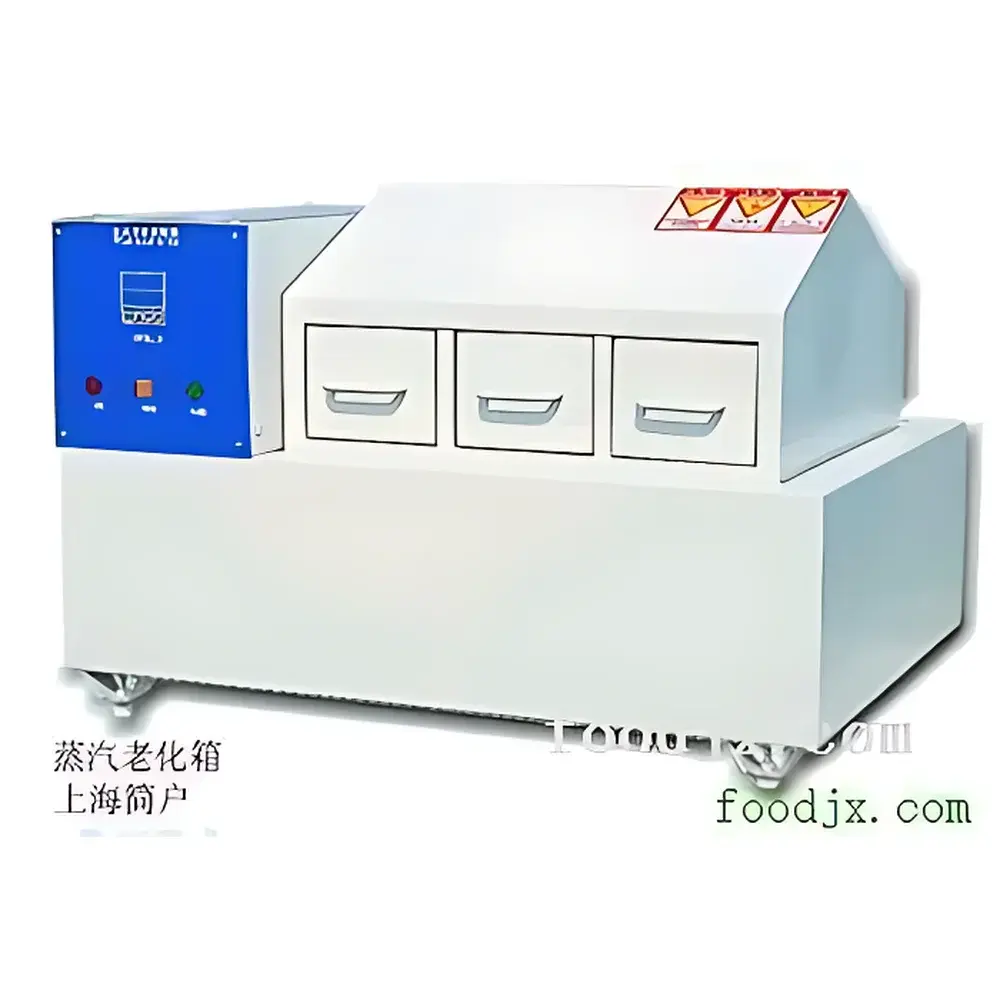
Jinhoo JWVT-3 Steam Aging Test Chamber
| Brand | Jinhoo |
|---|---|
| Model | JWVT-3 |
| Internal Dimensions | 50 cm (W) × 40 cm (H) × 17 cm (D) |
| External Dimensions | 60 cm (W) × 50 cm (H) × 42 cm (D) |
| Chamber Material | SUS 304 stainless steel (inner & outer) |
| Max Steam Temperature | 97 °C |
| Temperature Control Resolution | 0.1 °C |
| Heating Time to 97 °C | ~45 min |
| Timer Range | 0–9999 minutes |
| Control System | PID + SSR + PWM, digital LED display |
| Temperature Sensor | PT-100 platinum RTD |
| Water Level Management | Auto-refill reservoir with dry-run protection (Teflon-coated) |
| Power Supply | 1-phase, 220 V AC |
| Compliance | MIL-STD-202F, Method 208 (Solderability Preconditioning) |
Overview
The Jinhoo JWVT-3 Steam Aging Test Chamber is an engineered environmental test system designed specifically for accelerated aging and preconditioning of electronic components prior to solderability evaluation. It operates on the principle of controlled saturated steam exposure at elevated temperatures—up to 97 °C—to simulate long-term humidity-induced degradation mechanisms, including surface oxidation, intermetallic growth at metal terminations, and flux residue interaction. Unlike general-purpose humidity chambers, the JWVT-3 generates and maintains a stable, high-purity steam atmosphere without condensate pooling, ensuring uniform thermal and moisture stress across component leads, pins, and terminations. Its application scope is tightly aligned with IPC-J-STD-002, IPC-J-STD-003, and MIL-STD-202F Method 208 (Solderability Preconditioning), making it a critical tool in qualification labs, incoming quality control (IQC), and reliability engineering workflows for semiconductor packages, passive devices, connectors, and PCB assemblies.
Key Features
- Stainless steel chamber construction using SUS 304 for external housing and SUS 316 for internal weld-sealed cavity—resistant to chloride-induced corrosion during repeated steam cycles
- Precision temperature regulation via PID + PWM + SSR control architecture, paired with a calibrated PT-100 platinum resistance thermometer (±0.15 °C accuracy) and 0.1 °C setpoint resolution
- Dry-run safety interlock with Teflon-coated water-level sensor and automatic shutdown to prevent heater damage during low-water conditions
- Integrated auto-refill water reservoir with optional RO (reverse osmosis) pure water feed interface—minimizes mineral buildup and extends maintenance intervals
- Digital LED controller supporting dual-mode operation: target temperature hold mode and timed steam exposure mode (0–9999 minutes)
- Configurable start delay function for unattended overnight or shift-based testing protocols
- Compact footprint (60 × 50 × 42 cm) optimized for benchtop integration in QC laboratories and R&D cleanrooms
Sample Compatibility & Compliance
The JWVT-3 accommodates standard JEDEC trays, carrier tapes, bulk components, and bare PCBs up to 50 cm wide × 40 cm high × 17 cm deep. It is routinely deployed for preconditioning of QFP, SOIC, BGA, SOT, and radial/axial passive components prior to dip-and-look or surface mount solderability testing. The chamber meets the thermal stability, dwell time repeatability, and steam saturation requirements defined in MIL-STD-202F Method 208 and IPC-TM-650 2.6.25. All operational parameters—including temperature ramp rate, dwell consistency, and steam generation fidelity—are traceable to NIST-calibrated instrumentation. Optional audit-ready data logging (via RS-232 or USB) supports GLP/GMP documentation needs and FDA 21 CFR Part 11 compliance when paired with validated software.
Software & Data Management
While the base unit features a standalone microprocessor controller with real-time LED display, optional firmware upgrades enable serial communication (RS-232/USB) for remote parameter setting, runtime monitoring, and timestamped event logging. Exported CSV files include temperature setpoint, actual chamber temperature, elapsed time, and alarm status flags—structured for integration into LIMS or MES platforms. For regulated environments, validation documentation packages—including IQ/OQ protocols, calibration certificates, and uncertainty budgets for the PT-100 sensor—are available upon request. The system architecture supports periodic recalibration verification per ISO/IEC 17025 requirements.
Applications
- Pre-solderability aging of component leads per MIL-STD-202F Method 208 and JESD22-A101
- Oxidation acceleration testing for tin-, silver-, and copper-plated terminations
- Reliability screening of conformal-coated assemblies under cyclic steam exposure
- Process validation of lead-free termination finishes (e.g., matte Sn, NiPdAu) against intermetallic diffusion kinetics
- Qualification of new packaging materials (EMC, molding compounds) for moisture sensitivity level (MSL) correlation studies
- Failure analysis root cause isolation in field-return investigations involving solder joint voiding or dewetting
FAQ
What standards does the JWVT-3 support for solderability preconditioning?
It is configured and validated for MIL-STD-202F Method 208, IPC-J-STD-002, and JESD22-A101—covering both steam aging and saturated steam exposure protocols.
Can distilled or deionized water be used instead of RO water?
Yes, but RO water (≥1 MΩ·cm resistivity) is strongly recommended to minimize scaling on heating elements and steam nozzles over extended operation.
Is the chamber suitable for testing assembled PCBs?
Yes—provided the board’s thermal mass and layout allow uniform steam penetration; however, densely populated or conformal-coated boards may require extended dwell times for equivalent thermal equilibration.
Does the system include calibration documentation?
A factory calibration certificate for the PT-100 sensor and controller output is supplied; full IQ/OQ documentation and on-site SAT (Site Acceptance Testing) are available as add-on services.
What maintenance intervals are recommended?
Monthly visual inspection of seals and water lines, quarterly descaling of the steam generator (using citric acid solution), and annual verification of temperature uniformity per ASTM E2203 or IEC 60068-3-5.



