
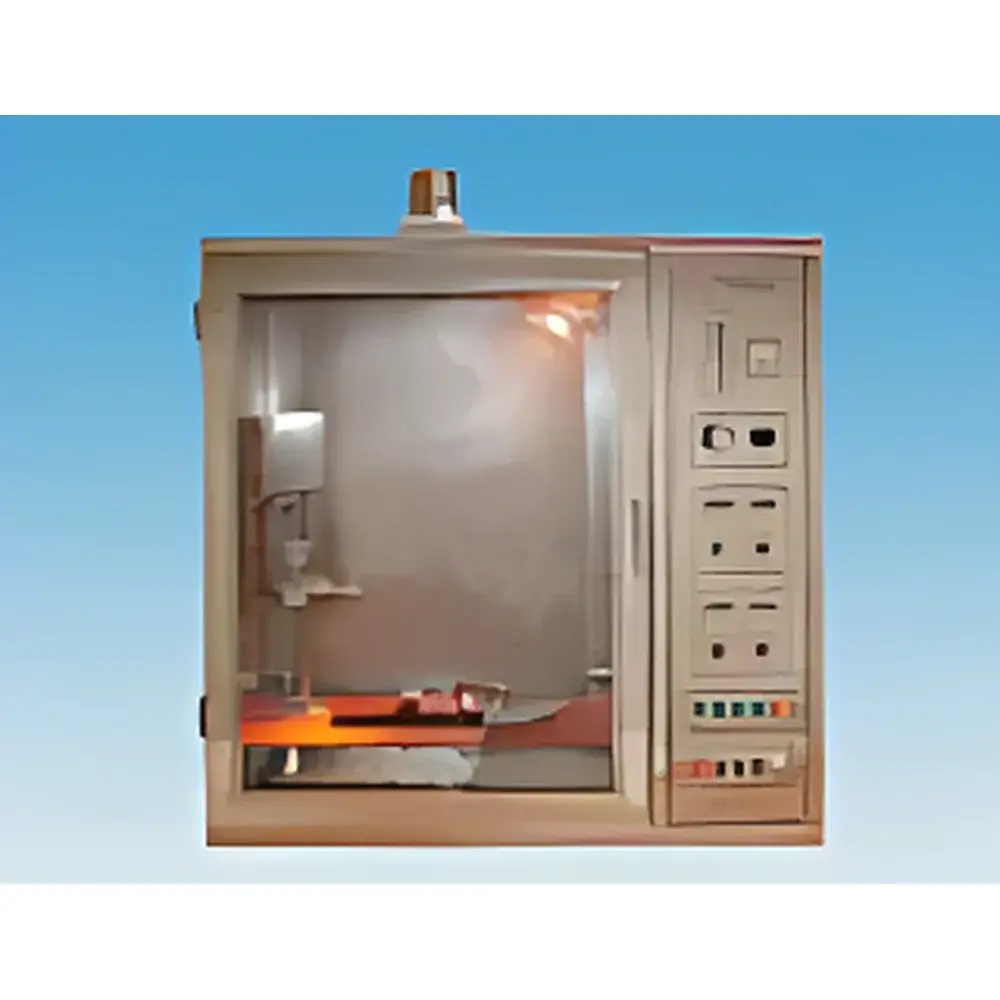
Jianhu JH UL94/IEC 60695-11-3 Vertical-Horizontal Plastic Flammability Tester
| Brand | Jianhu |
|---|---|
| Origin | Shanghai, China |
| Model | JH |
| Combustion Chamber Volume | 0.5 m³ |
| Sample Dimensions | 125 mm × 13 mm × (3–13) mm |
| Burner Tip ID | 9.5 mm (0.375 in), Length: 100 mm |
| Flame Angle Options | 45° (horizontal), 90° (vertical) |
| Gas Supply | Liquefied Petroleum Gas (LPG) or Natural Gas (37 MJ/m³) |
| Gas Flow Rate | <1 L/min |
| Timing Functions | Pre-ignition, Afterflame, Afterglow, and Flame-Out Duration |
| Actuation | Pneumatic burner positioning, Electric sample height adjustment, Manual horizontal support alignment |
| Construction | Stainless steel enclosure with tempered glass viewing door, internal LED lighting, and integrated exhaust fan |
| Overall Dimensions | 1100 mm × 600 mm × 1050 mm |
| Compliance | UL 94, IEC 60695-11-3, GB/T 2408–1996, GB 4943, GB 5169 |
Overview
The Jianhu JH UL94/IEC 60695-11-3 Vertical-Horizontal Plastic Flammability Tester is a precision-engineered benchtop apparatus designed to evaluate the ignition resistance and flame propagation behavior of polymeric materials under standardized direct-flame exposure conditions. It operates on the principle of controlled, reproducible flame impingement—applying a defined Bunsen-type flame from a calibrated burner to conditioned plastic specimens oriented either vertically (for V-0, V-1, V-2, and 5V classifications) or horizontally (for HB classification) per UL 94 and IEC 60695-11-3 test protocols. The system integrates thermally stable gas delivery, real-time flame geometry control, and synchronized multi-stage timing logic to ensure strict adherence to pass/fail criteria defined by flammability rating thresholds—including afterflame time, afterglow duration, specimen dripping behavior, and char length measurement. Its modular architecture supports both laboratory-scale R&D validation and production-line quality assurance workflows in polymer formulation, cable jacketing, electronic housing, and appliance component manufacturing.
Key Features
- Dual-axis orientation capability: switchable between 45° horizontal and 90° vertical flame application via mechanical fixture reconfiguration
- Four independent digital timers with microsecond resolution: pre-ignition dwell, afterflame duration (t₁), afterglow time (t₂), and total flame-out interval—each logged with timestamped event flags
- Pneumatically actuated burner carriage ensuring repeatable flame-to-specimen distance (±0.5 mm positional repeatability)
- Electrically driven vertical sample holder with fine-pitch lead screw adjustment (0.1 mm increments) for precise flame contact point alignment
- Stainless steel combustion chamber (800 × 580 × 1020 mm; 0.5 m³ volume) compliant with IEC 60695-2-2 and UL 94 spatial requirements
- Integrated forced-air exhaust system with variable-speed fan and external duct interface (Ø150 mm outlet) to evacuate combustion byproducts in accordance with occupational health and safety guidelines
- Tempered borosilicate glass observation window with built-in LED illumination for unobstructed visual monitoring during test execution
- Gas regulation subsystem featuring mass-flow-controlled LPG/natural gas supply (<1 L/min at 100 kPa), pressure-regulated solenoid valve, and high-voltage piezoelectric ignition
Sample Compatibility & Compliance
The JH tester accommodates rigid and semi-rigid plastic specimens conforming to standard dimensions: 125 mm length × 13 mm width × thickness between 3 mm and 13 mm. Thin films, laminates, and foamed polymers may be evaluated using supplementary mounting fixtures per Annex A of IEC 60695-11-10. All operational parameters—including burner tip geometry (9.5 mm ID × 100 mm length), flame temperature profile (approximately 1000 °C at tip), and air entrainment ratio—are validated against UL 94 Appendix A and ISO/IEC 17025-accredited calibration procedures. The instrument meets structural and functional requirements of UL 94 Edition 6 (2022), IEC 60695-11-3:2021, GB/T 2408–1996, GB 4943.1–2022, and GB 5169.16–2017. Optional traceable calibration certificates and IQ/OQ documentation packages are available for GLP-compliant laboratories subject to FDA 21 CFR Part 11 audit readiness.
Software & Data Management
While the base JH model operates via embedded microcontroller logic with front-panel push-button interface, optional firmware upgrade enables USB-C data export of time-stamped test logs (CSV format), including flame initiation time, t₁/t₂ values, operator ID, ambient temperature/humidity metadata, and pass/fail verdict per clause. No proprietary software installation is required—logs are compatible with LIMS platforms supporting ASTM E1447 or ISO/IEC 17025 data integrity standards. Audit trail functionality records all parameter changes, timer resets, and emergency stop events with immutable timestamps. For regulated environments, optional 21 CFR Part 11-compliant electronic signature module (with role-based access control and biometric authentication integration) is available upon request.
Applications
This flammability tester serves critical roles across multiple sectors: material selection and qualification in automotive interior trim development; fire-safety certification of consumer electronics enclosures (e.g., power supplies, routers, smart home devices); regulatory submission support for CE marking (EN 60335-1), CCC (China Compulsory Certification), and UL Recognition; and failure analysis of flame-retardant additive efficacy in halogen-free formulations. It is routinely deployed in third-party testing labs accredited to ISO/IEC 17025, OEM supplier qualification programs aligned with VW 80101 or GMW15635, and academic research investigating pyrolysis kinetics and char-forming mechanisms in thermoplastics.
FAQ
Does the JH tester support automated reporting generation?
Yes—when equipped with the optional data logging firmware, it exports fully timestamped CSV files containing all measured timing events, environmental readings, and operator annotations for direct import into Excel or LIMS.
Is external fume extraction mandatory?
Yes. Per IEC 60695-2-2 Clause 6.3 and OSHA 1910.1200, combustion effluents must be vented outdoors via dedicated ductwork; the unit includes a Ø150 mm exhaust port and static pressure rating of –250 Pa.
Can non-standard specimen geometries be tested?
Yes—custom jigs and clamping fixtures can be fabricated per customer specifications; dimensional deviations must be documented in test reports per ISO/IEC 17025 Clause 7.8.
What gas purity is required for compliance?
Liquefied petroleum gas (propane/butane mix) with ≥95% purity or natural gas with calorific value of 37 ± 1 MJ/m³, verified by supplier certificate of analysis.
How often does the burner require recalibration?
Annually—or after 500 test cycles—using NIST-traceable flow meters and thermocouple verification per UL 94 Section 7.2.2. Calibration records must be retained for audit purposes.



