
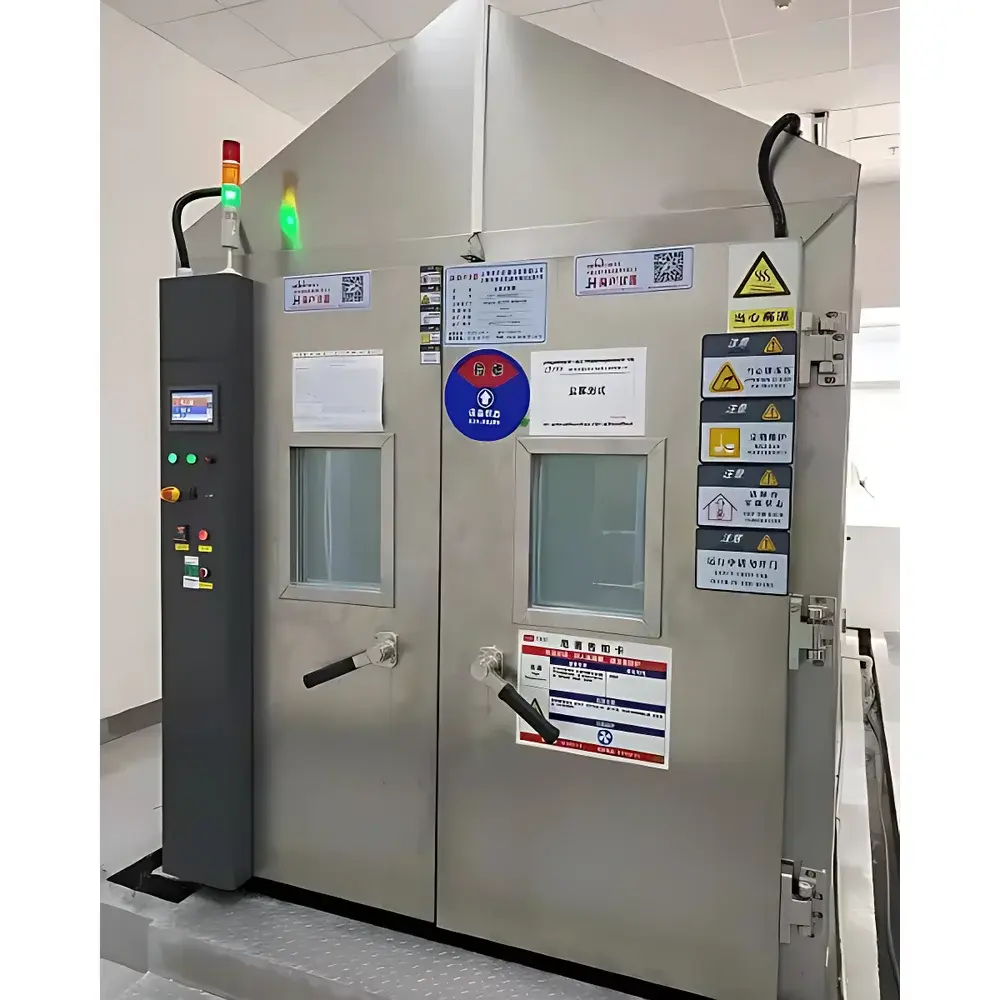
JianHu JH-Series Walk-In Salt Spray Test Chamber
| Brand | JianHu |
|---|---|
| Origin | Shanghai, China |
| Model | JH-Series Walk-In Salt Spray Test Chamber |
| Spray Method | Continuous Atomization |
| Fog Deposition Rate | 1–2 mL / 80 cm²·hr |
| Nozzle Pressure | 0.7–1.0 kg/cm² |
| De-fogging Method | Pneumatic Air-Pressure Exhaust |
| Compliance | ASTM B117, ISO 9227, GB/T 2423.17, JIS Z2371 |
| Software | Integrated PLC-based Control System with Data Logging & Audit Trail (21 CFR Part 11 Ready) |
| Construction | Fiberglass-Reinforced Polyester (FRP) Chamber Body, Corrosion-Resistant Stainless Steel Frame, Double-Walled Insulated Doors |
| Safety | Over-Temperature Protection, Low-Level Salt Solution Alarm, Emergency Stop, Leakage Current Protection |
| Optional Modules | Cyclic Corrosion Testing (CCT), Humidity & Dry Cycle Integration, Real-Time Remote Monitoring via Ethernet/RS485 |
Overview
The JianHu JH-Series Walk-In Salt Spray Test Chamber is an engineered environmental simulation system designed for accelerated corrosion evaluation of metallic materials, coated substrates, electronic enclosures, automotive components, and aerospace hardware. It operates on the principle of controlled continuous atomization of a standardized sodium chloride (NaCl) solution—typically 5% w/w—into a thermally stabilized test chamber, generating a highly reproducible corrosive fog environment per ASTM B117 and ISO 9227 protocols. Unlike benchtop units, the walk-in configuration enables full-scale testing of large assemblies—including engine blocks, control panels, structural frames, and prototype vehicles—without disassembly or dimensional compromise. The chamber’s robust FRP (fiberglass-reinforced polyester) interior resists acid fog degradation over extended operational cycles, while its double-walled insulated doors maintain thermal stability and minimize external heat exchange. Temperature uniformity across the working volume is maintained within ±2°C (per IEC 60068-3-5), supporting consistent salt deposition kinetics critical for inter-laboratory comparability.
Key Features
- Walk-in footprint (standard configurations: 2.5 m × 2.0 m × 2.2 m H) accommodating oversized test specimens up to 2,000 mm × 1,500 mm × 1,800 mm (L×W×H)
- Continuous spray system with precision-calibrated ceramic nozzles delivering uniform fog distribution; deposition rate independently verified per ISO 9227 Annex A
- Dual-stage air saturation tower ensuring stable fog generation at 35°C ± 1°C, with pre-heated compressed air supply to prevent nozzle clogging
- PLC-based control architecture with 7-inch color touchscreen HMI, real-time parameter monitoring, and configurable test profiles (e.g., single-cycle salt spray, multi-phase CCT sequences)
- Integrated data logging with timestamped records of chamber temperature, solution level, spray duration, and alarm events; exportable in CSV format for traceability
- Passive de-fogging mechanism utilizing regulated compressed air pressure to evacuate residual mist post-test—eliminating need for mechanical exhaust fans that introduce vibration or airflow turbulence
- Compliance-ready firmware supporting audit trail, user access levels, and electronic signature functionality aligned with FDA 21 CFR Part 11 requirements for GLP/GMP-regulated labs
Sample Compatibility & Compliance
The JH-Series accommodates diverse sample geometries—from printed circuit board (PCB) assemblies and galvanized fasteners to painted sheet metal panels and stainless steel weldments—without requiring fixture re-engineering. Its open-floor layout permits floor-mounted mounting of heavy-duty fixtures and integration with auxiliary conditioning systems (e.g., humidity chambers, thermal soak ovens). All internal surfaces meet ISO 14644-1 Class 8 cleanroom compatibility standards when operated under filtered air mode. Regulatory alignment includes full adherence to ASTM B117 (Standard Practice for Operating Salt Spray (Fog) Apparatus), ISO 9227 (Corrosion tests in artificial atmospheres — Salt spray tests), GB/T 2423.17 (Chinese national standard equivalent), and JIS Z2371 (Japanese Industrial Standard). Optional cyclic test modules support ISO 16701 (cyclic corrosion testing for automotive materials) and VDA 621-415 (German automotive association specification).
Software & Data Management
The embedded control software provides deterministic sequence execution, event-triggered logging, and password-protected parameter modification. Each test run generates a unique digital log file containing operator ID, start/stop timestamps, setpoint deviations, and fault codes—retained for ≥18 months on internal flash memory. Data export supports direct USB transfer or network upload to LIMS platforms via Modbus TCP or OPC UA interfaces. For regulated environments, optional validation packages include IQ/OQ documentation templates, calibration certificates traceable to NIST standards, and electronic signature workflows compliant with 21 CFR Part 11 Subpart C. Audit trails record all user actions—including profile edits, manual overrides, and calibration adjustments—with immutable timestamps and IP address logging.
Applications
This chamber serves as a core qualification tool in industries where long-term corrosion resistance directly impacts safety, reliability, and lifecycle cost. In automotive R&D, it validates paint adhesion, zinc-coated steel durability, and gasket sealing integrity under simulated coastal exposure. Electronics manufacturers use it to verify conformal coating performance on PCBs subjected to high-humidity saline ingress. Aerospace suppliers apply it to assess anodized aluminum alloys used in landing gear housings and avionics enclosures. Renewable energy firms evaluate corrosion resistance of solar tracker structural joints and offshore wind turbine fasteners. Academic and third-party testing labs—including SGS, TÜV Rheinland, and university materials science departments—leverage its reproducibility for comparative studies of novel anti-corrosion coatings, self-healing polymers, and surface passivation techniques.
FAQ
What is the maximum allowable test duration for uninterrupted operation?
The chamber is rated for continuous operation up to 1,000 hours per cycle, with automatic salt solution replenishment and thermal stability maintained via redundant heating elements and PID-controlled feedback loops.
Can the system be integrated into an existing laboratory automation network?
Yes—Ethernet/IP, RS485, and Modbus TCP communication protocols are standard; optional OPC UA gateway enables seamless interoperability with MES and SCADA systems.
Does the unit comply with ISO/IEC 17025 accreditation requirements for testing laboratories?
All factory calibration reports include uncertainty budgets and traceability statements to national metrology institutes; on-site IQ/OQ/ PQ support is available upon request.
Is remote monitoring and diagnostics supported?
Remote web-based interface allows real-time viewing of chamber status, historical trend charts, and alarm notifications via secure HTTPS connection—no proprietary client software required.
What maintenance intervals are recommended for optimal long-term performance?
Daily visual inspection of nozzles and solution reservoir; quarterly verification of temperature uniformity and fog deposition rate; annual recalibration of all sensors by certified technicians using NIST-traceable standards.



