
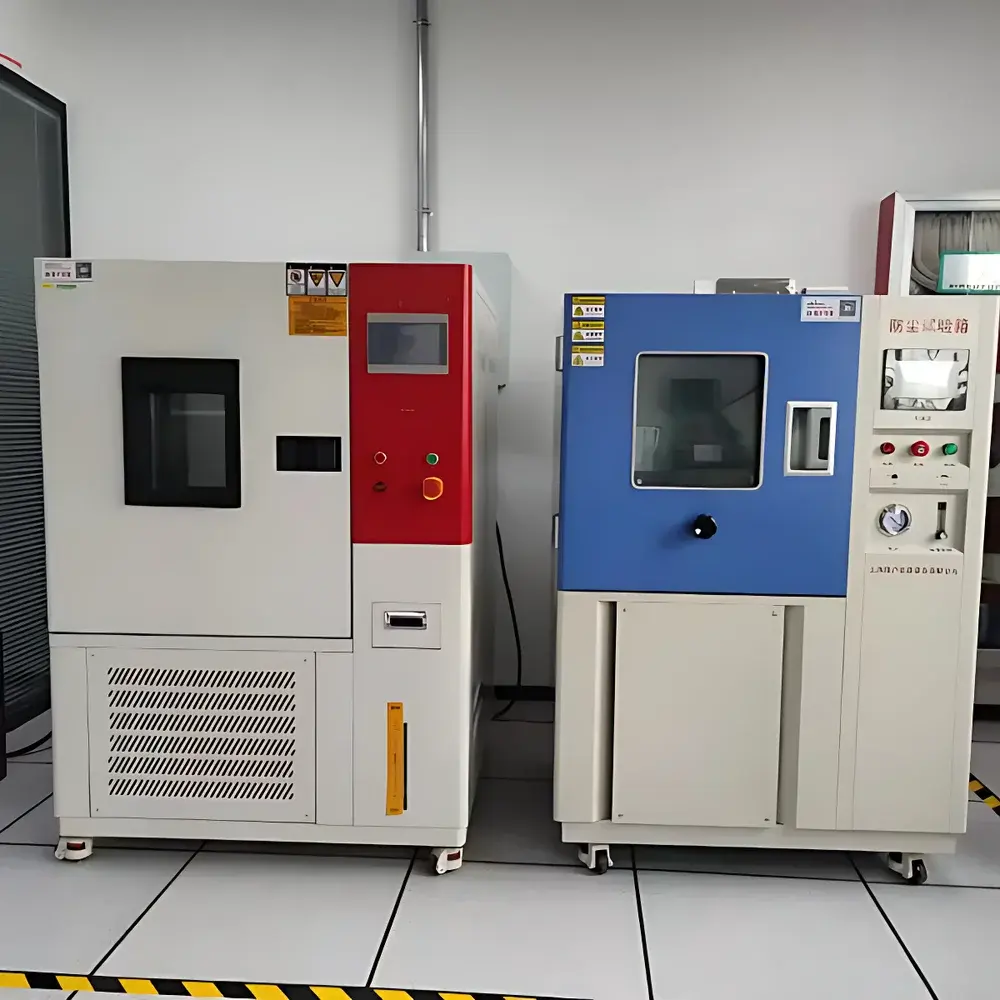
Jianhu Semiconductor Chip High-Low Temperature & Low-Pressure Environmental Test Chamber
| Brand | Jianhu |
|---|---|
| Origin | Shanghai, China |
| Model | Semiconductor Chip High-Low Temperature & Low-Pressure Environmental Test Chamber |
| Temperature Range | −70 °C to +150 °C |
| Cooling Method | Compressor-based refrigeration |
| Explosion-Proof Design | Yes |
| Temperature Fluctuation | ±0.5 °C |
| Temperature Uniformity | 2.0 °C |
| Temperature Deviation | ±2.0 °C |
| Ramp-Up Time (−70 °C to +150 °C) | ≤60 min |
| Pressure Control Range | 1–101.3 kPa (absolute) |
| Pressure Control Accuracy | ±2 kPa |
| Compliance | JEDEC JESD22-A104, JESD22-A105, GB/T 4937-2018, IEC 60068-2-1, IEC 60068-2-2, MIL-STD-810H (Section 501.7 & 505.6) |
Overview
The Jianhu Semiconductor Chip High-Low Temperature & Low-Pressure Environmental Test Chamber is an engineered platform for accelerated reliability assessment of semiconductor devices under combined thermal and barometric stress conditions. It operates on the principle of controlled environmental simulation—precisely regulating chamber temperature and absolute pressure in synchronized, programmable profiles to replicate real-world operational extremes encountered in aerospace, 5G infrastructure, autonomous systems, and high-altitude electronics. Unlike standard thermal chambers, this system integrates a vacuum-capable pressure control subsystem with high-stability dual-stage refrigeration and forced-air convection, enabling simultaneous exposure to sub-zero cryogenic temperatures (down to −70 °C), elevated thermal loads (up to +150 °C), and low-pressure environments (as low as 1 kPa absolute—equivalent to ~30 km altitude). This triaxial environmental fidelity supports failure mode identification rooted in thermomechanical stress, hermetic seal integrity, die attach delamination, wire bond lift-off, and parameter drift induced by gas-phase density changes.
Key Features
- Triple-stress capability: Independent yet coordinated control of temperature (−70 °C to +150 °C) and absolute pressure (1–101.3 kPa) within a single chamber volume
- Explosion-proof construction compliant with Class I, Division 1, Group D hazardous area requirements per UL 60079-0 and GB 3836.1–2010
- High-fidelity thermal regulation: ±0.5 °C temperature fluctuation, ±2.0 °C spatial deviation, and ≤2.0 °C uniformity across 300 L working volume
- Programmable multi-step test sequences supporting conditional branching, dwell timing, ramp rate specification (e.g., 5 °C/min), and pressure hold/step transitions
- Dual-stage cascade refrigeration system with environmentally compliant R404A/R23 mixed refrigerant, eliminating liquid nitrogen dependency
- Integrated RS485/Modbus RTU and Ethernet (TCP/IP) interfaces for remote monitoring, data logging, and integration into factory MES or LabVIEW-based test automation frameworks
Sample Compatibility & Compliance
The chamber accommodates wafer-level packages (WLP), QFN, BGA, CSP, and bare-die modules mounted on custom thermal interface fixtures or standard JEDEC trays. Internal dimensions (W × D × H: 600 × 500 × 600 mm) support up to 24 units of 14 mm × 14 mm BGA packages per cycle. All operational modes align with industry-standard qualification protocols: JEDEC JESD22-A104 (Temperature Cycling), JESD22-A105 (Power Temperature Cycling), JESD22-A110 (Highly Accelerated Stress Test – HAST), and GB/T 4937-2018 (Semiconductor device mechanical and climatic test methods). Pressure-controlled thermal cycling satisfies MIL-STD-810H Method 501.7 (Low Temperature) and Method 505.6 (Altitude), enabling validation of chip-level hermeticity, moisture ingress resistance, and vacuum-induced parametric shift. The system’s architecture supports GLP-compliant operation through audit-trail-enabled user access logs and electronic signature-ready test record generation.
Software & Data Management
Control and data acquisition are managed via Jianhu’s proprietary WinTest Pro v4.2 software, compatible with Windows 10/11 64-bit OS. The interface provides real-time dual-axis plotting (temperature vs. time; pressure vs. time), configurable alarm thresholds (e.g., pressure breach >±3 kPa, sensor fault timeout >10 s), and automated report export in PDF, CSV, and XML formats—including embedded digital signatures per FDA 21 CFR Part 11 Annex 11 requirements. Historical test data is stored in an encrypted SQLite database with versioned backups and SHA-256 hash verification. Optional API modules allow direct integration with enterprise LIMS (e.g., Thermo Fisher SampleManager, LabVantage) and statistical process control platforms (e.g., Minitab Connect, JMP Live) for SPC charting of electrical parameter trends (e.g., Vth, RDS(on), leakage current) collected via external SMU or parameter analyzers.
Applications
- Aerospace IC qualification: Simulating stratospheric flight profiles (e.g., −55 °C / 5 kPa → +125 °C / 10 kPa cycles) to detect package cracking, solder joint fatigue, and RF attenuation mechanisms
- Automotive AEC-Q100 stress screening: Executing temperature-pressure combined stress tests aligned with Grade 0/1 requirements for ADAS SoCs and power management ICs
- Advanced packaging R&D: Evaluating Cu pillar bump reliability, mold compound outgassing behavior, and underfill delamination kinetics under low-pressure thermal soak
- Failure analysis correlation: Generating repeatable, instrumented stress conditions to isolate root causes prior to SEM/FIB cross-sectioning or acoustic microscopy
- Qualification of MEMS sensors and optoelectronic transceivers operating in UAVs, satellite payloads, and high-altitude balloons
FAQ
Does the chamber support automatic pressure compensation during rapid temperature ramps?
Yes—pressure setpoints are dynamically adjusted in real time using a feed-forward algorithm that accounts for ideal gas law behavior (PV = nRT), minimizing transient overshoot and maintaining target absolute pressure within ±2 kPa tolerance throughout thermal transitions.
Can third-party electrical measurement instruments be synchronized with chamber events?
Yes—the system provides TTL-compatible trigger outputs (start, step complete, alarm) and accepts external sync pulses via isolated digital I/O, enabling precise timestamp alignment between environmental states and parameter analyzer sweeps.
Is calibration traceable to national standards?
All temperature and pressure sensors are calibrated annually against NIST-traceable references (Fluke 1523/1524 for temperature; Druck DPI 620 for pressure), with full calibration certificates issued per ISO/IEC 17025 requirements.
What maintenance intervals are recommended for long-term stability?
Compressor oil and filter replacement every 2,000 operating hours; vacuum pump oil change every 500 hours; annual verification of door seal integrity and chamber leak rate (<1.0 × 10⁻⁵ mbar·L/s) using helium mass spectrometry.
Is remote firmware update supported over network connection?
Yes—secure OTA updates are performed via HTTPS-authenticated download, with rollback capability and SHA-256 signature validation to ensure firmware integrity and compliance with IEC 62443-4-2 SL2 requirements.
Related Products



