
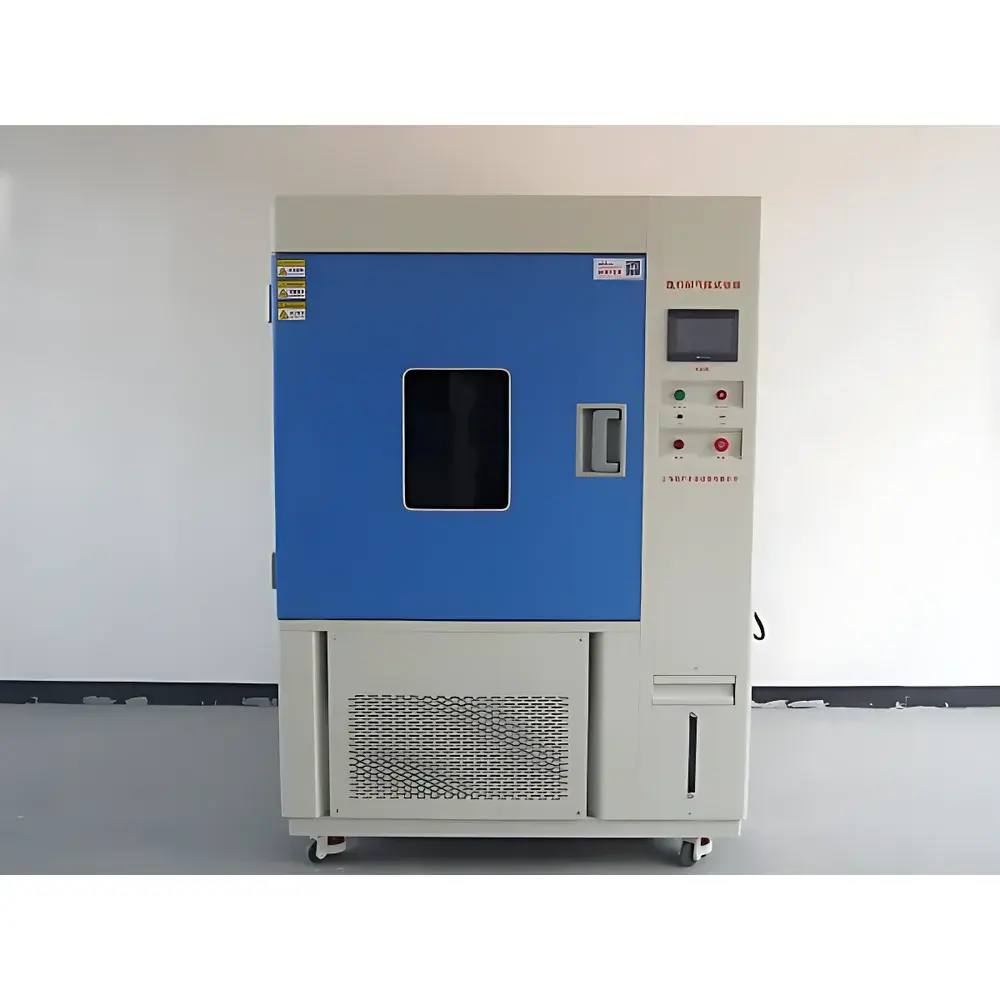
Jianhu JH-Series High-Capacity Xenon Arc Weathering Test Chamber
| Brand | Jianhu |
|---|---|
| Origin | Shanghai, China |
| Manufacturer Type | Direct Manufacturer |
| Product Category | Domestic |
| Model | JH-Series High-Capacity Xenon Arc Weathering Test Chamber |
| Price Range | USD 1,280 – 12,800 |
| Xenon Lamp Power | 1.8 kW to 6 kW |
| Irradiance Range | 150 W/m² to 736 W/m² |
| Light Exposure Duration | 1–9999 hours |
| Humidity Control Range | 20%–95% RH |
Overview
The Jianhu JH-Series High-Capacity Xenon Arc Weathering Test Chamber is engineered for accelerated weathering simulation under controlled laboratory conditions, utilizing a xenon arc lamp as the primary radiation source. This system replicates the full solar spectrum—including ultraviolet (UV), visible, and near-infrared (NIR) wavelengths—with spectral power distribution closely aligned to terrestrial sunlight (CIE No. 85, ISO 4892-2, ASTM G155). Designed specifically for high-throughput reliability validation, the chamber accommodates large-volume sample batches without compromising irradiance uniformity or environmental stability. Its robust thermal and hygrometric control architecture ensures precise regulation of black-standard temperature (BST), cabinet air temperature, and relative humidity—critical parameters for evaluating photodegradation, color fading, gloss loss, cracking, and polymer embrittlement in automotive components, consumer electronics housings, coatings, and elastomeric seals.
Key Features
- High-capacity test chamber volume (standard configurations: 500 L to 2000 L) enabling simultaneous exposure of multiple automotive trim parts, PCB assemblies, display modules, or structural plastic components
- Adjustable xenon lamp power output (1.8 kW–6 kW) with calibrated irradiance monitoring via broadband or narrowband (340 nm or 420 nm) sensors compliant with ISO 4892-2 Annex B
- Precise humidity control (20–95% RH) using steam injection and condensation-based dehumidification, with real-time feedback from capacitive RH sensors traceable to NIST standards
- Integrated black-standard thermometer (BST) and cabinet air temperature control (range: ambient +10°C to +80°C), meeting ASTM D4329 and ISO 4892-2 thermal profile requirements
- Programmable exposure cycles including light-only, light+dark, light+spray, and light+dark+spray sequences—fully configurable per IEC 60068-2-5 and SAE J2527
- Stainless steel 316L interior chamber construction with quartz-filtered xenon lamp housing to ensure UV stability and minimize spectral drift over extended operation
Sample Compatibility & Compliance
The JH-Series supports diverse sample geometries—from flat panels and molded automotive bumpers to stacked PCB trays and multi-layer OLED modules—via customizable sample racks and universal mounting fixtures. It meets core regulatory and industry-specific testing protocols including: ISO 4892-2 (Plastics — Methods of exposure to laboratory light sources), ASTM G155 (Standard Practice for Operating Xenon Arc Lamp Apparatus), SAE J2412/J2527 (Accelerated Exposure of Automotive Exterior Materials), and IEC 60068-2-5 (Environmental Testing — Radiation, Solar). All systems are designed for GLP-compliant operation, supporting audit-ready data logging, user access control, and electronic signature functionality per FDA 21 CFR Part 11 when paired with optional validated software packages.
Software & Data Management
Equipped with a Windows-based controller interface (Jianhu LabControl v4.x), the chamber provides real-time graphical monitoring of irradiance, temperature, humidity, and elapsed exposure time. Data is logged at user-defined intervals (minimum 1-second resolution) and exported in CSV or XML format for traceability and integration into LIMS or PLM platforms. Optional IQ/OQ documentation packages include calibration certificates for irradiance sensors (traceable to PTB/NIM), temperature/humidity sensor verification reports, and performance qualification protocols aligned with ISO/IEC 17025 requirements. Remote diagnostics and firmware updates are supported via Ethernet or RS485 interfaces.
Applications
- Automotive: Accelerated aging of instrument panel substrates, headlamp lenses, door trims, rubber gaskets, and ADAS camera housings under cyclic UV/heat/humidity stress
- Electronics: Reliability screening of smartphone casings, flexible printed circuits (FPCs), OLED encapsulation layers, and conformal coatings exposed to combined photo-thermal-hygrometric loads
- Coatings & Polymers: Evaluation of chalking resistance, gloss retention, and yellowing index (YI) in architectural paints, automotive clearcoats, and engineering thermoplastics (e.g., PC, ABS, PBT)
- Textiles & Composites: Assessment of colorfastness and tensile property degradation in aerospace interior fabrics and carbon-fiber reinforced polymer (CFRP) laminates
- Medical Devices: Photostability testing of polymer-based diagnostic housings and drug delivery system components per ISO 10993-12 guidance
FAQ
What standards does this chamber support for automotive component testing?
It fully complies with SAE J2412 (Interior) and J2527 (Exterior), as well as ISO 11341 for rubber and elastomer evaluation.
Can the chamber simulate rain or dew cycles during exposure?
Yes—integrated water spray nozzles and condensation humidity control enable light+spray and dark+condensation cycles per ASTM D4329 and ISO 4892-2.
Is irradiance calibration traceable to national metrology institutes?
All standard irradiance sensors are supplied with calibration certificates traceable to NIM (China National Institute of Metrology) or PTB (Physikalisch-Technische Bundesanstalt).
Does the system support automated pass/fail reporting against predefined thresholds?
When integrated with Jianhu LabControl Advanced Edition, users may configure custom pass/fail logic based on irradiance deviation, BST drift, or cycle timing tolerance.
What maintenance intervals are recommended for xenon lamps and filters?
Xenon lamps require replacement every 1,500–2,000 operational hours; outer quartz filters every 500 hours; and inner daylight filters every 1,000 hours—maintenance logs are auto-generated within the controller.



