
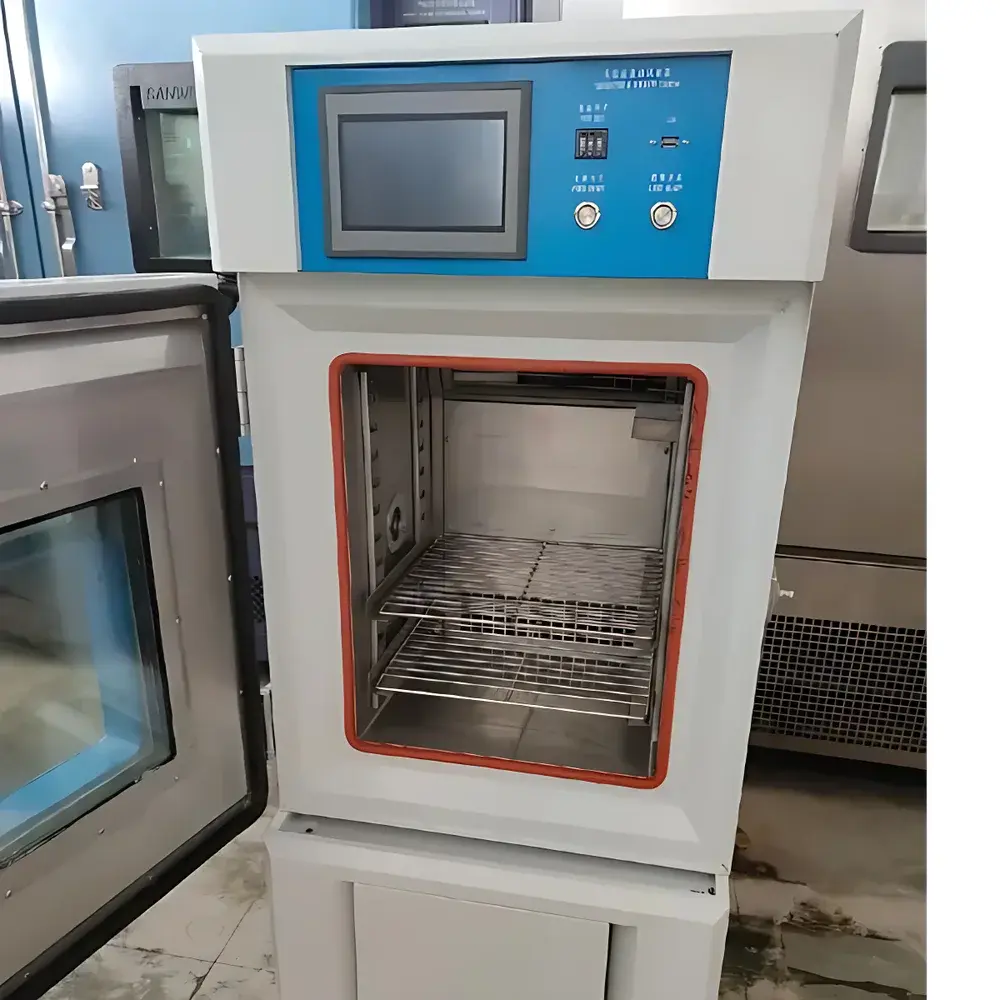
JH-JiAnHu Dual-Chamber Explosion-Proof Constant-Temperature Environmental Test Chamber for Lithium-Ion Battery Safety Validation
| Brand | JiAnHu |
|---|---|
| Origin | Shanghai, China |
| Model | JH-DualChamber-EP-CT-Battery |
| Temperature Range | –40°C to +150°C (standard), ±0.3°C temperature uniformity |
| Explosion Protection Rating | EN 60079-1 (Flameproof Enclosure “d”) + EN 60079-28 (Optical Radiation) compliant dual-chamber architecture |
| Internal Volume | 100 L to 1000 L (customizable) |
| Control System | PID-based digital controller with real-time data logging and Ethernet/RS485 interface |
| Compliance | Meets ISO 12405-4, UN 38.3, IEC 62133-2, GB/T 31485, GB/T 31467.3, and supports GLP/GMP audit trails per FDA 21 CFR Part 11 requirements |
| Power Supply | 3-phase 380 VAC ±10%, 50/60 Hz |
Overview
The JH-JiAnHu Dual-Chamber Explosion-Proof Constant-Temperature Environmental Test Chamber is an engineered solution for the rigorous safety validation of lithium-ion battery cells, modules, and packs under controlled thermal and hazardous-condition scenarios. Designed specifically for R&D laboratories, QC departments, and third-party certification bodies, this system implements a certified dual-chamber architecture—comprising a primary test chamber and a secondary containment chamber—to physically isolate thermal runaway events while maintaining uninterrupted environmental control. Its operational principle relies on flameproof enclosure design (EN 60079-1 “d” rating) combined with pressure-relief venting, optical isolation, and real-time gas monitoring integration capability. Unlike conventional environmental chambers, this platform enables safe execution of accelerated life testing, overcharge/overdischarge stress tests, and temperature cycling protocols—while meeting the stringent physical containment requirements mandated by UN 38.3 Section 38.3.4 (thermal abuse), IEC 62133-2 Clause 8.2.2 (crush & nail penetration simulation environments), and GB/T 31485–2015 Annex A (explosion resistance verification).
Key Features
- Dual-chamber explosion containment system with independent pressure-rated inner and outer enclosures—engineered to withstand ≥20 bar peak overpressure from Li-ion cell venting or deflagration events
- Precision temperature control across –40°C to +150°C range, with ≤±0.3°C chamber uniformity (measured per IEC 60068-3-5) and ≤±0.5°C stability over 24 h
- Integrated safety interlocks: redundant door-locking mechanism, automatic chamber purge cycle upon door opening, emergency power-off via Class 0.5A circuit breaker
- Modular chamber configuration supporting customizable internal volume (100 L to 1000 L), optional humidity control (10–95% RH), and mechanical vibration coupling ports (for synchronized shock/vibration + thermal stress testing)
- Compliance-ready hardware architecture: pre-wired for optional O₂/CO/HF gas sensors, infrared thermal imaging window, and explosion-proof lighting (ATEX Zone 1 rated)
Sample Compatibility & Compliance
This chamber accommodates cylindrical (18650, 21700, 4680), prismatic, and pouch-format Li-ion batteries up to 500 mm × 300 mm × 100 mm per test unit. It supports both single-cell and multi-cell module configurations, with configurable mounting fixtures and insulated busbar access ports. All structural materials—including chamber walls, observation windows, and internal shelving—are selected per EN 13463-1 non-sparking requirements and UL 94 V-0 flammability classification. The system conforms to international regulatory frameworks including: UN Manual of Tests and Criteria Part III Subsection 38.3 (transport safety), IEC 62133-2:2017 (secondary cells for portable applications), ISO 12405-4:2018 (electric vehicle battery performance), and China’s mandatory GB/T 31485–2015 and GB/T 31467.3–2015 standards for electric vehicle traction battery safety assessment. Documentation includes full traceable calibration certificates (NIST-traceable reference sensors), CE Declaration of Conformity, and EN 60079-1 type examination report.
Software & Data Management
The embedded control system runs JiAnHu’s proprietary ETS-OS v4.2 firmware, featuring ISO/IEC 17025-aligned audit trail functionality—including user login history, parameter change logs, alarm event timestamps, and electronic signature support per FDA 21 CFR Part 11. Data export supports CSV, XML, and PDF formats with embedded metadata (test ID, operator, chamber ID, calibration status). Optional cloud synchronization enables remote monitoring via secure TLS 1.2 API endpoints, compatible with enterprise LIMS platforms (e.g., LabVantage, Thermo Fisher SampleManager). All firmware updates undergo formal change control review; version history and validation reports are provided with each release. Calibration intervals follow ISO/IEC 17025 recommendations and are tracked automatically within the system’s maintenance scheduler.
Applications
- Thermal runaway propagation testing in multi-cell battery modules (per UL 9540A methodology)
- Temperature-dependent impedance spectroscopy (EIS) preconditioning under inert atmosphere
- Accelerated calendar/cycle life testing under variable SOC and temperature profiles
- Validation of battery management system (BMS) thermal response algorithms
- Pre-certification testing for UL 2580, GB 38031, and EU Regulation (EU) 2019/2144 compliance
- Root-cause analysis of electrolyte decomposition pathways using in-situ FTIR-compatible chamber variants
FAQ
Does this chamber meet ATEX or IECEx certification requirements for use in classified hazardous areas?
Yes—the outer chamber housing carries ATEX Category 2G (Zone 1) and IECEx Ex db IIB T4 Gb certification. Internal instrumentation is intrinsically safe (Ex ia IIC T4 Ga) or encapsulated per EN 60079-18.
Can the system be integrated with external battery cyclers or gas chromatography units?
Yes—standardized analog/digital I/O (0–10 V, 4–20 mA, Modbus TCP) and dry-contact relay outputs enable seamless synchronization with Arbin, Bio-Logic, or MACCOR cyclers, as well as GC/MS vent gas analyzers.
What is the maximum allowable test duration for continuous operation at 120°C?
Rated for indefinite operation at ≤120°C when ambient conditions remain within 15–35°C and relative humidity ≤75%; extended high-temp operation requires optional high-temperature insulation package.
Is third-party validation support available for IQ/OQ/PQ documentation?
JiAnHu provides full qualification protocol templates (aligned with ASTM E2500 and Annex 15), plus on-site witness support by ISO/IEC 17025-accredited engineers.
How is chamber integrity verified after a thermal runaway event?
Post-event inspection includes helium leak testing (≤1×10⁻⁹ mbar·L/s sensitivity), visual weld seam assessment per ISO 5817-B, and functional revalidation of all safety interlocks and purge cycles.



