
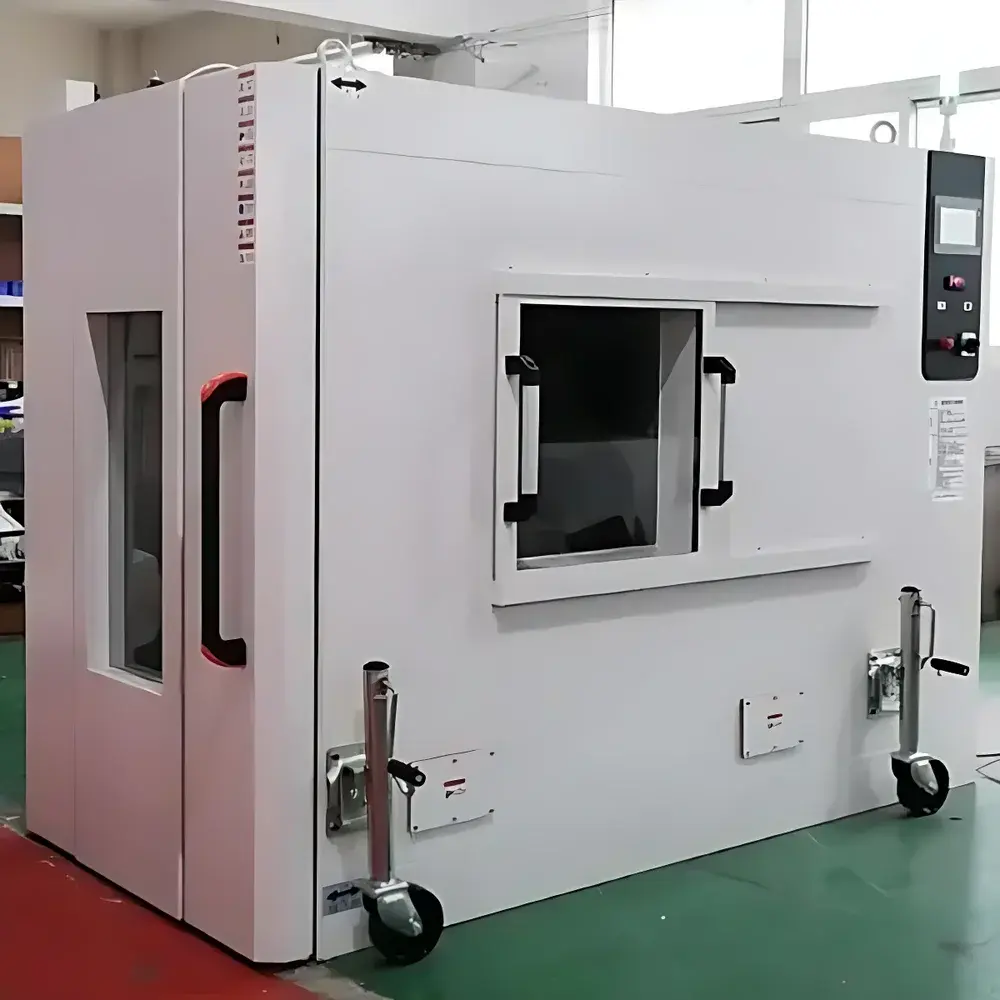
Jianhu JH-Series High-Low Temperature Environmental Test Chamber for Server Motherboard Reliability Testing
| Brand | Jianhu |
|---|---|
| Origin | Shanghai, China |
| Model | JH-Server-Motherboard Environmental Test Chamber |
| Temperature Range | -70 °C to +150 °C |
| Refrigeration Method | Compressor-based |
| Explosion-Proof Design | Yes |
| Temperature Fluctuation | ±0.5 °C |
| Temperature Uniformity | ±2.0 °C |
| Temperature Deviation | ±2.0 °C |
| Heating Rate | ≤60 min (from 25 °C to +150 °C) |
| Cooling Rate | ≤45 min (from 25 °C to -40 °C), ≤60 min (to -55 °C), ≤80 min (to -70 °C) |
| Internal Chamber Dimensions | Customizable upon consultation |
Overview
The Jianhu JH-Series High-Low Temperature Environmental Test Chamber is an engineered solution designed specifically for thermal stress validation of server motherboard assemblies under controlled, repeatable, and traceable environmental conditions. Built upon fundamental principles of convective heat transfer and closed-loop thermodynamic control, this chamber enables precise simulation of operational thermal extremes encountered during data center deployment, transportation logistics, and field service scenarios. It complies with core thermal testing requirements outlined in IEC 60068-2-1 (cold tests), IEC 60068-2-2 (dry heat), and JEDEC JESD22-A104 (temperature cycling), supporting qualification protocols for high-reliability computing hardware. The system features a dual-stage cascade refrigeration architecture with eco-friendly R404A/R23 mixed-refrigerant circuits, enabling stable operation across the full -70 °C to +150 °C range without thermal shock or condensation-induced failure modes.
Key Features
- Explosion-proof certified enclosure (IEC 60079-0 / GB 3836.1) suitable for use in hazardous environments where flammable vapors or dust may be present during motherboard burn-in or failure analysis.
- PID-based digital temperature controller with adaptive tuning algorithms and real-time deviation compensation, delivering sustained stability within ±0.5 °C fluctuation and ±2.0 °C spatial uniformity across the working volume.
- High-efficiency heating system using sheathed NiCr resistance elements with distributed mounting to minimize thermal gradients; cooling achieved via hermetic scroll compressors and optimized finned evaporator geometry.
- Integrated platinum RTD sensors (PT100, Class A tolerance) mounted at multiple spatial locations—center, corners, and mid-height—for continuous feedback and dynamic correction of thermal drift.
- Robust structural design featuring double-wall insulated stainless steel interior (SUS304), reinforced aluminum alloy frame, and vibration-damped mounting feet to isolate external mechanical interference during long-duration soak tests.
- Comprehensive safety architecture including over-temperature cut-off, compressor high-pressure shutdown, phase-loss protection, ground-fault interruption, and door interlock circuitry compliant with EN 61000-6-2/6-4 EMC standards.
Sample Compatibility & Compliance
The chamber accommodates standard 19-inch rack-mounted server chassis, ATX/EATX motherboards (up to 305 × 244 mm), and modular compute sleds—either bare PCBs or fully populated units with active cooling modules installed. Internal airflow management ensures laminar, non-turbulent circulation to prevent localized hot spots that could skew thermal mapping results. All materials in contact with test specimens conform to RoHS 2011/65/EU and REACH SVHC regulations. The system supports audit-ready documentation per ISO/IEC 17025:2017 laboratory accreditation requirements, including calibration certificates traceable to NIM (National Institute of Metrology, China) and uncertainty budgets for temperature measurement channels.
Software & Data Management
Equipped with Jianhu’s proprietary TMS-Link™ control software (v4.2+), the chamber provides real-time monitoring, multi-channel logging (≥16 channels), and automated test sequencing—including ramp-soak-hold profiles, stepwise cycling, and user-defined dwell times. Data export is supported in CSV, XML, and PDF formats with embedded metadata (operator ID, timestamp, chamber ID, sensor IDs). For regulated industries, optional 21 CFR Part 11-compliant configuration includes electronic signatures, audit trail logging, role-based access control, and encrypted database storage. All firmware updates are digitally signed and verified prior to installation to ensure integrity and compliance continuity.
Applications
- Thermal validation of CPU/GPU VRM designs under transient load conditions at extreme ambient temperatures.
- Material compatibility testing of solder alloys, capacitors, and polymer substrates used in high-density interconnect layers.
- Accelerated life testing (ALT) of PCIe 5.0/6.0 signal integrity components exposed to repeated thermal cycling.
- Environmental screening per MIL-STD-810H Method 501.7 (high temperature) and Method 502.7 (low temperature) for aerospace-grade server modules.
- Pre-compliance thermal stress screening for UL 62368-1 and IEC 62368-1 Annex G thermal hazard evaluation.
- Supporting GLP/GMP-aligned reliability labs performing IQ/OQ/PQ qualification of environmental test infrastructure.
FAQ
What temperature accuracy specifications apply during extended soak periods (>24 h)?
The chamber maintains ±0.5 °C fluctuation and ±2.0 °C uniformity over continuous operation up to 168 hours, validated per ASTM E744-19 Annex A1.
Can the chamber interface with external power supplies or data acquisition systems?
Yes—standard RS485 Modbus RTU and optional Ethernet/IP interfaces support integration with third-party DAQ platforms, programmable loads, and PXI-based test controllers.
Is custom chamber dimensioning available for non-standard server form factors?
Yes—working volume can be tailored from 100 L to 1000 L with adjustable internal shelving, cable ports, and viewing windows per customer mechanical drawings.
Does the system include calibration documentation required for ISO/IEC 17025 accreditation?
Each unit ships with a factory calibration report (NIST-traceable reference standards), uncertainty budget, and verification checklist aligned with ILAC-G8:2022 guidelines.
How is explosion-proof certification maintained during routine maintenance?
All service procedures follow ATEX/IECEx-certified maintenance protocols; replacement parts carry identical Ex marking and are supplied with updated certificate supplements.



