
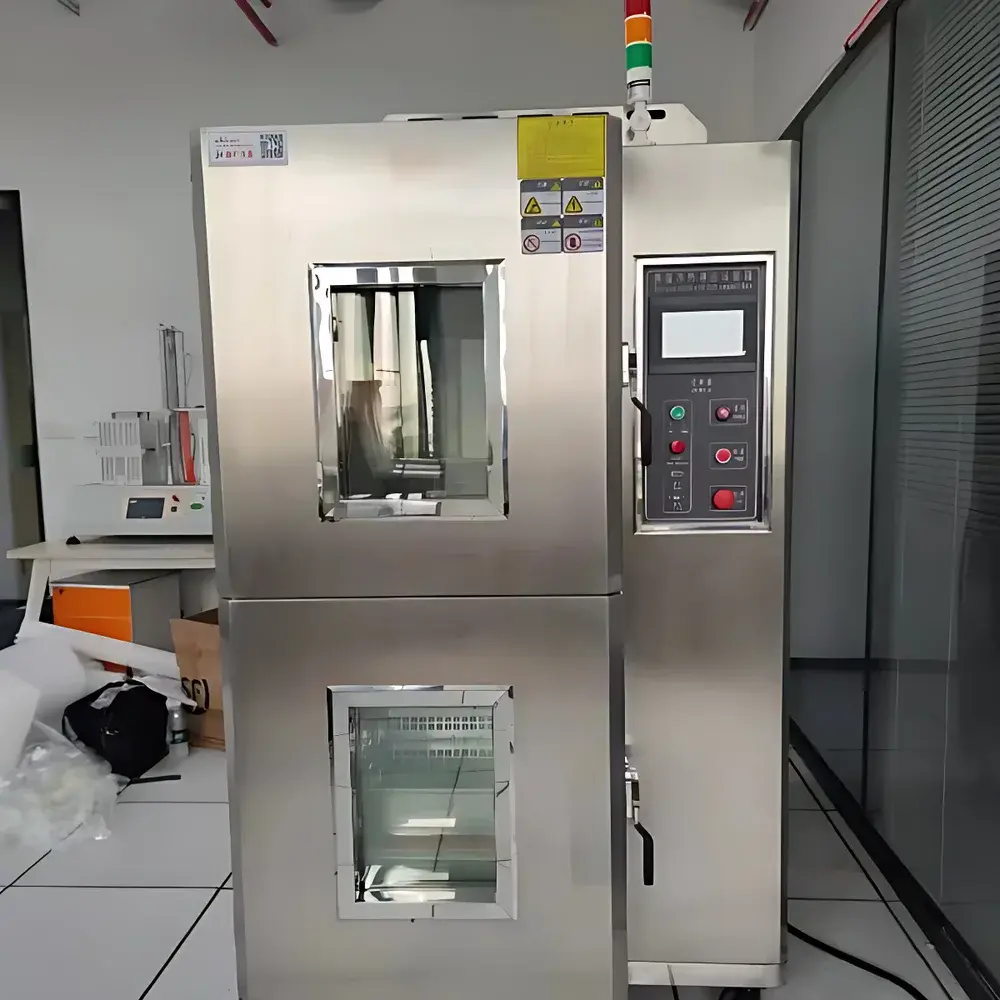
Jianhu JH-CTC Series Semiconductor Cold-Hot Thermal Shock Chamber with Altitude/Vacuum Simulation Capability
| Brand | Jianhu |
|---|---|
| Origin | Shanghai, China |
| Model | JH-CTC Series |
| Temperature Range | -70 °C to +150 °C |
| Cooling Method | Compressor-based Refrigeration |
| Explosion-Proof Design | Yes |
| Temperature Fluctuation | ±0.5 °C |
| Temperature Deviation | ±2.0 °C |
| Temperature Uniformity | ±2.0 °C |
| Heating Rate | ≤60 min (from -40 °C to +150 °C) |
| Compliance | JESD22-A104, MIL-STD-202, IEC 60068-2-14, GB/T 2423.22 |
Overview
The Jianhu JH-CTC Series Semiconductor Cold-Hot Thermal Shock Chamber is an engineered environmental test system designed specifically for accelerated reliability assessment of semiconductor devices, integrated circuits, power modules, and advanced electronic assemblies under extreme thermal transients and simulated high-altitude vacuum conditions. It operates on the principle of rapid two- or three-zone thermal shock—transferring test specimens between independently controlled low-temperature (-70 °C), ambient, and high-temperature (+150 °C) chambers via pneumatic or servo-driven transfer mechanisms. The system integrates optional altitude simulation capability (vacuum down to 10 kPa absolute, equivalent to ~30,000 m elevation) to replicate combined thermal-vacuum stress profiles encountered during aerospace deployment, automotive under-hood operation, or high-altitude data center environments. Unlike standard thermal cycling chambers, the JH-CTC Series meets the stringent requirements of JESD22-A104 (Temperature Cycling) and complements JEDEC’s A110 (Highly Accelerated Temperature and Humidity Stress Test) and A118 (Mechanical Shock) frameworks by enabling synchronized thermal ramping with pressure modulation.
Key Features
- Triple-chamber architecture with independent refrigeration and heating circuits ensures minimal thermal crosstalk and precise dwell control at each setpoint.
- Explosion-proof construction (certified to Class I, Division 2, Group C/D per NEC/CE standards) enables safe testing of battery-integrated ICs, GaN/SiC power modules, and encapsulated optoelectronic packages.
- Advanced fuzzy-PID hybrid controller with adaptive learning algorithms minimizes overshoot (<0.3 °C) and stabilizes temperature within ±0.5 °C fluctuation after door opening or load insertion.
- CFD-validated air distribution system delivers uniform airflow (≤0.3 m/s velocity gradient) across the working volume, achieving ±2.0 °C temperature uniformity per IEC 60068-3-5.
- Integrated vacuum manifold with oil-free diaphragm pump and pressure regulation module supports programmable altitude profiling (10–101 kPa abs) synchronized with thermal ramps.
- Stainless steel 304 interior, 150 mm thick polyurethane foam insulation (density ≥40 kg/m³), and seamless welded chamber joints ensure long-term thermal integrity and contamination-free operation.
Sample Compatibility & Compliance
The JH-CTC Series accommodates wafer-level packages (WLP), flip-chip BGAs, stacked die modules, MEMS sensors, and hermetically sealed TO-can devices up to 400 mm × 400 mm × 300 mm (W×D×H). Fixturing options include ceramic-insulated DUT carriers, thermocouple-integrated sockets, and vacuum-compatible probe stations. All configurations comply with JEDEC JESD22-A104 for temperature cycling qualification, as well as MIL-STD-202G Method 107 (Thermal Shock) and IEC 60749-25 (Reliability Testing of Integrated Circuits). The system supports audit-ready GLP/GMP documentation, including calibration traceability to NIM (National Institute of Metrology, China) and optional 21 CFR Part 11-compliant electronic signatures for regulated semiconductor fabs.
Software & Data Management
Equipped with Jianhu’s proprietary TSCore™ v4.2 control and analysis platform, the chamber provides real-time monitoring of chamber temperatures, transfer timing, vacuum pressure, and DUT thermocouple inputs (up to 16 channels). The software supports multi-step test profiles with conditional branching (e.g., “hold at -55 °C until vacuum reaches 25 kPa”), automatic pass/fail evaluation against user-defined failure thresholds (e.g., resistance drift >5%), and export of timestamped CSV/Excel reports compliant with ISO/IEC 17025 laboratory requirements. Data integrity safeguards include encrypted local storage, RAID-1 redundant logging, and optional cloud backup with TLS 1.3 encryption. Audit trails record all parameter changes, user logins, and calibration events with immutable timestamps.
Applications
- Semiconductor qualification: Screening for solder joint fatigue, die attach delamination, and mold compound cracking in QFN, QFP, and CSP packages.
- Aerospace electronics: Validating performance of avionics controllers and radiation-hardened FPGAs under combined thermal shock and low-pressure conditions.
- Automotive ADAS: Accelerated life testing of radar MMICs and LiDAR drivers subjected to under-hood thermal gradients and cabin altitude cycling.
- Power electronics: Assessing intermetallic growth and wire bond lift-off in SiC MOSFET modules operating across -40 °C to +175 °C junction ranges.
- Research & development: Supporting DOE-based thermal fatigue modeling, coefficient of thermal expansion (CTE) mismatch analysis, and failure mechanism identification via post-test SEM/FIB cross-sectioning.
FAQ
What standards does the JH-CTC Series explicitly support for semiconductor qualification?
It is validated for JESD22-A104 (Temperature Cycling), MIL-STD-202G Method 107, and IEC 60068-2-14. Optional configuration supports JESD22-A110 and A118 when paired with humidity and mechanical shock modules.
Can the system perform simultaneous thermal shock and vacuum exposure?
Yes—the vacuum manifold is fully synchronized with thermal profile execution, allowing ramp-and-hold sequences where pressure reduction occurs concurrently with temperature transitions.
Is third-party calibration and performance verification available?
Jianhu provides factory-issued IQ/OQ documentation and offers accredited calibration services through CNAS-certified partners, including temperature uniformity mapping and vacuum leak rate certification.
What is the typical lead time for custom configurations (e.g., larger work volume or extended low-temperature range)?
Standard models ship within 8–10 weeks; custom engineering variants (e.g., -80 °C capability or 600 mm transfer stroke) require 14–18 weeks from PO confirmation and technical review.
Does the system support remote monitoring and integration into existing MES or SCADA infrastructure?
Yes—OPC UA and Modbus TCP interfaces are standard; RESTful API access for test scheduling, status polling, and alarm forwarding is available via optional TSCore™ Connect license.



