
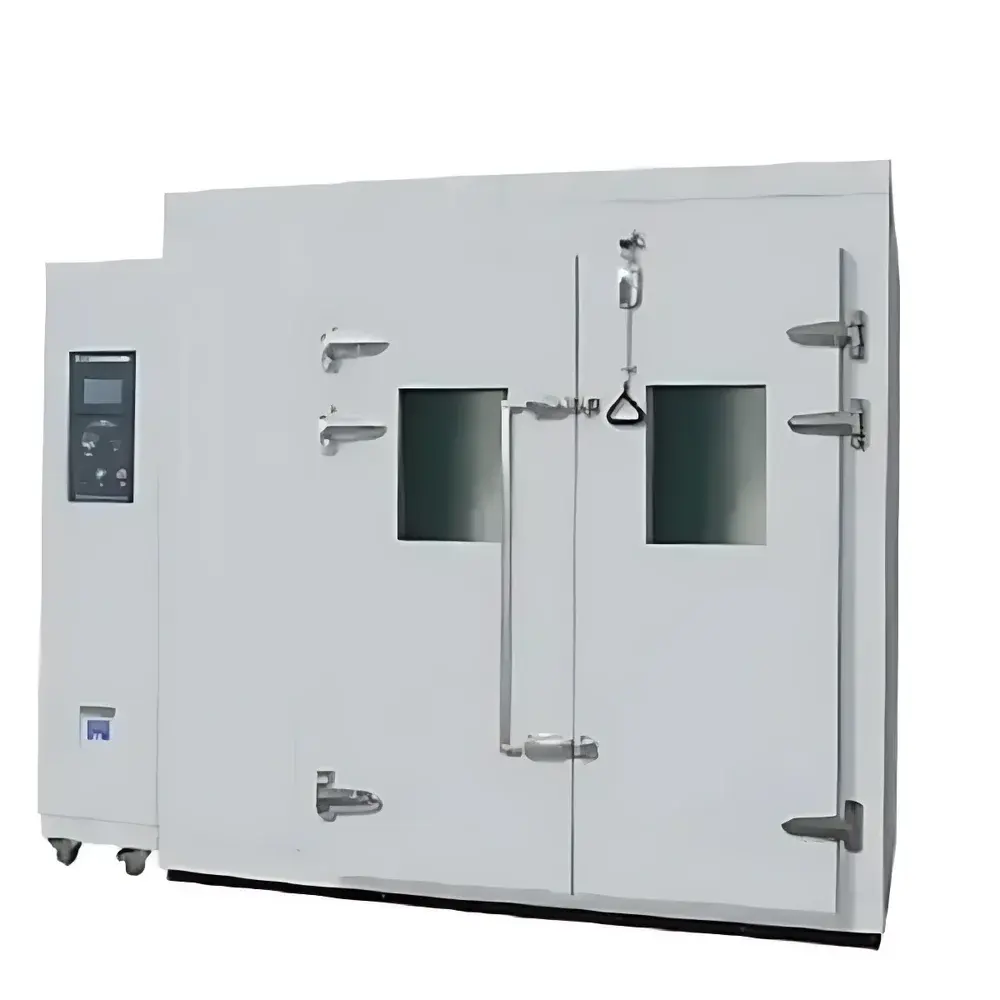
JH Battery Washing Test Instrument – Vertical Immersion Washer for Lithium-ion & Secondary Cell Evaluation
| Brand | JH Instruments |
|---|---|
| Origin | Shanghai, China |
| Model | JH-BWTI Series |
| Price Range | USD 1,100 – 110,000 |
| Application | Battery Enclosure Integrity & Electrolyte Leakage Resistance Testing |
| Compliance | Designed per IEC 62133-2, UN 38.3 Section 38.3.4 (Washing Simulation), GB/T 31241–2014 Clause 7.9.3 |
Overview
The JH Battery Washing Test Instrument (JH-BWTI Series) is a purpose-built vertical immersion washer engineered to evaluate the mechanical integrity and environmental resistance of rechargeable battery cells—particularly lithium-ion, Ni-MH, and solid-state pouch/prismatic formats—under simulated aqueous exposure conditions. Unlike generic washing or cleaning equipment, this instrument implements controlled, repeatable mechanical agitation combined with programmable immersion protocols to replicate real-world scenarios such as accidental submersion in rainwater, coolant leakage, or industrial cleaning processes. Its core methodology follows the principle of dynamic fluid interaction: batteries are mounted vertically on a motor-driven rotating carrier submerged in temperature-regulated test solution (e.g., deionized water, 5% NaCl, or pH-adjusted electrolytes), while synchronized oscillation induces shear stress at electrode terminals, gasket interfaces, and housing seams. Real-time monitoring of open-circuit voltage (OCV), internal impedance (via ACIR at 1 kHz), and surface leakage current (±1 µA resolution) enables early detection of seal degradation, pinhole formation, or electrolyte egress—critical failure modes not observable via static immersion alone.
Key Features
- Vertical-axis immersion architecture minimizes gravitational distortion during testing, ensuring uniform stress distribution across cell surfaces and enabling consistent evaluation of top-seal and terminal weld integrity.
- Programmable agitation profile: adjustable rotational speed (0–60 rpm), oscillation amplitude (±5 mm to ±25 mm), and dwell time per cycle—configurable to match IEC 62133-2 Annex D or custom OEM specifications.
- Integrated thermal control system maintains bath temperature within ±0.5°C across range of 5°C to 50°C, supporting accelerated aging studies under thermally coupled washing conditions.
- Dual-channel electrochemical monitoring interface: simultaneous acquisition of OCV stability and AC internal resistance (ACIR) at 1 kHz, sampled at 10 Hz with timestamped logging.
- IP54-rated enclosure with corrosion-resistant 316 stainless steel tank, PTFE-coated carrier arms, and sealed optical encoder feedback for long-term operational reliability in high-humidity lab environments.
- Compliant with functional safety requirements per IEC 61000-4-2 (ESD immunity) and IEC 61000-4-3 (radiated RF immunity), suitable for integration into GLP-compliant battery validation labs.
Sample Compatibility & Compliance
The JH-BWTI accommodates cylindrical (18650, 21700, 32650), prismatic (up to 200 × 150 × 20 mm), and pouch cells (max. 200 × 150 mm footprint) via modular fixture kits. Each fixture ensures mechanical stability without compressing active layers or compromising thermal expansion pathways. The system supports compliance verification against multiple international standards: IEC 62133-2:2020 Clause 7.9.3 (washing test), UN Manual of Tests and Criteria Part III Subsection 38.3.4 (simulated washing procedure), and GB/T 31241–2014 Section 7.9.3. Optional add-ons include conductivity monitoring probes (for bath ion concentration tracking) and humidity-controlled post-test drying chambers (to assess residual moisture ingress). All firmware and calibration records adhere to ISO/IEC 17025 traceability requirements, with optional NIST-traceable certificate packages available upon request.
Software & Data Management
JH-BWTI operates under JH-TestSuite v4.2—a Windows-based control and analysis platform compliant with FDA 21 CFR Part 11 for electronic records and signatures. The software provides role-based user access (Administrator, Technician, Auditor), full audit trail logging (including parameter changes, start/stop events, and alarm triggers), and automated report generation in PDF/A-1b and CSV formats. Raw sensor data (voltage, impedance, temperature, position) is stored in SQLite databases with SHA-256 hash integrity verification. Export modules support direct import into MATLAB, Python (via Pandas), or LIMS platforms using ASTM E1382-compliant metadata tagging. Calibration certificates, maintenance logs, and test sequence definitions are version-controlled and digitally signed to meet GMP documentation requirements for battery qualification dossiers.
Applications
This instrument serves critical roles across battery development and manufacturing quality assurance workflows. In R&D labs, it supports comparative analysis of sealing technologies (laser welding vs. adhesive bonding), gasket material selection (silicone vs. fluoroelastomer), and thermal interface design under cyclic wet-dry stress. For production QA, it functions as a 100% inline or batch sampling station to verify lot-to-lot consistency in enclosure robustness prior to shipping. Automotive Tier-1 suppliers utilize the JH-BWTI to validate cell-level compliance with OEM-specific washing protocols (e.g., VW TL 82000, GMW15531). Academic institutions employ it in failure mechanism studies—including dendrite-induced microleakage detection and SEI layer stability assessment under hydrothermal stress. It is also deployed in third-party certification labs accredited to ISO/IEC 17065 for issuing CB Scheme test reports.
FAQ
What battery chemistries and form factors does the JH-BWTI support?
It supports Li-ion, Li-polymer, Ni-MH, and emerging solid-state cells in cylindrical, prismatic, and pouch configurations—up to 200 × 150 × 20 mm.
Can the system be integrated into an automated battery testing line?
Yes—equipped with Modbus TCP and EtherNet/IP interfaces, it supports synchronization with PLC-controlled handling systems and MES data exchange via OPC UA.
Is bath solution composition monitored in real time?
Standard configuration includes temperature and level sensing; optional conductivity and pH sensors enable closed-loop bath chemistry management.
Does the instrument provide pass/fail criteria per standard?
Pre-loaded test templates include decision logic per IEC 62133-2 and UN 38.3, with configurable thresholds for voltage drop (>5% from baseline), impedance rise (>15%), or leakage current (>10 µA).
What calibration and service support is offered internationally?
JH Instruments provides factory calibration with NIST-traceable documentation, on-site annual verification services in APAC/EU/NA regions, and remote firmware updates with cybersecurity patching aligned with IEC 62443-4-2.



