
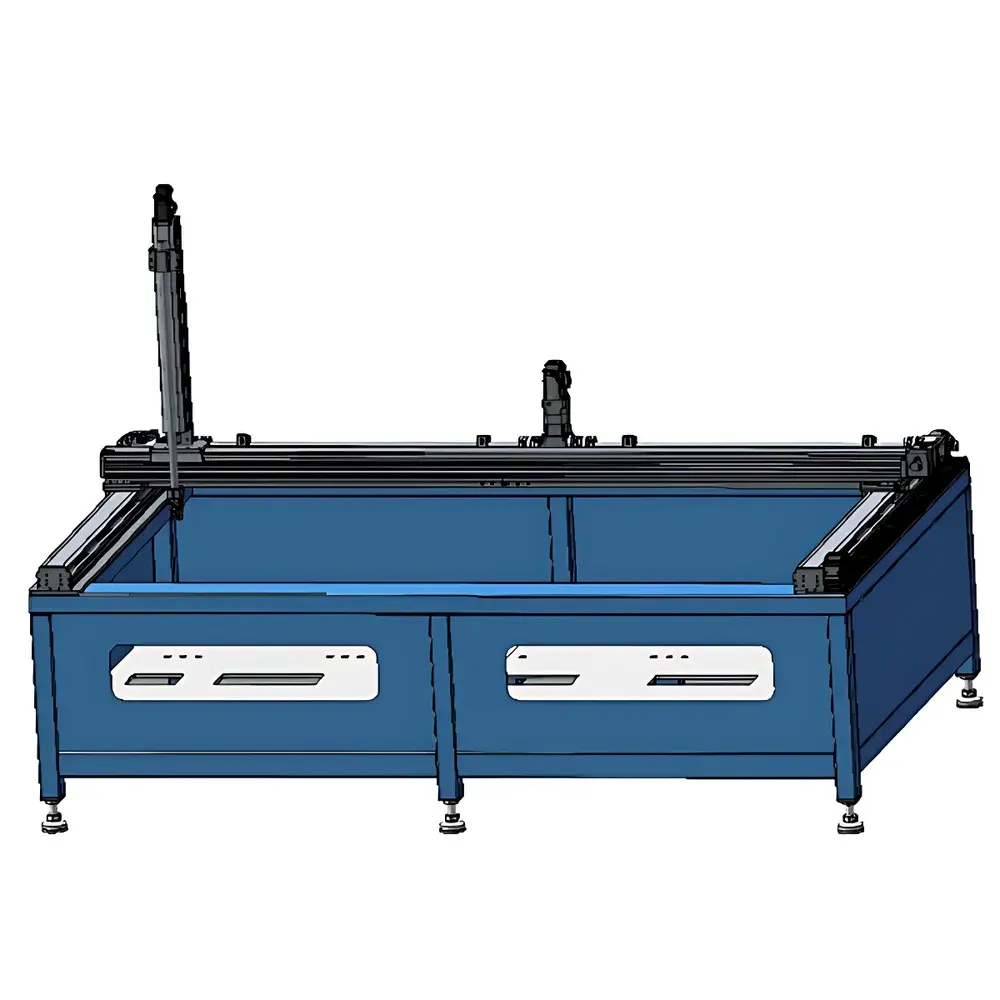
Olympus Water-Coupled C-Scan Ultrasonic Testing System
| Brand | Olympus |
|---|---|
| Origin | Shanghai, China |
| Manufacturer Type | Authorized Distributor |
| Regional Classification | Domestic (PRC) |
| Model | Custom-Configurable C-Scan Platform |
| Pricing | Upon Technical Consultation |
| Application Scope | Aerospace Composites, Additive Manufacturing Parts, Ceramic Matrix Composites, and Other High-Integrity Structural Components |
Overview
The Olympus Water-Coupled C-Scan Ultrasonic Testing System is an automated immersion ultrasonic inspection platform engineered for high-resolution, quantitative volumetric evaluation of complex geometries and advanced materials. Operating on the principle of pulse-echo and through-transmission ultrasonics, the system utilizes water as an acoustic coupling medium to eliminate air gaps and ensure consistent sound energy transmission into test specimens. Unlike contact-based methods, water immersion enables precise standoff control, stable beam alignment, and repeatable transducer positioning—critical for detecting sub-millimeter discontinuities such as porosity, delamination, inclusions, and interfacial voids in non-homogeneous or curved components. The system integrates a motorized multi-axis scanning gantry (X-Y-Z + optional θ/tilt), synchronized with high-speed digitizing ultrasonic receivers, to generate spatially registered C-scan images representing amplitude, time-of-flight (TOF), or thickness data across the entire inspection surface.
Key Features
- Multi-axis precision motion control (±1.5 µm repeatability) with programmable scan patterns including raster, spiral, and contour-following trajectories
- Water temperature-regulated immersion tank (±0.5 °C stability) to minimize acoustic velocity drift and ensure measurement consistency
- Support for broadband immersion transducers (2–25 MHz) with focal lengths configurable from 12.7 mm to 254 mm, enabling optimization for resolution vs. penetration depth
- Real-time A-scan acquisition at up to 100 MHz sampling rate with 12-bit dynamic range and hardware-based gating for noise suppression
- Ruggedized stainless-steel frame and corrosion-resistant tank construction compliant with ISO 16931-2 for long-term industrial deployment
- Integrated safety interlocks, liquid level monitoring, and emergency drain valve meeting CE Machinery Directive 2006/42/EC requirements
Sample Compatibility & Compliance
The system accommodates flat, curved, and contoured parts up to 600 mm × 600 mm × 300 mm (L×W×H), with maximum weight capacity of 25 kg. Compatible specimen materials include carbon fiber-reinforced polymer (CFRP), titanium alloys, aluminum-lithium sheet, ceramic matrix composites (CMCs), and additive manufactured nickel superalloys. All inspection protocols are structured to align with ASTM E114 (Standard Practice for Ultrasonic Pulse-Echo Straight-Beam Examination), ASTM E273 (Standard Practice for Ultrasonic Testing of the Weld Zone of Welded Pipe and Tubing), and ISO 17640 (Non-destructive testing — Ultrasonic testing — Techniques, testing levels, and assessment). Data integrity complies with FDA 21 CFR Part 11 requirements via electronic signature support, audit trail logging, and user-access tiering.
Software & Data Management
Powered by Olympus NDT Studio™ v5.2 software, the platform delivers full workflow integration—from scan plan definition and real-time imaging to defect characterization and report generation. The software supports dual-mode visualization: grayscale and color-coded C-scan overlays with customizable thresholds, cross-sectional B-scan slicing, and 3D volume rendering. Raw RF data is stored in HDF5 format for traceability and post-processing interoperability with MATLAB, Python (NumPy/H5Py), or third-party analysis tools. Automated report templates conform to ASNT SNT-TC-1A and EN ISO 9712 documentation standards, including inspector certification details, equipment calibration records, and measurement uncertainty statements.
Applications
This system serves critical quality assurance functions in regulated manufacturing environments: detection of porosity clusters in electron-beam melted (EBM) Ti-6Al-4V turbine blades; mapping of disbonds in honeycomb-core aircraft panels; quantification of layer misalignment in fused deposition modeling (FDM) thermoplastic tooling; and thickness mapping of thermal barrier coatings on gas turbine vanes. It is also deployed in R&D laboratories for microstructure-property correlation studies, where C-scan-derived attenuation coefficients are correlated with SEM-EDS phase distribution data.
FAQ
What types of transducers are supported?
Standard immersion transducers from Olympus (e.g., V311, V312 series) and third-party OEMs compliant with IEEE 1850-2021 electrical interface specifications.
Is calibration traceable to national standards?
Yes—system-level calibration is performed using NIST-traceable reference blocks (e.g., IIW Type 1, ASTM E127), with certificate of calibration issued per ISO/IEC 17025 requirements.
Can the system be integrated into an automated production line?
Yes—equipped with Ethernet/IP and OPC UA interfaces for seamless PLC communication and MES-level data handshaking.
Does it support phased array ultrasonic testing (PAUT)?
Not natively; however, optional PAUT module integration is available upon request for sectorial scanning and beam steering capabilities.
What maintenance intervals are recommended?
Daily water filtration and degassing; quarterly transducer cable continuity verification; annual mechanical axis recalibration and acoustic path validation.



