
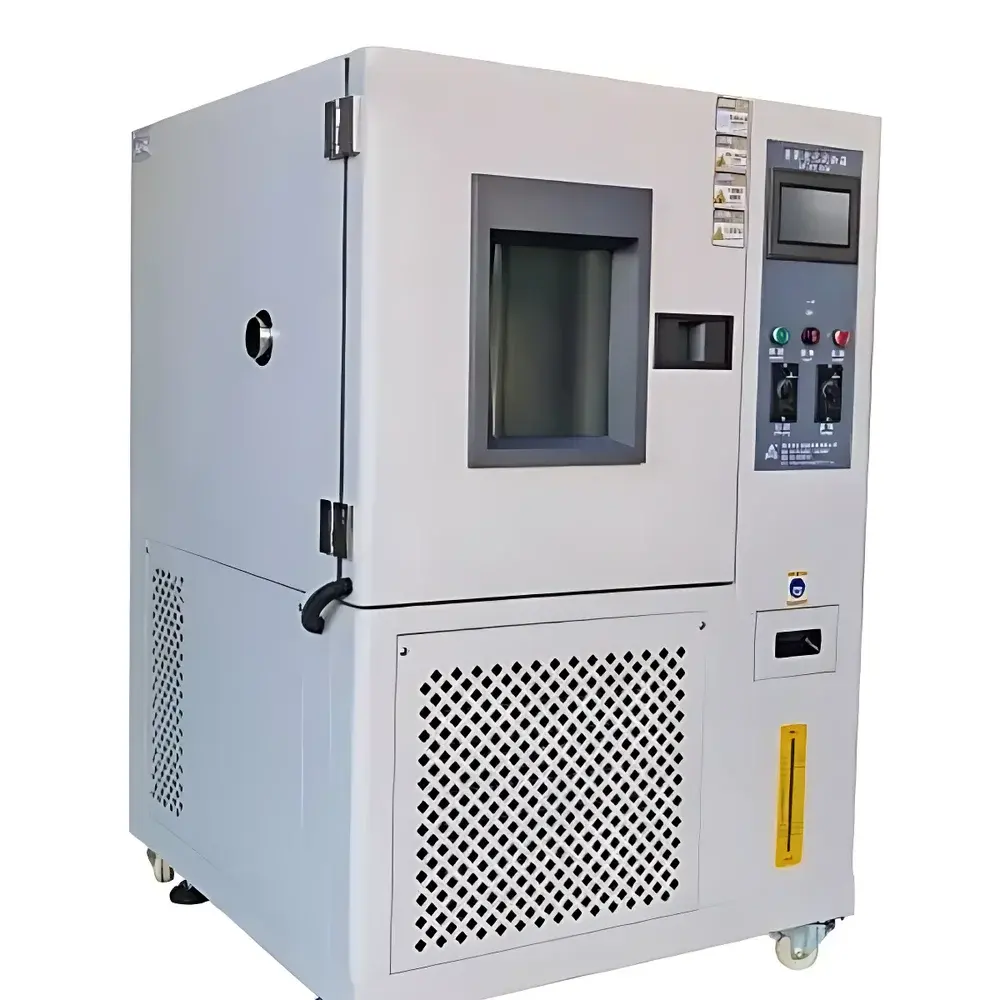
Jinhoo Salt Spray Test Chamber – ASTM B117 Compliant, Benchtop Corrosion Testing System
| Brand | Jinhoo |
|---|---|
| Origin | Shanghai, China |
| Model | JH-SSC Series |
| Type | Benchtop Environmental Test Chamber |
| Cooling Method | Air-Cooled |
| Temperature Range | 15–45 °C |
| Humidity Range | 30–98 % RH |
| Temperature Uniformity | ≤ ±2 °C |
| Temperature Fluctuation | ±1 °C (high-temp), ±2 °C (low-temp) |
| Humidity Uniformity | ≤ ±3 % RH |
| Humidity Fluctuation | ±3 % RH |
| Heating Rate | 1.0–3.0 °C/min |
| Compliance | ASTM B117, ISO 9227 (NSS), GB/T 2423.17 |
| Application Focus | Automotive Components, Electronics Enclosures, Plated Fasteners, PCB Substrates, Aerospace Hardware |
Overview
The Jinhoo Salt Spray Test Chamber (JH-SSC Series) is a benchtop environmental test system engineered for precise, repeatable accelerated corrosion evaluation in accordance with ASTM B117 – Standard Practice for Operating Salt Spray (Fog) Apparatus. It employs a saturated air chamber and controlled NaCl aerosol generation to replicate aggressive chloride-laden atmospheres typical of coastal, industrial, or de-icing environments. Unlike generic humidity chambers, this instrument maintains strict thermodynamic equilibrium between the salt solution reservoir, atomization nozzle, and test chamber—ensuring stable fog density, uniform droplet distribution (typically 1–2 µm median diameter), and consistent pH (6.5–7.2 for NSS). Its design prioritizes metrological traceability: temperature and humidity sensors are calibrated per ISO/IEC 17025 protocols, and chamber airflow dynamics follow ASTM-defined velocity and collection rate requirements (1.0–2.0 mL/h/80 cm²). The system supports standard Neutral Salt Spray (NSS), Acetic Acid Salt Spray (AASS), and Copper-Accelerated Acetic Acid Salt Spray (CASS) testing modes via programmable solution delivery and chamber conditioning sequences.
Key Features
- Benchtop footprint (W×D×H ≈ 750 × 500 × 600 mm) optimized for lab space efficiency without compromising test volume (≥ 120 L usable chamber capacity)
- Air-cooled condensation system eliminating need for external water chiller or drainage infrastructure
- Dual PID-controlled heating and humidification circuits enabling independent regulation of chamber temperature (15–45 °C) and relative humidity (30–98 % RH)
- Corrosion-resistant PVC-coated stainless steel chamber interior with removable, acid-resistant glass observation window
- Adjustable spray nozzle array with calibrated air pressure regulator (0.8–1.2 bar) and pre-heated saturated air supply
- Integrated digital controller with real-time logging of chamber parameters, alarm thresholds, and test duration; supports USB data export
- Compliance-ready architecture: meets mechanical and electrical safety requirements per IEC 61000-6-2/6-3 and EN 61000-6-4
Sample Compatibility & Compliance
The JH-SSC accommodates samples up to 600 mm in height and 450 mm in width—including automotive brake calipers, printed circuit board assemblies, zinc-plated fasteners, anodized aluminum housings, and coated medical device components. Fixtures include non-metallic sample racks, adjustable angle sample holders (15°–30° tilt), and insulating support stands to prevent galvanic coupling. All operational parameters align with ASTM B117 Annex A1 (chamber calibration procedures), ISO 9227 Annex B (fog collection verification), and GB/T 2423.17 Clause 5 (test condition validation). The chamber is routinely verified using NIST-traceable hygrometers and calibrated salt solution conductivity meters. For regulated industries, audit trails (time-stamped parameter logs, operator ID inputs, calibration records) support GLP/GMP documentation workflows and FDA 21 CFR Part 11 readiness when paired with optional PC-based software.
Software & Data Management
While the base unit features an embedded 7-inch TFT touchscreen HMI with multilingual interface (English, German, Japanese), optional Jinhoo TestSuite™ software enables advanced test orchestration. This Windows-based application supports method templates compliant with ASTM B117 Section 7 (test cycle definition), automatic report generation (PDF/CSV), statistical process control (SPC) charting of corrosion onset times, and integration with LIMS platforms via OPC UA. All data—including temperature/humidity profiles, spray duration, and alarm events—is timestamped and cryptographically signed to ensure integrity. Calibration certificates, sensor drift logs, and preventive maintenance records are stored in a secure local database with role-based access control (RBAC) and exportable audit logs meeting ISO/IEC 17025 clause 7.7 requirements.
Applications
This chamber serves as a critical verification tool across sectors where long-term material integrity is non-negotiable. In automotive Tier-1 supply chains, it validates electroplated brackets per VW 801 01 and GMW 14872 specifications. Electronics manufacturers use it to qualify conformal coatings on flex-rigid PCBs under IPC-CC-830B. Aerospace subcontractors perform CASS testing on cadmium-plated steel hardware per AMS 2700. Battery enclosure developers assess gasket seal degradation under cyclic NSS exposure. Academic labs apply it in metallurgical studies of Mg-Al alloys or Ni-P amorphous coatings, correlating mass loss rates with electrochemical impedance spectroscopy (EIS) data. Its reproducibility enables cross-laboratory comparison studies referenced in journals such as Corrosion Science and Electrochimica Acta.
FAQ
Does this chamber support automated transition between NSS, AASS, and CASS test modes?
Yes—via programmable solution switching valves and chamber preconditioning sequences; full mode change requires <15 minutes manual setup.
What verification documentation is provided at shipment?
Factory calibration certificate (temperature/humidity/spray rate), ASTM B117 conformance statement, CE Declaration of Conformity, and ISO 9001:2015 manufacturing certification.
Can the chamber be integrated into a larger environmental test suite (e.g., with thermal shock or UV exposure systems)?
Yes—standard RS-485 Modbus RTU and optional Ethernet/IP interfaces enable synchronization with third-party controllers for multi-stress corrosion protocols (e.g., ISO 16701 cyclic testing).
Is remote monitoring supported for unattended operation?
With optional IoT gateway module: real-time parameter streaming, SMS/email alerts on deviation events, and secure cloud dashboard access (TLS 1.2 encrypted).
How is chamber uniformity validated during routine maintenance?
Per ASTM B117 Annex A1: nine-point temperature mapping, fog collection rate verification at 16 locations using calibrated funnels, and pH/conductivity checks of collected solution every 100 hours of operation.



