
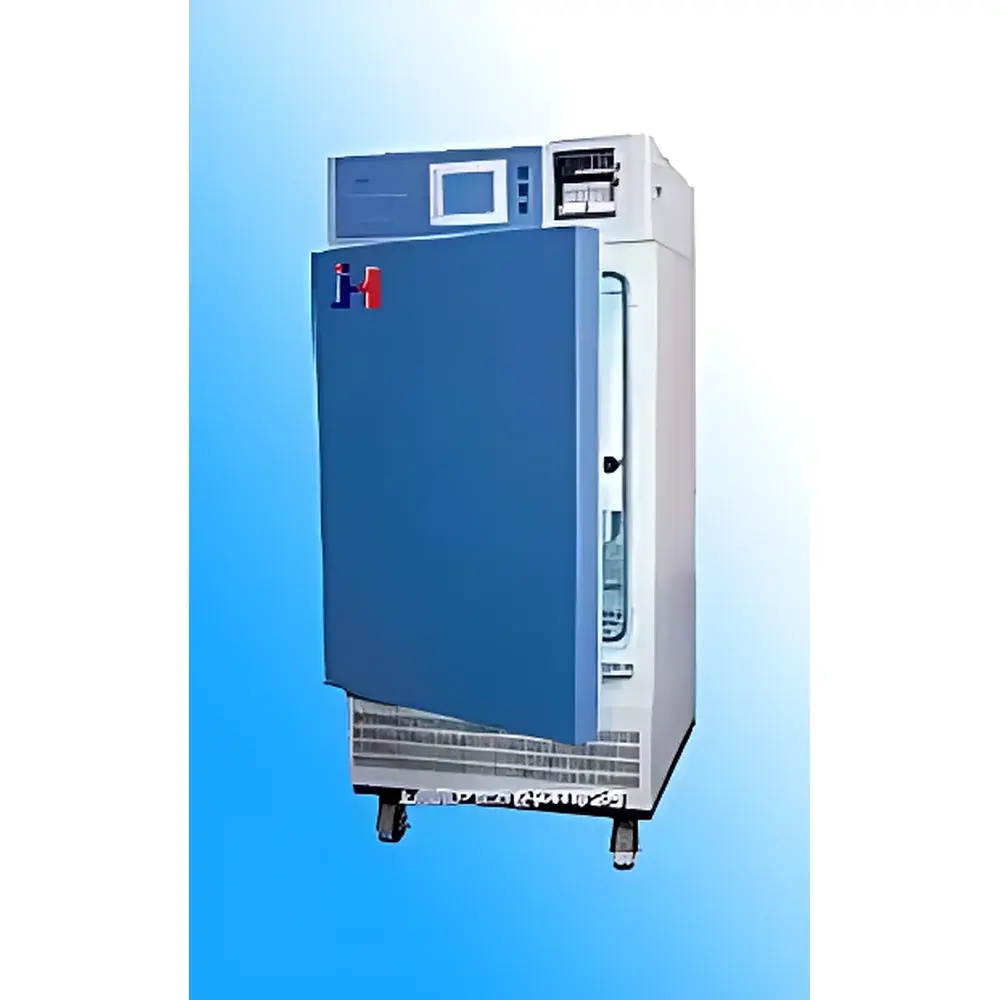
Jianhu JHH/LHH Series Pharmaceutical Stability Chambers
| Brand | Jianhu |
|---|---|
| Origin | Shanghai, China |
| Model | JHH-150SD / JHH-250SDP / JHH-500SD / JHH-150GSP / JHH-250GSP |
| Temperature Range | 0–65°C (dark), 10–65°C (with illumination) |
| Temperature Uniformity | ±2°C |
| Temperature Fluctuation | ±0.5°C |
| Humidity Range | 40–95% RH |
| Humidity Fluctuation | ±3% RH |
| Illuminance Range | 0–6000 lx (adjustable) |
| Illuminance Accuracy | ≤±500 lx |
| Control System | OYO programmable touchscreen controller (100 programs, 1000 segments, 999 cycles) |
| Refrigeration | Dual independent French Tecumseh hermetic compressors with auto-switching |
| Internal Chamber Material | Imported stainless steel (SUS304), semi-circular corner design |
| Safety Protections | Compressor overheat, fan overheat, over/under temperature, high-pressure, overload, and low-water level alarms |
| Compliance | Designed per Chinese Pharmacopoeia (2000 Edition) Stability Guidelines and GB 10586–89 |
Overview
The Jianhu JHH/LHH Series Pharmaceutical Stability Chambers are engineered for precision-controlled long-term environmental simulation required in pharmaceutical stability testing per ICH Q1–Q5 guidelines. These chambers integrate simultaneous, independent regulation of temperature (0–65°C), relative humidity (40–95% RH), and photometric irradiance (0–6000 lx) to replicate the accelerated, intermediate, long-term, high-humidity, and photostability test conditions mandated by regulatory submissions to the FDA, EMA, PMDA, and NMPA. Unlike generic environmental chambers, the JHH/LHH series employs a balanced heating–cooling–humidification architecture—based on principles of psychrometric control and radiant heat management—to maintain thermodynamic equilibrium across the entire working volume. This ensures compliance with ICH Q1B (photostability) and Q5C (stability of biotechnological/biological products), while supporting GLP- and GMP-aligned validation protocols including IQ/OQ/PQ documentation.
Key Features
- Microprocessor-based dual-channel OYO programmable controller with 10.4″ TFT touchscreen interface; supports English/Chinese language selection and real-time graphical display of temperature/humidity/light profiles.
- Dual independent French Tecumseh hermetic compressors with automatic load-sharing switching—engineered for uninterrupted 24/7 operation during 6-month accelerated studies (e.g., 40°C/75% RH).
- Optimized air circulation system featuring centrifugal fans and rear-mounted ducted airflow, achieving ±2°C temperature uniformity and ±3% RH consistency across the full chamber volume (per ISO 16770 Annex B verification methodology).
- Stainless steel (SUS304) interior with radius-corner construction, facilitating cleaning validation and residue-free decontamination per EU GMP Annex 1 requirements.
- Integrated 50 mm diameter access port with gasket-sealed feedthrough and standardized analog output socket for external data loggers or process monitoring systems.
- Comprehensive safety architecture: compressor overheat, refrigerant high-pressure, fan stall, thermal runaway, low-water cutoff, and power-fail recovery with auto-restart and alarm memory logging.
- Optional RM10/C high-accuracy digital recorder (UL/CE/OSHA certified, IP65 rated) with RS-232/RS-485 interface, compliant with FDA 21 CFR Part 11 for electronic records and signatures when paired with validated software.
Sample Compatibility & Compliance
The JHH/LHH chambers accommodate standard pharmaceutical packaging formats—including blister packs, HDPE bottles, glass vials, and aluminum pouches—within configurable shelf layouts (3–5 stainless steel trays, load-rated to 15 kg per shelf). Internal dimensions range from 680 × 400 × 600 mm (JHH-150SD) to 700 × 800 × 900 mm (JHH-500SD), enabling ICH-defined storage configurations for bracketing and matrixing study designs. All models are constructed and tested per GB 10586–89 (“Electrical Equipment for Environmental Testing — General Requirements”) and aligned with ASTM E2709–21 (statistical confidence for stability protocol execution). Optional thermal mapping kits (with 12–24 calibrated Pt100 sensors) support qualification per WHO TRS 992 Annex 6 and EU Commission Guide to Good Manufacturing Practice Annex 15.
Software & Data Management
The embedded OYO controller logs timestamped temperature, humidity, and illuminance values at user-defined intervals (1–60 min), storing up to 30 days of continuous data internally. Data export is supported via USB flash drive or RS-232/RS-485 serial link to third-party LIMS or ELN platforms. When equipped with the RM10/C recorder, raw sensor outputs (±0.1°C accuracy, ±1.5% RH, ±20 lx) are archived with audit-trail-enabled metadata—including operator ID, calibration status, and instrument firmware version—meeting ALCOA+ principles. Firmware updates are performed via secure signed packages, and controller configuration files are encrypted to prevent unauthorized modification—fulfilling critical requirements for computerized system validation under Annex 11 and 21 CFR Part 11.
Applications
- ICH Q1A(R2) Accelerated Stability Testing (40°C ±2°C / 75% RH ±5% RH, 6 months)
- ICH Q1B Photostability Testing (Option A: UV + visible light; Option B: near-UV only)
- Long-Term Storage Simulation (25°C ±2°C / 60% RH ±5% RH, up to 36 months)
- Intermediate Condition Studies (30°C ±2°C / 65% RH ±5% RH)
- High-Humidity Stress Testing (40°C / 75–95% RH)
- Excipient Compatibility Screening under controlled hygrothermal gradients
- Reference Standard Storage under GCP-compliant environmental monitoring
FAQ
What regulatory standards does this chamber comply with?
It meets GB 10586–89, aligns with ICH Q1–Q5, and supports validation against FDA 21 CFR Part 11, EU Annex 11, WHO TRS 992, and ISO 16770 when used with qualified sensors and documented procedures.
Can the chamber perform ICH Q1B Option B (near-UV only) testing?
Yes—the illuminance spectrum is tunable between 320–400 nm (UVA) with calibrated output, and optional UV-filtered lamps are available to exclude visible light per Q1B Option B requirements.
Is remote monitoring and alarm notification supported?
Via RS-485 integration with building management systems (BMS) or SCADA platforms; email/SMS alerts require external middleware (e.g., Ignition SCADA or LabVantage) configured per site-specific IT policies.
What is the recommended calibration frequency for temperature and humidity sensors?
Per ISO/IEC 17025 and internal SOPs, quarterly field calibration using NIST-traceable dry-well calibrators (temperature) and saturated salt solutions (humidity) is advised, with full sensor replacement every 24 months.
Does the chamber support automated reporting for regulatory submissions?
Raw data export is native; validated PDF report generation (including trend charts, pass/fail flags, and deviation annotations) requires integration with third-party compliance software such as Veeva Vault RIM or MasterControl QMS.



