
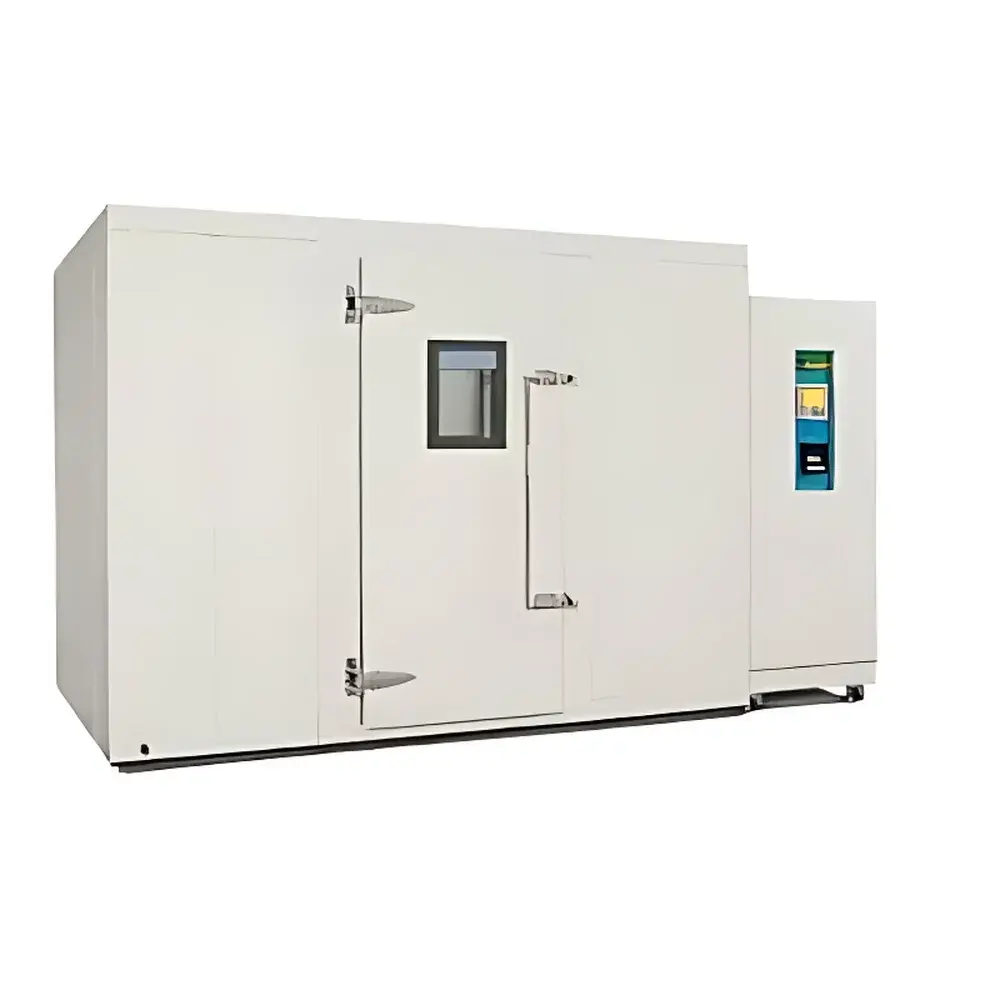
Jianhu LTH/LCT/LRT Series Walk-in Environmental Test Chamber
| Brand | Jianhu |
|---|---|
| Origin | Shanghai, China |
| Model | LTH-( )P(S)-(A/B/C/D), LCT-( )P(S)-(A/B/C/D), LRT-( )P(S) |
| Temperature Range | –60 °C to +80 °C (configurable by suffix A=0 °C, B=–20 °C, C=–40 °C, D=–60 °C) |
| Humidity Range | 30–95 %RH |
| Temperature Control Accuracy | ±0.5 °C (P-type), ±1.0 °C (S-type) |
| Humidity Control Accuracy | ±3 %RH (P-type), ±5 %RH (S-type) |
| Temperature Display Resolution | 0.01 °C (P), 0.1 °C (S) |
| Humidity Display Resolution | 0.1 %RH (P), 1 %RH (S) |
| Ramp Rates | ~60 min (heat-up), 90–210 min (cool-down, dependent on low-temp configuration) |
| Power Supply | AC 3-phase 380 V, 50 Hz |
| Safety Protections | Leakage current protection, overcurrent/overload protection, compressor overload protection, overtemperature cut-off, emergency power-off |
Overview
The Jianhu LTH/LCT/LRT Series Walk-in Environmental Test Chamber is an industrial-grade, large-volume climatic simulation system engineered for precision thermal and hygrothermal stress testing of bulky components, subassemblies, and finished products. Designed in accordance with fundamental principles of psychrometric control and forced-convection thermodynamics, the chamber maintains stable, programmable temperature and humidity profiles across volumetric test spaces—typically ranging from 5 to 100 m³—enabling full-scale validation under real-world environmental extremes. Its architecture supports continuous operation in compliance with long-duration reliability protocols required in aerospace qualification (e.g., MIL-STD-810H, DO-160G), automotive component endurance (ISO 16750-4), and pharmaceutical stability storage (ICH Q1A–Q1E). The system operates via dual-mode control logic: P-type models integrate a touchscreen-based programmable controller supporting multi-segment ramp-soak cycles; S-type units employ microprocessor-driven digital display controllers optimized for steady-state or step-change testing.
Key Features
- Modular stainless steel and pre-painted galvanized steel insulated panel construction (50–150 mm thickness), enabling field-assembled, expandable configurations and relocation-friendly reinstallation.
- Horizontal air distribution system with multi-blade centrifugal fans and vertical heat-exchange ducting—engineered to minimize thermal stratification and ensure uniformity ≤ ±1.5 °C and ≤ ±5 %RH across the working volume (per ISO 16750-4 Annex D verification).
- Dual-stage refrigeration circuit utilizing environmentally compliant R404A/R507A mixed-refrigerant blends and imported hermetic compressors (Embraco, Bitzer, or equivalent), configured for optimal efficiency across distinct temperature domains (ambient-to-low, low-to-ultra-low).
- Integrated safety architecture including Class II leakage protection, motor overload relays, high-limit thermal fuses, and fail-safe emergency power disconnect—certified per IEC 61000-6-2/6-4 EMC and UL 61010-1 requirements.
- RS-232/485 communication interface supporting remote monitoring, data logging, and script-based test sequencing via host PC software compatible with Windows-based laboratory informatics platforms.
- Real-time fault diagnostics with on-screen alarm codes, automatic shutdown, and context-sensitive troubleshooting guidance—reducing mean time to repair (MTTR) during GLP/GMP audits.
Sample Compatibility & Compliance
This walk-in chamber accommodates test specimens up to 3.5 m in height and 4.0 m in width, making it suitable for avionics racks, automotive ECUs, battery modules, medical imaging systems, and bulk pharmaceutical packaging. It meets structural and operational prerequisites for ASTM E145 (Standard Specification for Gravity-Convection and Forced-Ventilation Ovens), IEC 60068-3-5 (Environmental testing — Part 3-5: Supporting documentation and guidance — Confirmation of the performance of temperature chambers), and ISO 22810 (Horology — Water-resistant watches), when configured with appropriate sensor placement and calibration intervals. Optional NIST-traceable temperature/humidity mapping reports are available for 21 CFR Part 11-compliant environments.
Software & Data Management
The P-type controller includes embedded firmware supporting up to 100 programmable test profiles, each with 99 segments (ramp, soak, cycle), user-defined alarms, and timestamped event logging. Data export is supported in CSV format for integration with LIMS or MES systems. Optional Ethernet expansion enables HTTP/HTTPS API access for RESTful integration into enterprise QA workflows. Audit trails—including operator login, parameter changes, and alarm history—are retained for ≥18 months and comply with ALCOA+ data integrity principles. Software validation packages (IQ/OQ/PQ documentation templates) are provided for regulated industries.
Applications
- Aerospace: Thermal vacuum pre-screening of satellite subsystems and ground support equipment per ECSS-E-ST-10-03C.
- Automotive: Climate cycling of ADAS sensors, infotainment head units, and traction inverters per ISO 16750-4 and GMW16270.
- Energy Storage: Accelerated aging of lithium-ion battery packs at elevated humidity and variable temperature gradients.
- Medical Devices: Environmental stress screening (ESS) of MRI consoles, infusion pumps, and diagnostic analyzers under IEC 60601-1 Clause 11.
- Electronics Manufacturing: Burn-in testing of server chassis and telecom base station cabinets using extended dwell profiles.
FAQ
What is the standard calibration interval for temperature and humidity sensors?
Annual recalibration is recommended; however, internal verification using certified reference probes (e.g., Fluke 1523/1524) should be performed prior to each critical test campaign.
Can the chamber be integrated into a factory-wide SCADA system?
Yes—via Modbus RTU (RS-485) or optional Ethernet/IP gateway, supporting real-time setpoint synchronization and status reporting.
Is humidity control available below 0 °C?
Humidity is not actively controlled below freezing; dehumidification is suspended below 5 °C to prevent condensation-induced frost accumulation on evaporator surfaces.
What documentation is supplied for regulatory submissions?
Factory acceptance test (FAT) report, IQ/OQ protocol templates, traceable calibration certificates, and material compliance declarations (RoHS, REACH, PFAS-free refrigerants) are included.
How is airflow uniformity verified during installation?
A 9-point spatial mapping procedure per ISO 16750-4 Annex D is conducted using calibrated thermohygrometers and documented in the site acceptance test (SAT) report.



