
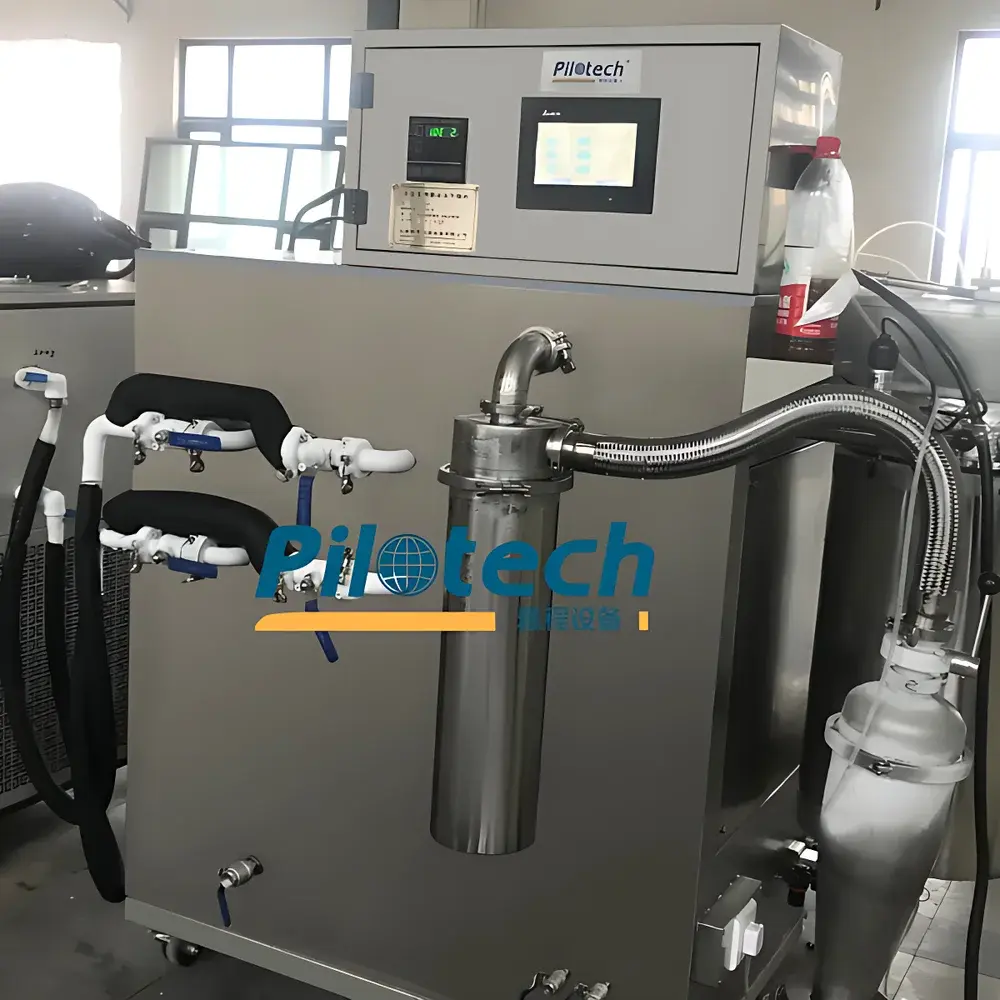
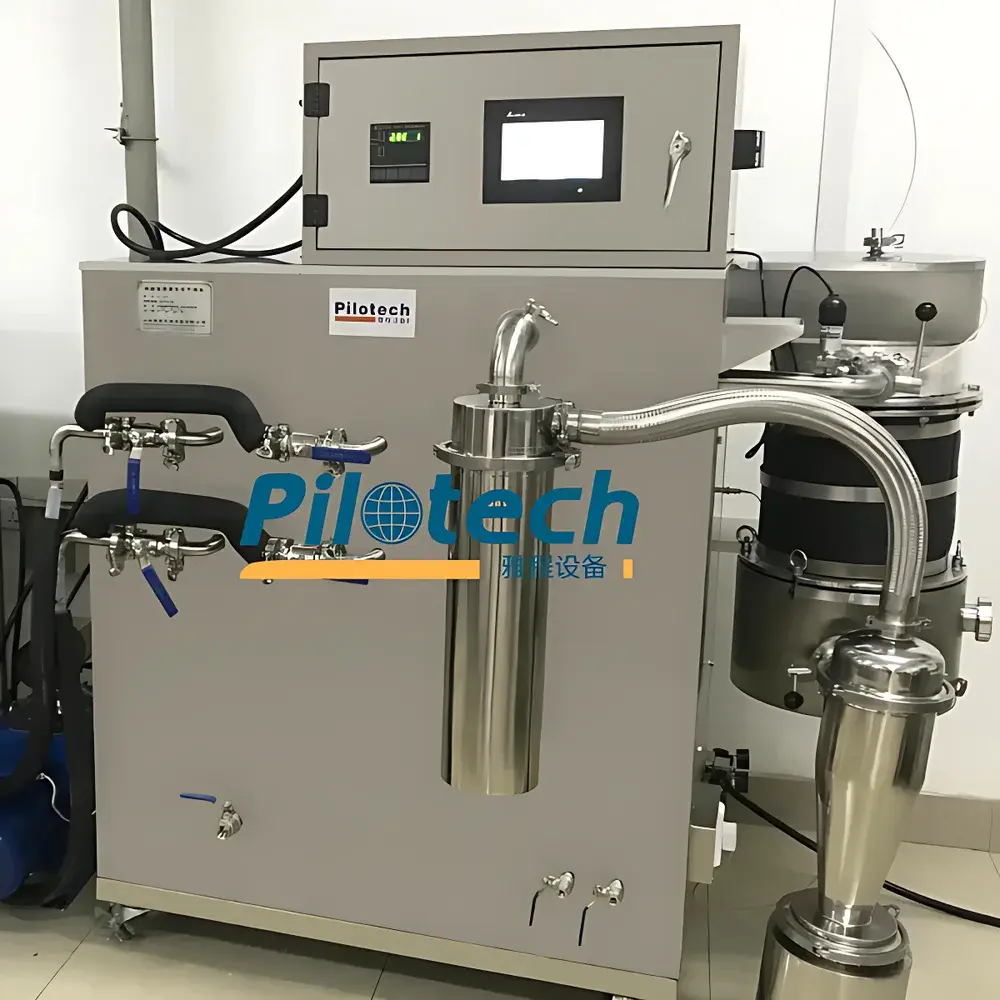
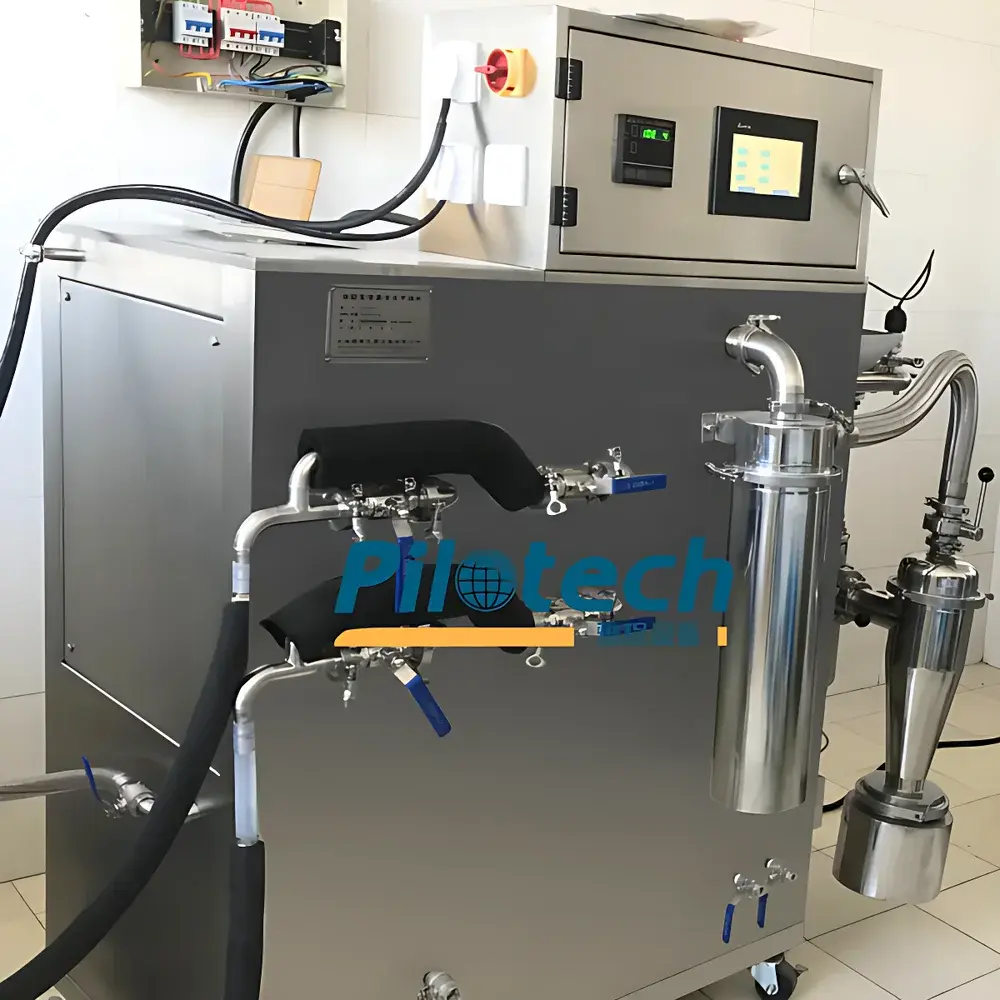
雅程YC-3000喷雾冷冻干燥机
| Brand | Yacheng / PILOTECH |
|---|---|
| Origin | Shanghai, China |
| Manufacturer Type | Direct Manufacturer |
| Instrument Type | Standard Shelf-Type Freeze Dryer |
| Batch Capacity | 1500 mL per cycle |
| Processing Time | <6 hours per batch (1500 mL) |
| Inlet Air Temperature | <−50 °C |
| Cold Trap Temperature | ≤−60 °C |
| Ultimate Vacuum | <20 Pa (empty chamber) |
| Vacuum Pump Power | 1.1 kW |
| Spray Pressure Range | 1–3 bar (adjustable) |
| Air Compressor Output | 32 L/min |
| Nozzle Type | Adjustable coaxial two-fluid spray nozzle |
| Display | Color LCD touchscreen (inlet temp, fan frequency, peristaltic pump speed, needle purge frequency) |
| Compliance | Designed for GLP-compliant lab environments |
Overview
The Yacheng YC-3000 Laboratory-Scale Spray Freeze Dryer is an engineered hybrid platform integrating high-efficiency spray atomization with low-temperature vacuum sublimation drying. Unlike conventional lyophilizers that rely solely on slow conductive freezing and primary drying under vacuum, the YC-3000 introduces rapid cryo-atomization—where feed solution is atomized directly into a sub-zero (<−50 °C) drying chamber, enabling instantaneous flash-freezing of droplets followed by controlled secondary drying under vacuum (≤20 Pa). This dual-stage thermodynamic process preserves structural integrity, bioactivity, and chemical fidelity of thermolabile compounds—including proteins, enzymes, probiotics, botanical extracts, and polymer dispersions—while yielding free-flowing, spherical microparticles with narrow size distribution. The system is purpose-built for research-scale formulation development, stability studies, and preclinical powder dosage optimization in pharmaceutical, nutraceutical, food science, and biomaterial laboratories.
Key Features
- Coaxial two-fluid spray nozzle with vertical position adjustability—ensures symmetrical atomization, eliminates off-center drift, and enables precise tuning of droplet size and distribution for reproducible particle morphology.
- Integrated air-cooled, hermetic refrigeration system with dual-stage cascade compressors—achieves stable cold trap temperatures ≤−60 °C and maintains consistent condensation efficiency across extended cycles.
- Digital real-time monitoring via 7-inch color LCD touchscreen—displays inlet gas temperature, peristaltic feed pump RPM, fan speed, needle purge frequency, vacuum level, and chamber temperature with ±0.5 °C/±1 Pa resolution.
- Standardized ISO-KF vacuum fittings (DN25/DN40)—ensures leak-tight, tool-free connections compatible with common laboratory vacuum pumps and auxiliary instrumentation.
- Onboard vacuum pump power outlet—eliminates redundant power cabling and simplifies benchtop setup without compromising electrical safety or EMI shielding.
- Passive ambient-air heating during desorption phase—avoids thermal shock to sensitive matrices while maintaining residual moisture below 2.0% w/w (typical, verified by Karl Fischer titration).
- Low-noise operation (<62 dB[A] at 1 m)—meets ISO 15712-2 acoustic requirements for shared laboratory environments.
Sample Compatibility & Compliance
The YC-3000 accommodates aqueous and water-miscible organic solutions with viscosities up to 250 cP and total solids content ranging from 2% to 40% w/v. It has been validated for processing heat-labile biologics (e.g., monoclonal antibody formulations), polysaccharide-rich botanical extracts (e.g., ginseng, goji, and turmeric concentrates), dairy-based emulsions, enzyme suspensions (lipase, amylase), and synthetic polymer colloids (PLGA, chitosan nanoparticles). All wetted surfaces contact 316L stainless steel or FDA-compliant fluoropolymer coatings. System architecture supports audit-ready data integrity: timestamped parameter logs, user-access controls, electronic signatures, and exportable CSV/Excel reports—fully aligned with GLP, GMP Annex 11, and FDA 21 CFR Part 11 expectations when paired with compliant third-party software.
Software & Data Management
While the YC-3000 operates as a standalone instrument with embedded firmware, its RS485 and USB 2.0 interfaces enable seamless integration with external SCADA or LIMS platforms. Raw sensor data—including vacuum decay curves, temperature gradients across the condenser and chamber, and feed rate profiles—are time-stamped and stored internally for ≥30 days (expandable via optional SD card module). Export protocols support UTF-8–encoded .csv files compatible with MATLAB, Python (pandas), JMP, and UNIFI for multivariate process analysis. Optional firmware upgrade adds automated cycle validation reports compliant with ASTM F2476-21 (Standard Practice for Validation of Freeze Drying Processes).
Applications
- Rapid development of inhalable dry powder formulations (DPIs) with aerodynamic particle size (MMAD 1–5 µm) and low hygroscopicity.
- Stabilization of live bacterial cultures (e.g., Lactobacillus spp.) and viral vectors without cryoprotectant overuse.
- Production of amorphous solid dispersions for BCS Class II/IV APIs with enhanced dissolution kinetics.
- Preparation of nanostructured food-grade carriers for encapsulation of anthocyanins, omega-3 oils, and volatile flavor compounds.
- Generation of reference standards for quantitative LC-MS/MS assays requiring matrix-matched freeze-dried calibrants.
- Accelerated stability testing per ICH Q1A(R2) under low-humidity, low-oxygen storage conditions post-drying.
FAQ
What is the fundamental difference between spray freeze drying and conventional lyophilization?
Spray freeze drying combines rapid droplet freezing (via cryogenic atomization) with vacuum sublimation, reducing total cycle time from days to hours while producing spherical, low-density powders. Conventional lyophilization freezes bulk liquid statically, leading to longer drying times, potential collapse, and irregular cake morphology.
Can the YC-3000 handle high-sugar formulations such as fruit juice concentrates?
Yes—the system’s rapid freezing rate inhibits sucrose crystallization, preserving amorphous structure and minimizing Maillard browning. Users routinely process mango, pomegranate, and acai extracts at 25–35% total solids.
Is the coaxial nozzle compatible with organic solvents like ethanol or acetone?
The standard nozzle is rated for aqueous and water-ethanol mixtures (<30% v/v); for higher solvent loads, optional PTFE-lined nozzles and explosion-proof vacuum pump configurations are available upon request.
Does the system support IQ/OQ documentation packages?
Yes—Yacheng provides factory-verified Installation Qualification (IQ) and Operational Qualification (OQ) templates aligned with ISO 9001:2015 and ASTM E2500-13, including calibration certificates for all critical sensors.
What maintenance intervals are recommended for long-term reliability?
Compressor oil and refrigerant levels should be verified annually; cold trap condenser surfaces require cleaning every 50 operational hours using isopropanol-rinsed lint-free wipes; vacuum pump oil replacement is required every 300 hours or per manufacturer specifications.



