
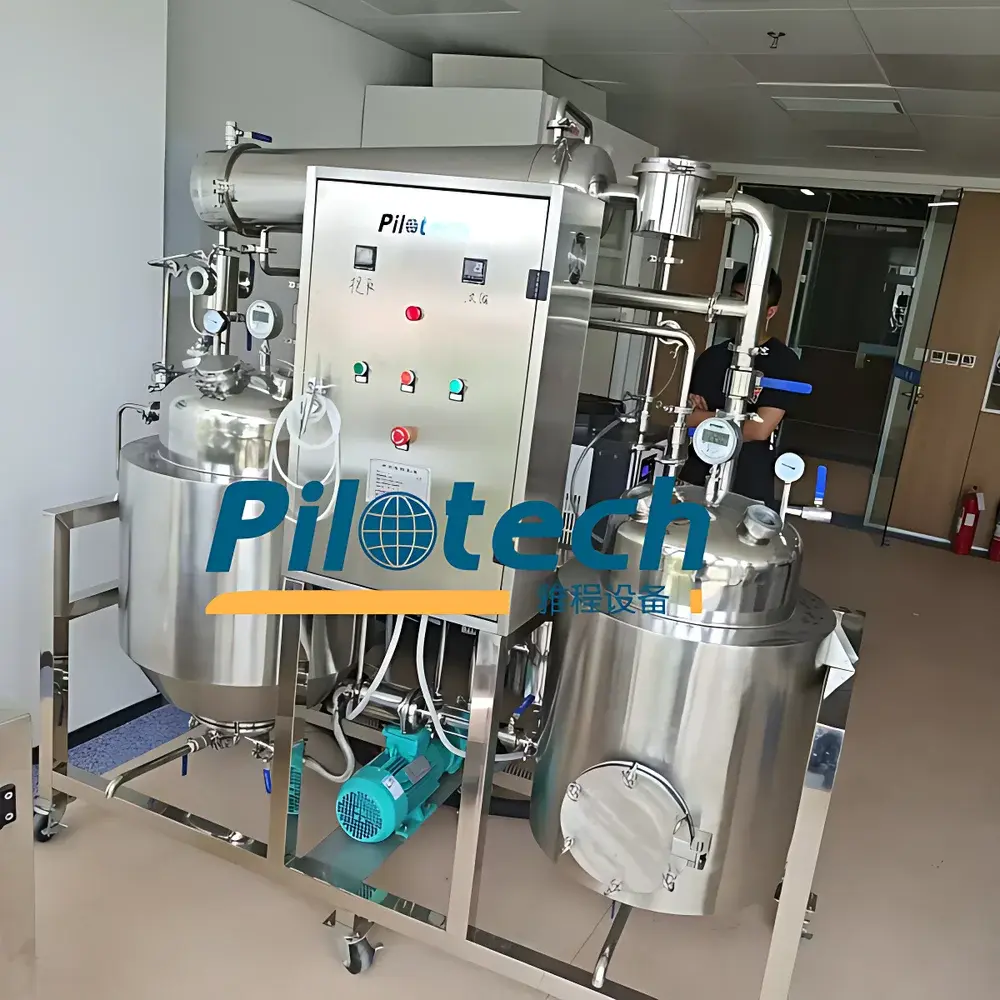
Yacheng YC-100 100L Multifunctional Extraction and Concentration Unit
| Brand | Yacheng / PILOTECH |
|---|---|
| Origin | Shanghai, China |
| Manufacturer Type | OEM Manufacturer |
| Product Origin | Domestic (China) |
| Model | YC-100 |
| Pricing | Upon Request |
Overview
The Yacheng YC-100 is a fully integrated, pilot-scale extraction and concentration system engineered for rigorous R&D and process development in natural product chemistry, phytochemistry, and botanical pharmaceutical manufacturing. It operates on the principles of vacuum-assisted thermal extraction, reflux condensation, dynamic circulation evaporation, and phase separation—enabling simultaneous or sequential solid–liquid extraction, solvent recovery, aromatic oil isolation, and low-temperature concentration of heat-sensitive extracts. Designed to meet the operational demands of academic laboratories, contract research organizations (CROs), and GMP-compliant pilot plants, the unit supports aqueous, alcoholic (e.g., ethanol, methanol), and other GRAS organic solvent-based extractions under controlled temperature and pressure conditions. Its closed-loop architecture ensures full containment of volatile solvents and aromatics, eliminating fugitive emissions and supporting compliance with OSHA, ATEX (for Class I, Div 2 environments), and ISO 14001 environmental management frameworks.
Key Features
- Compact footprint (3–4 m²), plug-and-play installation requiring only electrical supply (380 V, 27 kW) and cooling water (< 0.3 MPa, 3 t/h).
- 100 L stainless steel (SUS304) triple-layer extraction vessel: inner polished surface (Ra ≤ 0.4 µm), middle thermal oil jacket (pressure-free circulation), outer polyurethane insulation.
- Integrated reflux system featuring a 3 m² tubular condenser and a dedicated oil–water separator for quantitative recovery of volatile aromatic oils (e.g., eucalyptol, limonene, menthol).
- Dynamic circulation evaporator enabling continuous thin-film flow across heating surfaces—maintaining high heat transfer coefficients even at final concentrate viscosities (density range: 1.10–1.38 g/cm³).
- Full pressure versatility: operable under vacuum (0 to –0.08 MPa), atmospheric, or slight positive pressure (≤ 0.1 MPa) for flexible process routing.
- Automated temperature control via Omron PID controller (±2 °C accuracy) with programmable ramp/soak profiles.
- Hygienic discharge design: bottom-mounted slag outlet with zero-dead-leg geometry; optional lift-type herb basket for rapid, residue-free unloading.
- Optional ultrasonic enhancement module (15–60 kHz frequency selection) utilizing focused acoustic cavitation to disrupt plant cell walls—improving mass transfer kinetics without thermal degradation of labile compounds (e.g., flavonoids, terpenoids, glycosides).
Sample Compatibility & Compliance
The YC-100 accommodates diverse botanical matrices—including dried herbs, granulated tea leaves, fruit pulps, and marine algal biomass—with batch loading capacities of 5–20 kg. All wetted parts comply with FDA 21 CFR Part 110 (Current Good Manufacturing Practice for Food) and ASME BPE-2022 surface finish standards. The system meets ISO 9001:2015 quality system requirements and supports audit-ready documentation for GLP and early-phase GMP workflows. Pressure components conform to PED 2014/68/EU (when operated above 0.5 bar gauge), while electrical controls adhere to IEC 61000-6-2/6-4 EMC standards. Optional validation packages include IQ/OQ protocols aligned with ASTM E2500-13 and EU Annex 15 guidelines.
Software & Data Management
The integrated PLC-based control cabinet provides HMI-driven operation with real-time monitoring of temperature, vacuum level, condensate flow, and heating power. Data logging is performed at 1-second intervals and stored locally (SD card) with optional Ethernet/IP or Modbus TCP connectivity for SCADA integration. Audit trails record all parameter changes, user logins, and alarm events—fully compliant with FDA 21 CFR Part 11 electronic records and signature requirements when paired with qualified user access controls and digital certificate authentication. Export formats include CSV and PDF for regulatory submission readiness.
Applications
- Preclinical extraction optimization of Traditional Chinese Medicine (TCM) formulas and standardized herbal monographs (e.g., pharmacopoeial methods per ChP, USP-NF, or EP).
- Pilot-scale production of botanical concentrates for nutraceuticals, functional beverages (tea, juice), and cosmetic actives.
- Solvent recovery and reclamation loops for ethanol, isopropanol, and ethyl acetate—reducing raw material costs and VOC emissions.
- Isolation of essential oils from citrus peels, lavender, or mint using fractional condensation and gravity-based phase separation.
- Process development for continuous or semi-batch extraction strategies prior to scale-up to industrial 500–5000 L systems.
FAQ
What types of solvents are compatible with the YC-100 system?
Water, ethanol, methanol, isopropanol, ethyl acetate, and other low-boiling, non-halogenated organic solvents—provided vapor pressure and flash point allow safe operation within the system’s vacuum and temperature envelope.
Can the unit operate under inert gas blanket (e.g., N₂)?
Yes—the vessel includes dedicated gas inlet/outlet ports and pressure relief valves rated for operation up to 0.1 MPa(g), enabling nitrogen purging for oxygen-sensitive extractions.
Is third-party calibration and qualification support available?
Yes—Yacheng offers factory-verified IQ/OQ documentation, traceable thermocouple calibration (NIST-traceable), and on-site commissioning services by certified field engineers.
What maintenance intervals are recommended for the water-ring vacuum pump?
Daily visual inspection; oil change every 500 operating hours; seal replacement every 2,000 hours or annually—whichever occurs first.
Does the ultrasonic module affect stainless steel integrity over long-term use?
No—the transducer assembly is externally mounted with acoustic coupling gel interface; no direct cavitation impingement on vessel walls occurs, preserving surface passivation and corrosion resistance.



