
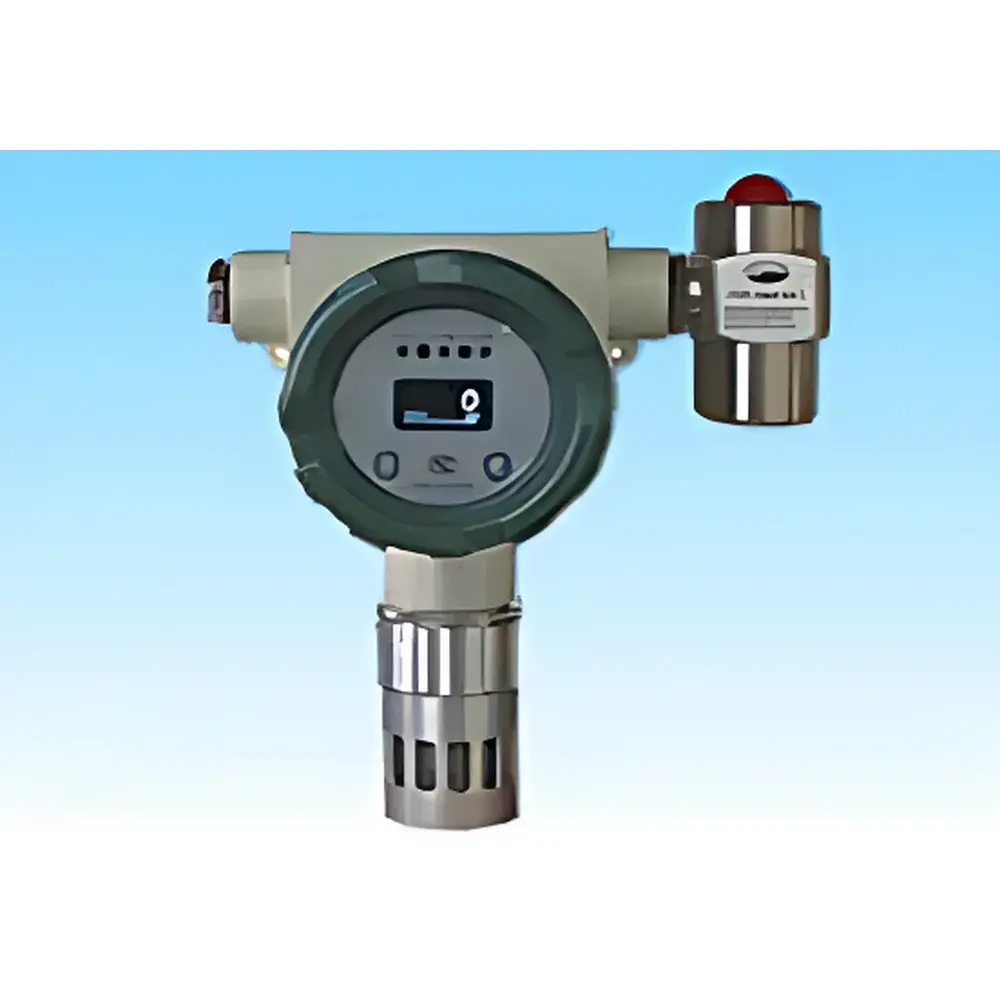
HK-7200A Photoionization Detector (PID) Toxic Gas Alarm
| Origin | Beijing |
|---|---|
| Manufacturer Type | Authorized Distributor |
| Origin Category | Domestic (China) |
| Model | HK-7200A Digital Multi-Principle Gas Detector |
| Pricing | Available Upon Request |
| Detection Principle | Photoionization (PID) |
| Measurement Range | 0–20 ppm, 0–100 ppm, 0–200 ppm, 0–500 ppm, 0–1000 ppm, 0–2000 ppm |
| Resolution | 1 ppm |
| Accuracy | ±3% FS |
| Response Time (T90) | ≤30 s |
| Operating Temperature | −40 to +55 °C |
| Atmospheric Pressure Range | 86–106 kPa |
| Output Signals | 4–20 mA, CAN Bus, RS485 |
| Max Transmission Distance | 1000 m (4–20 mA, 2.5 mm²), 10 km (CAN), 1.2 km (RS485) |
| Supply Voltage | DC 18–30 V |
| Wiring | 3-wire or 4-wire |
| Power Consumption | ≤2 W |
| Explosion Protection | Ex d IIC T6 Gb |
| Ingress Protection | IP66 |
| Compliance Standard | GB 12358–2006 |
| Display | High-brightness OLED, bilingual Chinese/English interface |
| Operation Modes | Magnetic stylus & bidirectional infrared remote |
| Sensor Interface | Hot-swappable, auto-diagnostic, multi-principle sensor platform (PID, electrochemical, catalytic bead, infrared, MOS) |
| Compatible Gases | VOCs and selected toxic gases (e.g., benzene, toluene, xylene, styrene, acetone, isopropanol, chlorinated hydrocarbons) |
Overview
The HK-7200A Photoionization Detector (PID) Toxic Gas Alarm is a field-deployable, intrinsically robust fixed-gas monitoring instrument engineered for continuous detection of volatile organic compounds (VOCs) and select toxic gases in industrial, environmental, and safety-critical applications. Utilizing ultraviolet (UV) photoionization as its core detection principle, the HK-7200A ionizes target molecules with photon energy exceeding their ionization potential (typically 10.6 eV UV lamp), generating measurable current proportional to gas concentration. Unlike catalytic or electrochemical sensors, PID technology delivers non-destructive, broad-spectrum response to unsaturated and aromatic hydrocarbons, ketones, aldehydes, amines, and halogenated solvents—without cross-sensitivity to CO₂, methane, or water vapor. Designed for integration into centralized safety systems or standalone perimeter monitoring, the HK-7200A conforms to China’s national standard GB 12358–2006 for general-purpose gas detectors and meets international explosion protection requirements per IEC 60079-0 and IEC 60079-1 (Ex d IIC T6 Gb), enabling safe deployment in Zone 1 hazardous areas.
Key Features
- Modular, multi-principle architecture supporting hot-swappable PID, electrochemical, catalytic bead, NDIR, and metal oxide semiconductor (MOS) sensors—enabling full interchangeability across >200 gas-specific configurations without hardware modification.
- 32-bit embedded microcontroller delivering real-time signal processing, self-calibration routines, and fault diagnostics—including automatic sensor health assessment, drift compensation, and zero/span validation alerts.
- Bilingual OLED display (Chinese/English) with high contrast and wide operating temperature range (−40 °C to +55 °C), ensuring legibility under low-light, high-glare, or extreme ambient conditions.
- Dual operational interfaces: contactless bidirectional infrared remote control and magnetic stylus—eliminating mechanical button wear and enabling safe configuration in live hazardous zones.
- Flexible power and communication options: supports loop-powered 4–20 mA analog output (up to 1000 m on 2.5 mm² cable), CAN bus (≤10 km), and RS485 Modbus RTU (≤1.2 km), facilitating scalable integration into DCS, PLC, or SCADA platforms.
- Robust mechanical design: aluminum alloy housing rated IP66 for dust-tight and high-pressure water resistance; certified Ex d IIC T6 Gb for use in flammable gas atmospheres containing hydrogen, acetylene, or ethylene-group vapors.
Sample Compatibility & Compliance
The HK-7200A is optimized for detection of VOCs with ionization potentials below 10.6 eV, including but not limited to benzene (9.24 eV), toluene (8.82 eV), xylene (8.57 eV), styrene (8.47 eV), acetone (9.70 eV), isopropanol (10.12 eV), and trichloroethylene (9.43 eV). It does not respond to permanent gases (e.g., O₂, N₂, CO₂), saturated alkanes (e.g., methane, propane), or highly polar compounds with high IP (e.g., formic acid, methanol). While not certified to ISO 16000 series or ASTM D5403 for laboratory-grade air quality analysis, the device complies with GB 12358–2006 for functional safety, alarm reliability, and electromagnetic compatibility (EMC) in industrial environments. Its 4–20 mA output supports traceability under GLP-aligned calibration protocols when paired with documented span gas verification (e.g., certified 100 ppm isobutylene in nitrogen).
Software & Data Management
The HK-7200A operates autonomously without proprietary PC software; all configuration—including alarm thresholds (dual-level programmable), sampling interval, unit selection (ppm or mg/m³), and sensor identity registration—is performed locally via IR remote or magnetic stylus. Configuration changes are stored in non-volatile memory with write-cycle logging. For system-level data aggregation, the CAN and RS485 interfaces support standard Modbus RTU register mapping, enabling direct ingestion into third-party HMI or historian platforms (e.g., Ignition, Siemens Desigo, Honeywell Experion). Though not FDA 21 CFR Part 11 compliant out-of-the-box, audit trails and configuration change logs can be externally captured and archived when integrated with validated supervisory control systems meeting GMP/GLP documentation requirements.
Applications
- Industrial hygiene monitoring in petrochemical refineries, paint booths, pharmaceutical cleanrooms, and semiconductor fabrication facilities.
- Leak detection and fugitive emission surveys along pipeline corridors, storage tank farms, and loading/unloading stations.
- Confined space entry pre-screening for VOC presence prior to worker access (per OSHA 1910.146 guidelines).
- Environmental remediation site monitoring during soil vapor extraction or groundwater treatment operations.
- Indoor air quality (IAQ) baseline assessment in laboratories, printing facilities, and adhesive application zones.
FAQ
What gases can the HK-7200A detect using PID technology?
It detects VOCs with ionization potentials below 10.6 eV—including aromatics, olefins, ketones, and many chlorinated solvents—but not methane, ethane, CO₂, or ammonia.
Does the HK-7200A require routine calibration?
Yes; recommended calibration interval is every 3–6 months using certified span gas, or after exposure to high-concentration events, sensor replacement, or environmental shock.
Can the same HK-7200A housing accept non-PID sensors?
Yes—the platform supports five detection principles; switching between PID, electrochemical, catalytic, NDIR, and MOS sensors requires only physical replacement and firmware-recognized sensor ID coding.
Is the 4–20 mA output intrinsically safe?
No—the 4–20 mA loop is not intrinsically safe by default; intrinsic safety must be ensured at the system level via associated apparatus (e.g., Zener barrier or galvanic isolator) compliant with IEC 60079-11.
What maintenance is required for the UV lamp?
The 10.6 eV UV lamp has a typical service life of 6,000–8,000 hours; output decay is monitored continuously, and lamp replacement triggers an alert in the diagnostic log.







