
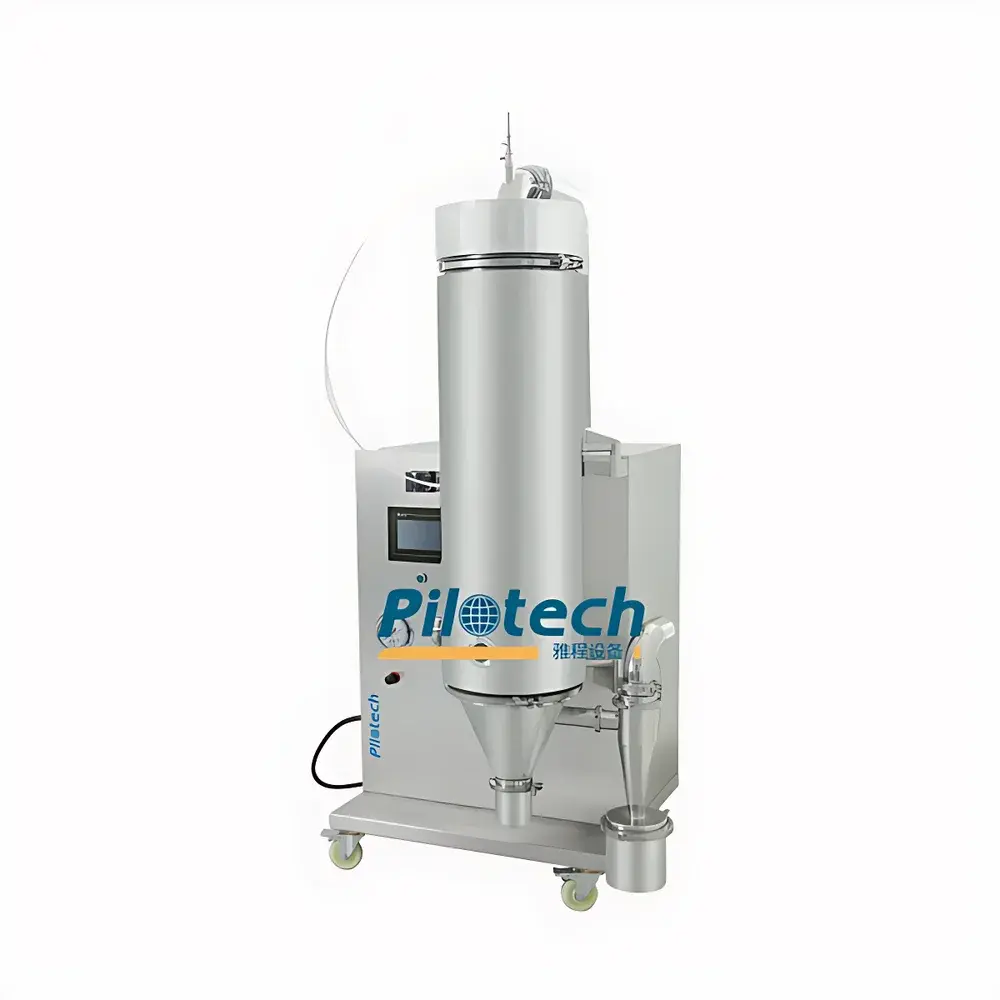
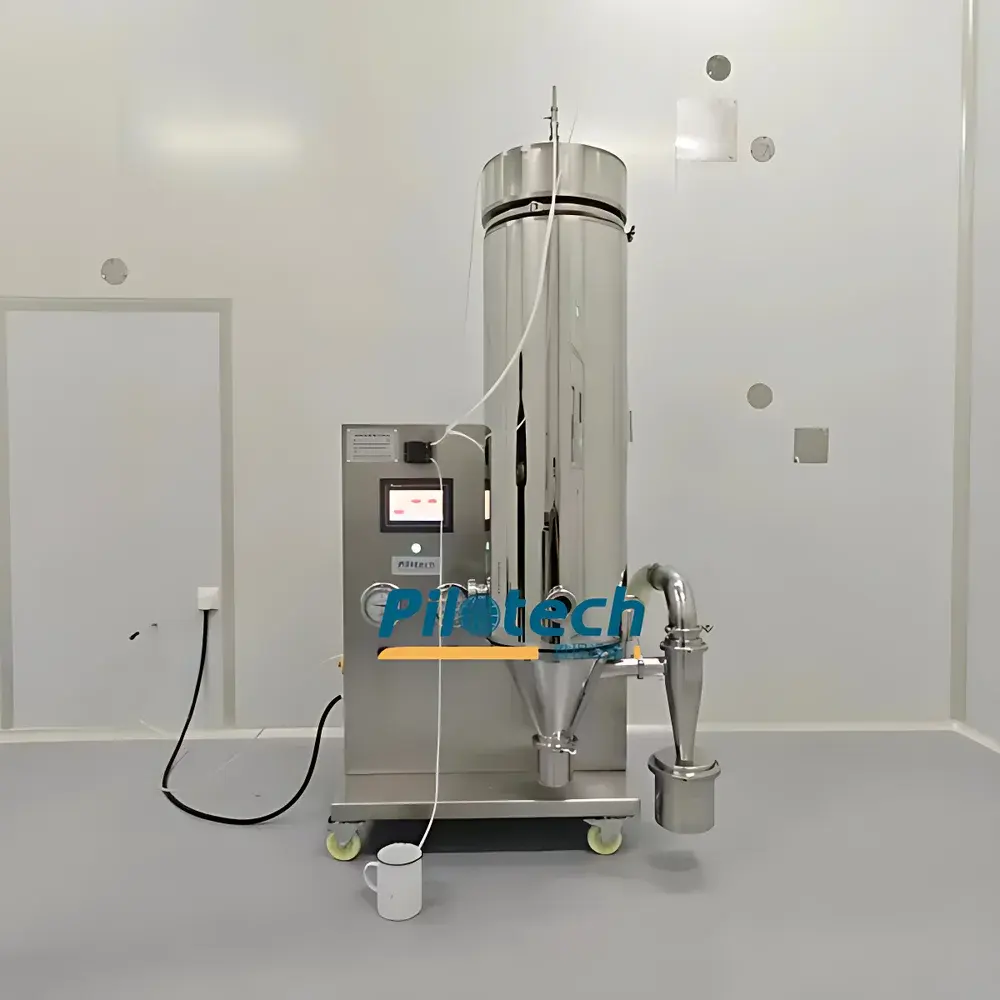
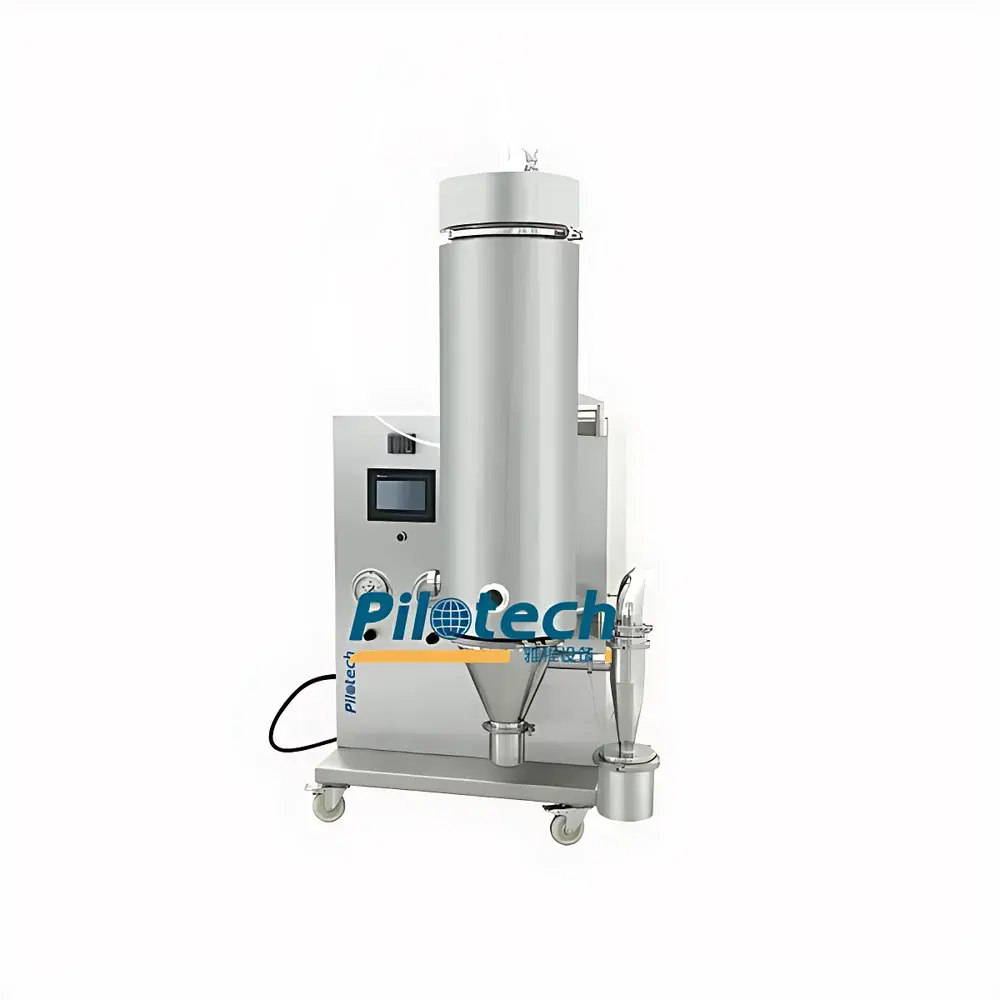
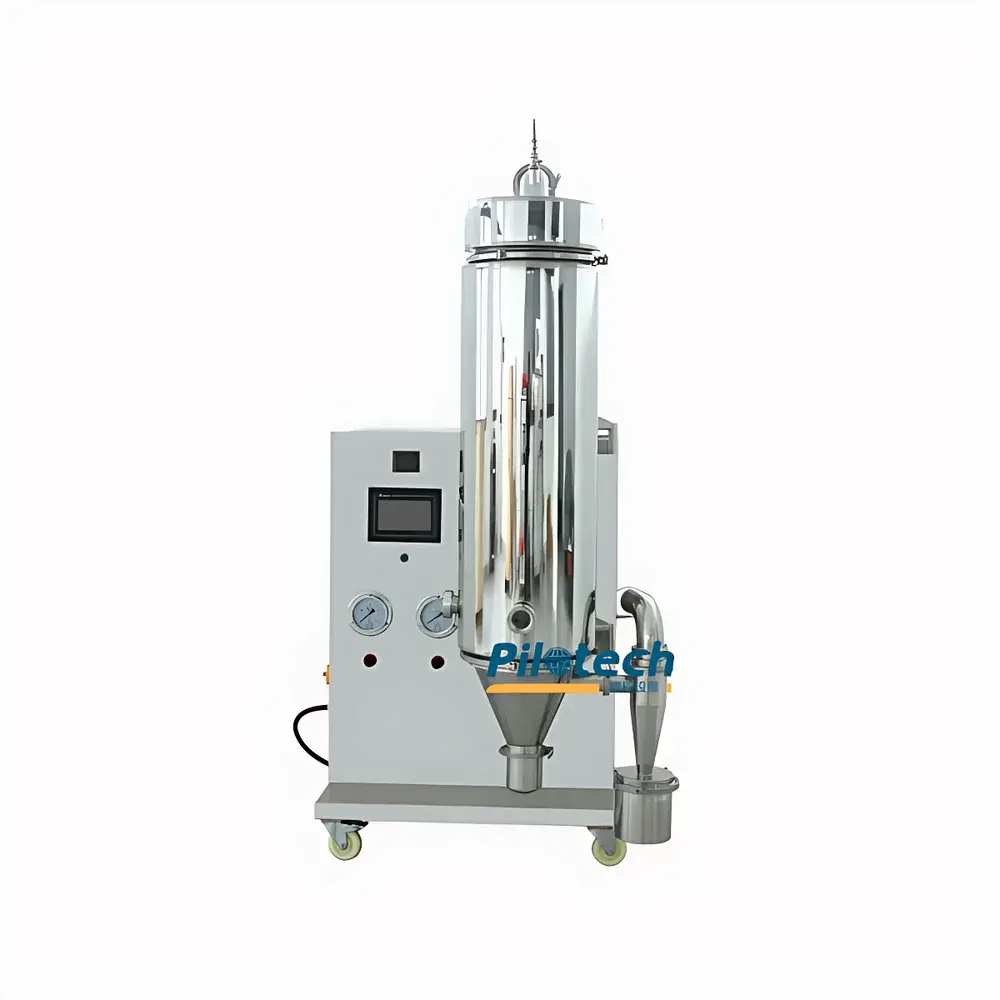
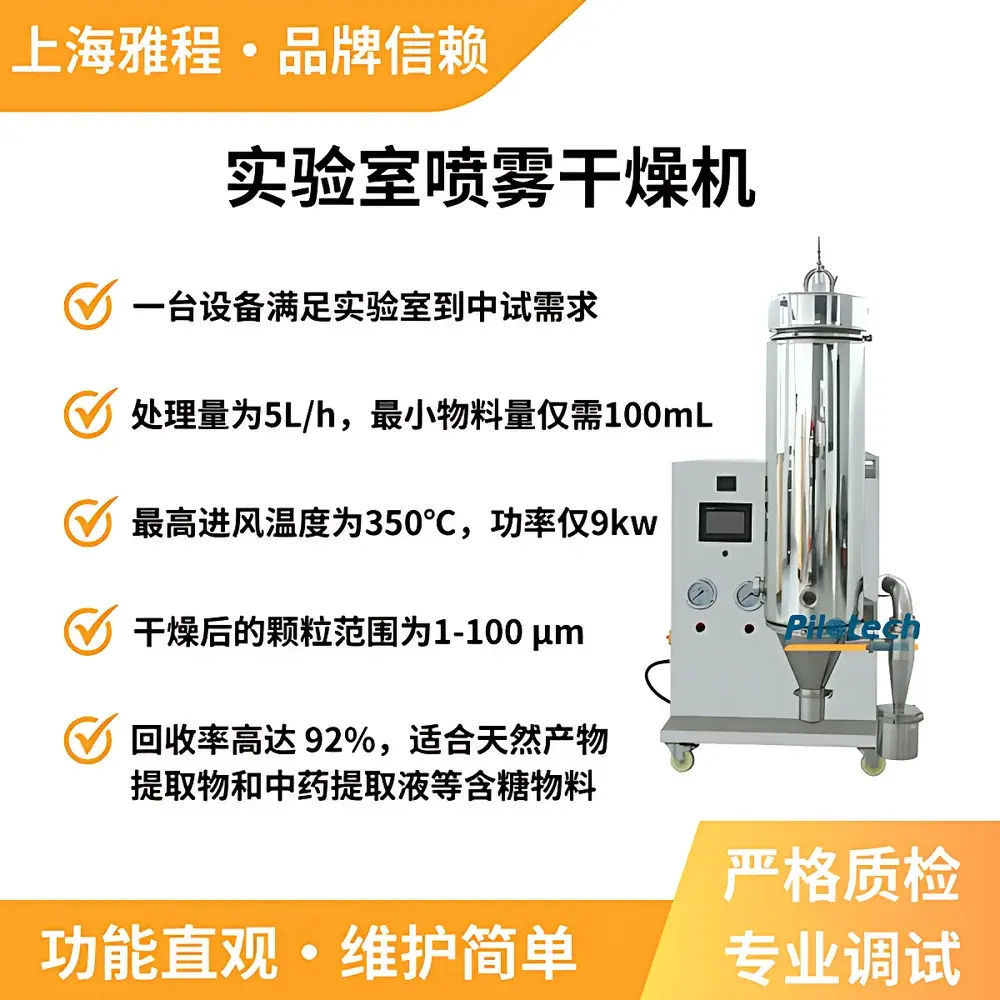
Pilotech YC-019 Pilot-Scale Spray Dryer
| Brand | Pilotech |
|---|---|
| Origin | Shanghai, China |
| Manufacturer Type | OEM Manufacturer |
| Product Origin | Domestic (China) |
| Model | YC-019 |
| Sample Type | Aqueous solutions only |
| Max Feed Rate | 5000 mL/h |
| Inlet Air Temperature Range | 105–350 °C |
| Particle Size Range | 1–100 µm |
| Recovery Efficiency | Up to 92% |
| Nozzle Orifice | 2.0 mm standard (0.5/0.8/1.0/1.5 mm optional) |
| Drying Time | 1.0–1.5 s |
| Temperature Control Accuracy | ±2 °C (PID) |
| Construction Material | 304 Stainless Steel (drying chamber, cyclone, collection tubing) |
| Compressor | Oil-free air compressor |
| Display | Color LCD touchscreen with real-time animation |
Overview
The Pilotech YC-019 Pilot-Scale Spray Dryer is a benchtop-to-pilot transition instrument engineered for reproducible, scalable powder production from aqueous feedstocks. It operates on the principle of single-stage concurrent spray drying: liquid feed is atomized via a pneumatic nozzle into fine droplets, which are rapidly dried by controlled hot air in a vertical drying chamber. The short residence time (1.0–1.5 s) and precise thermal management ensure minimal thermal degradation—critical for thermolabile biologics, herbal extracts, enzymes, and pharmaceutical actives. Unlike conventional lab-scale units limited to sub-25 µm output, the YC-019 achieves particle diameters up to 100 µm through optimized airflow dynamics, nozzle geometry, and residence time distribution—making it suitable for catalyst supports, sustained-release excipients, and functional food microcarriers where coarse, free-flowing powders are required. Its compact footprint (<1 m²) and low acoustic emission (<60 dB(A)) meet ISO 14040-compliant laboratory noise standards, enabling integration into shared core facilities without environmental compromise.
Key Features
- Wide inlet air temperature range (105–350 °C), supporting both low-temperature drying of sugar-rich botanical extracts and high-temperature ceramic precursor processing
- High-efficiency dual-stage recovery architecture: redesigned cyclone geometry combined with optimized chamber wall geometry achieves ≥92% mass recovery—significantly exceeding industry-standard single-cyclone systems
- Real-time PID-controlled thermal regulation with ±2 °C accuracy across the full temperature range, validated per ASTM E2251 for thermal uniformity in drying chambers
- Integrated cleaning-by-pulse (CBP) system with adjustable frequency needle (‘通针’), preventing nozzle clogging during viscous or particulate-laden feed applications
- Modular nozzle configuration: standard 2.0 mm orifice; optional 0.5/0.8/1.0/1.5 mm nozzles available for tailored droplet size distribution (DSD) control
- Oil-free compressed air supply ensures contaminant-free particle surfaces—essential for GMP-aligned preclinical formulation development
- Full-color touchscreen interface with animated process visualization: real-time display of inlet temperature, blower frequency, peristaltic pump speed, and needle actuation status
Sample Compatibility & Compliance
The YC-019 is validated for aqueous-based feeds only—including colloidal suspensions, protein solutions, polysaccharide gels, and nanoemulsions—with total solids content up to 35 wt%. It is not rated for organic solvents, corrosive acids/bases, or explosive vapors. All wetted parts—including drying chamber, cyclone separator, and collection tubing—are constructed from electropolished 304 stainless steel, compliant with FDA 21 CFR Part 11 material contact requirements for non-sterile pharmaceutical intermediates. The unit meets CE machinery directive 2006/42/EC and conforms to IEC 61000-6-3 (EMC emissions). While not certified for GLP or GMP production, its data logging, parameter traceability, and audit-ready operation log support Stage 1–2 process development under ICH Q5C and Q8(R2) guidelines.
Software & Data Management
The embedded control system records all operational parameters at 1 Hz resolution—including inlet/outlet temperatures, pump RPM, blower frequency, and cycle timestamps—exportable as CSV files via USB. No cloud connectivity or remote access is provided, preserving data sovereignty in regulated environments. The interface supports user-defined drying protocols with up to 10 programmable temperature ramps and feed rate profiles, facilitating DOE-driven optimization. Audit trail functionality logs operator ID (via manual entry), start/stop events, and critical alarms (e.g., overtemperature, pump stall), satisfying basic ALCOA+ principles for lab-scale development data integrity.
Applications
- Pharmaceutical: Spray-dried amorphous solid dispersions (ASDs) of BCS Class II drugs; inhalable dry powder formulations; vaccine adjuvant carriers
- Food & Nutrition: Encapsulated probiotics, omega-3 oils, and anthocyanin-rich fruit extracts; functional ingredient powders with controlled hygroscopicity
- Materials Science: Ceramic precursors (e.g., alumina, zirconia), battery cathode materials (LiCoO₂, NMC), and supported metal catalysts (Pt/C, Ni/Al₂O₃)
- Natural Products: Low-temperature drying of heat-sensitive plant alkaloids, glycosides, and polyphenols without Maillard browning
- Academic Research: Scale-down modeling for industrial spray dryer validation; particle engineering studies correlating atomization energy, evaporation kinetics, and morphology
FAQ
Is the YC-019 suitable for organic solvent-based feeds?
No. The system is designed exclusively for aqueous solutions and suspensions. Organic solvents pose explosion risks and are incompatible with the standard air heating and filtration architecture.
What is the minimum sample volume required for a valid run?
The practical lower limit is 100 mL of feed solution, though reproducibility improves above 300 mL due to stable pump priming and thermal equilibrium establishment.
Can particle size distribution be narrowed beyond the standard 1–100 µm range?
Yes—by selecting smaller nozzles (e.g., 0.5 mm), reducing feed rate, and optimizing inlet temperature, D50 can be shifted toward 5–20 µm with improved span (D90/D10 < 2.5).
Does the unit comply with FDA 21 CFR Part 11 for electronic records?
It supports essential elements (audit trail, operator identification, data export), but lacks digital signature capability and system validation documentation required for full Part 11 compliance.
What maintenance intervals are recommended for the oil-free compressor and nozzle assembly?
Compressor filter replacement every 500 operating hours; nozzle inspection and ultrasonic cleaning after each use when processing high-viscosity or particulate feeds.



