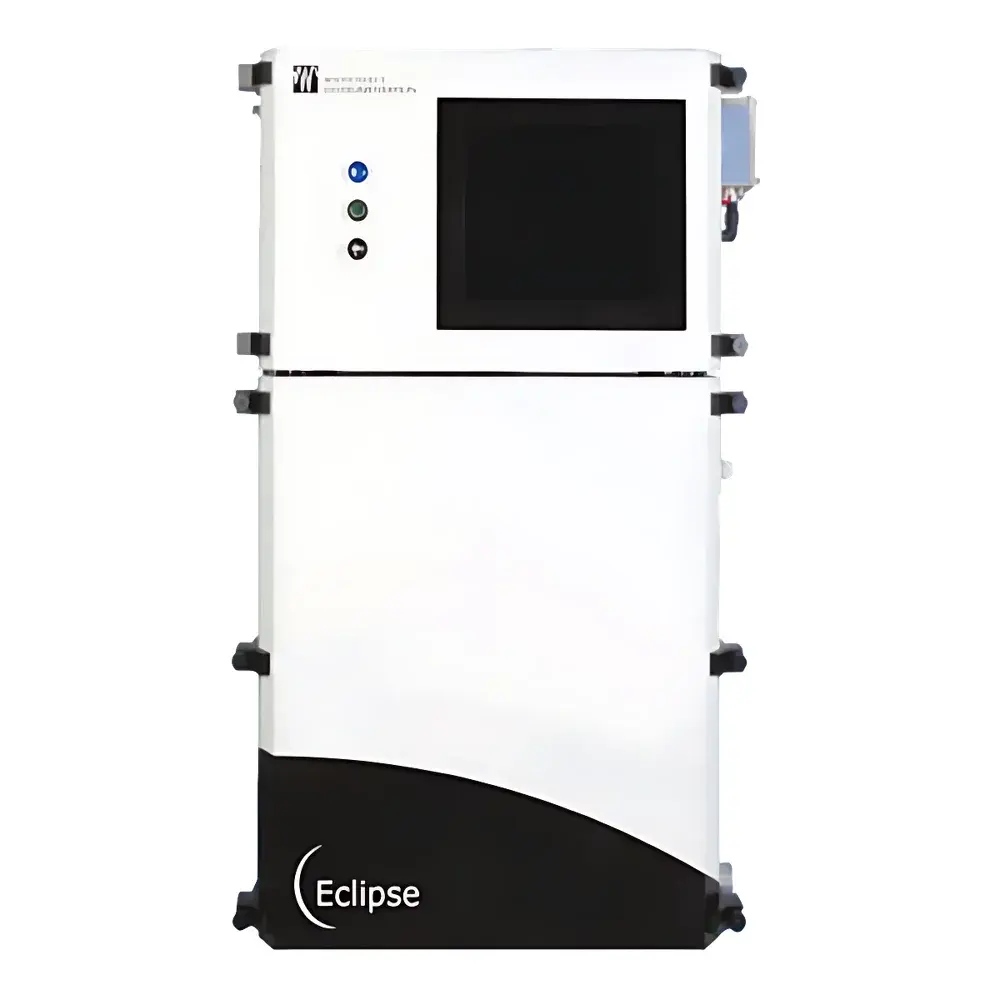
Wasson-ECE Eclipse Series Online Process Gas Chromatograph
| Brand | Wasson-ECE |
|---|---|
| Model | Eclipse |
| Detector Options | TCD, FID, PDHID, MSD, VUVD |
| Column Configurations | Multiple capillary and packed columns |
| Oven Architecture | Dual independent programmable temperature ramp ovens or isothermal ovens |
| Flow & Pressure Control | Full electronic pneumatic control (EPC) |
| Certification | Class I, Division 2 / ATEX Zone 2 |
| Software | Wasson-ECE Chromatographic Data System (CDS) |
| Compliance | ASTM D8071 (for oxygenates, PIONA, BTEX), USP <621>, ISO/IEC 17025 support via audit trail and data integrity features |
Overview
The Wasson-ECE Eclipse Series Online Process Gas Chromatograph is an engineered analytical platform designed for continuous, unattended hydrocarbon and trace impurity analysis in demanding industrial process environments. Built upon decades of field-proven expertise in laboratory and online GC system development, the Eclipse bridges the performance gap between benchtop chromatography and real-time process monitoring requirements. Its core architecture leverages gas chromatographic separation principles—partitioning of volatile analytes across a stationary phase under controlled carrier gas flow—combined with high-fidelity detection technologies to deliver laboratory-grade precision in hazardous-area installations. Unlike conventional online analyzers limited to single-detection modalities or fixed column configurations, the Eclipse integrates modular thermal management, multi-detector compatibility, and full electronic pressure and flow control (EPC) to support method flexibility without hardware reconfiguration. This enables dynamic adaptation to evolving process streams—from refinery off-gas to polymer-grade ethylene—while maintaining compliance with international safety and data integrity standards.
Key Features
- Modular detector architecture supporting simultaneous or sequential operation of TCD, FID, PDHID, MSD, and VUVD—each optimized for specific compound classes (e.g., permanent gases, hydrocarbons, sulfur/nitrogen species, oxygenates).
- Dual independent oven zones: one programmable temperature-ramping zone for complex separations and one isothermal zone for rapid, stable analysis of light-end components.
- Multi-column capability: configurable with up to four columns—including fused-silica capillaries and stainless-steel packed columns—to address co-elution challenges and extend compound coverage across C1–C20 ranges.
- Full EPC system providing sub-mL/min flow resolution and ±0.01 psi pressure stability—critical for retention time reproducibility and quantitative accuracy in unattended operation.
- Intrinsically safe design certified to Class I, Division 2 (NEC/CEC) and ATEX Zone 2 requirements, enabling direct installation in proximity to process piping without external purging or pressurization enclosures.
- Robust mechanical construction with corrosion-resistant materials and sealed optical paths for long-term reliability in ambient temperatures from –20 °C to +50 °C and relative humidity up to 95% non-condensing.
Sample Compatibility & Compliance
The Eclipse system accommodates gaseous and liquefied samples directly from process streams, including refinery gas, ethylene/propylene monomer, syngas, hydrogen reformate, and fuel blending components. Sample introduction utilizes heated, stainless-steel sample loops and automated valving to prevent condensation and adsorption losses. All configurations comply with applicable safety directives for hazardous locations and support regulatory alignment through documented validation protocols. The system’s software architecture includes full audit trail functionality, electronic signatures, and data encryption—meeting foundational requirements for FDA 21 CFR Part 11, EU Annex 11, and GLP/GMP environments. When configured per ASTM D8071, the VUVD-based Eclipse VUV variant delivers validated, repeatable quantitation of oxygenates (e.g., MTBE, ETBE), PIONA (Paraffins, Isoparaffins, Olefins, Naphthenes, Aromatics), and BTEX compounds in gasoline-range hydrocarbons.
Software & Data Management
The Wasson-ECE Chromatographic Data System (CDS) provides integrated instrument control, method development, peak integration, calibration management, and report generation. It supports multi-user access with role-based permissions, method locking, and version-controlled method storage. Raw data files are stored in vendor-neutral formats (e.g., .cdf) compatible with third-party LIMS and MES platforms. The CDS includes built-in tools for system suitability testing (SST), drift correction, and automatic baseline optimization. All user actions—including method edits, calibration updates, and result approvals—are timestamped and logged with immutable audit trails. Remote diagnostics and firmware updates are supported over secure TLS-enabled connections, minimizing downtime during routine maintenance cycles.
Applications
- Refinery Gas Analysis: Eclipse Super RGA configuration enables comprehensive C1–C20 hydrocarbon speciation using dual-TCD/FID detection and hybrid column sets—supporting ASTM D1945, D1946, and GPA 2261.
- Polymer-Grade Monomer Purity Monitoring: Eclipse Neutrino with MSD delivers identification and sub-ppb quantitation of reactive impurities (e.g., H2S, COS, PH3, AsH3, CH3SH) that impact catalyst lifetime and product quality.
- Fuel Blending & Regulatory Compliance: Eclipse VUV implements ASTM D8071-compliant workflows for real-time measurement of ethanol, tert-butanol, benzene, and other regulated species in finished gasoline.
- Hydrogen Quality Assurance: PDHID-equipped systems detect ppm-level CO, CO2, O2, and CH4 in PEM electrolyzer output per ISO 8573-8 and SAE J2719 specifications.
- Custom Method Deployment: Systems can be pre-configured to replicate existing lab GC methods—including retention time matching, calibration curve templates, and reporting formats—for seamless transition from offline to online analysis.
FAQ
What certifications does the Eclipse system hold for hazardous area installation?
The Eclipse platform is certified for Class I, Division 2 (UL/cULus) and ATEX Zone 2 (IECEx/ATEX) environments, permitting direct mounting on process skids without additional explosion-proof housings.
Can the Eclipse replace multiple standalone analyzers?
Yes—the modular detector and oven architecture allows a single Eclipse unit to perform analyses previously requiring separate TCD, FID, and MS systems, reducing footprint, maintenance overhead, and calibration complexity.
Is method transfer from laboratory GC possible?
Absolutely. Wasson-ECE offers method migration services, including column selection guidance, temperature program translation, and detector response factor alignment to ensure equivalent or improved performance versus lab instruments.
How is data integrity ensured for regulated industries?
The CDS implements ALCOA+ principles: attributable, legible, contemporaneous, original, accurate, complete, consistent, enduring, and available—with electronic signatures, audit trails, and secure backup protocols aligned with 21 CFR Part 11 and Annex 11.
What level of remote support is available?
Wasson-ECE provides 24/7 remote diagnostics, firmware updates, and real-time troubleshooting via encrypted VPN channels, with optional predictive maintenance alerts based on system health metrics.